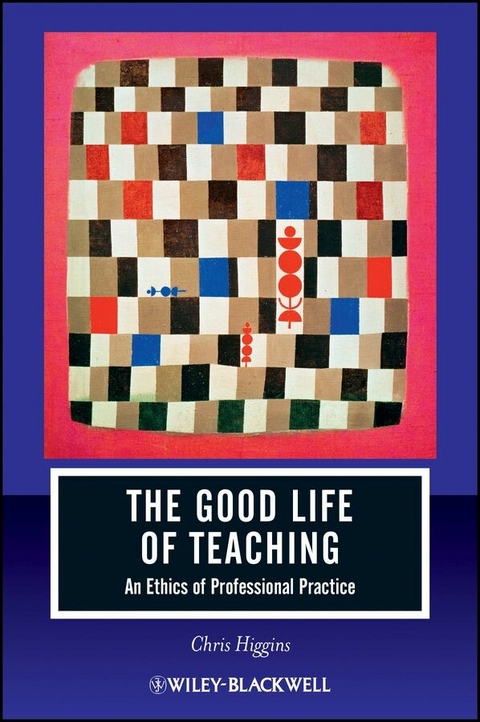

- Makes a significant contribution to the philosophy of teaching and also offers new insights into virtue theory and professional ethics
- Offers fresh and detailed readings of major figures in ethics, including Alasdair MacIntyre, Charles Taylor, and Bernard Williams and the practical philosophies of Hannah Arendt, John Dewey and Hans-Georg Gadamer
- Provides illustrations to assist the reader in visualizing major points, and integrates sources such as film, literature, and teaching memoirs to exemplify arguments in an engaging and accessible way
- Presents a compelling vision of teaching as a reflective practice showing how this requires us to prepare teachers differently
Chris Higgins is Assistant Professor in the Department of Educational Policy, Organization and Leadership at the University of Illinois at Urbana-Champaign, where he is also Associate Editor and Review Editor of Educational Theory. A philosopher of education, his work draws on virtue ethics, hermeneutics, and psychoanalysis. His scholarly interests include professional ethics and teacher identity, dialogue and the teacher-student relationship, liberal learning and the humanistic imagination, professional education and the philosophy of work.
Foreword by Richard Smith vii
Acknowledgements ix
Introduction: Why We Need a Virtue Ethics of Teaching 1
Saints and scoundrels 1
A brief for teacherly self-cultivation 2
From the terrain of teaching to the definition of professional ethics 9
Outline of the argument 10
Part I The Virtues of Vocation: From Moral Professionalism to Practical Ethics
1 Work and Flourishing: Williams' Critique of Morality and its Implications for Professional Ethics 21
Retrieving Socrates' question 22
Modern moral myopia 25
What do moral agents want? 31
From moral professionalism to professional ethics 35
2 Worlds of Practice: MacIntyre's Challenge to Applied Ethics 47
The architecture of MacIntyre's moral theory 48
A closer look at internal goods 55
The practicality of ethical reflection 61
What counts as a practice: The proof, the pudding, and the recipe 63
Boundary conditions: Practitioners, managers, interpreters, and fans 69
3 Labour, Work, and Action: Arendt's Phenomenology of Practical Life 85
Arendt's singular project 87
Defining the deed 92
Hierarchy and interdependence in the vita activa 99
Praxis in the professions 101
4 A Question of Experience: Dewey and Gadamer on Practical Wisdom 111
The constant gardener 113
The existential and aesthetic dimensions of vocation 119
Our dominant vocation 125
Practical wisdom and the circle of experience 130
The open question 134
Part II a Virtue Ethics for Teachers: Problems and Prospects
5 The Hunger Artist: Pedagogy and the Paradox of Self-Interest 145
A blind spot in the educational imagination 145
The hunger artist 154
The very idea of a helping profession 161
This ripeness of self 170
6 Working Conditions: The Practice of Teaching and the Institution of School 177
A prima facie case for teaching as a practice 178
MacIntyre's objection 190
Schools as surroundings 198
7 The Classroom Drama: Teaching as Endless Rehearsal and Cultural Elaboration 205
Education as the drama of cultural renewal 208
A false lead 214
Teaching as labour, work, and action 217
Education, shelter, and mediation 223
Teaching as endless rehearsal 227
Teaching as cultural elaboration 233
8 Teaching as Experience: Toward a Hermeneutics of Teaching and Teacher Education 241
Teaching as vocational environment 241
Batch processing, kitsch culture, and other obstacles to teacher vocation 248
The syntax of educational claims 254
The shape of humanistic conversation 258
Horizons of educational inquiry 266
Teacher education for practical wisdom 273
References 283
Index 305
"The question of the ethical life of the teacher is as old as
philosophy; but in the contemporary world this has been transformed
into a question of professional ethics. In The Good Life of
Teaching, Chris Higgins brings this newer question of
professionalism back to its philosophical roots. Anyone who
experiences teaching as a vocation - in the sense of a calling -
but also wants to participate in the vocation of teaching - in the
sense of a profession - will want to read this book."
--Jonathan Lear, The University of Chicago
'This is an exemplary book in philosophy of education. It
combines intellectual rigour, ethical seriousness and imaginative
verve in a finely pitched exploration of the nature of teaching.
Philosophers will applaud how its argument for the pertinence to
education of a wisely chosen group of key thinkers creatively
extends our understanding of their work. More important, teachers
will be deeply confirmed or transformed by its sane vision of what
can make their work both noble and sustainable.'
--Joseph Dunne, Cregan Professor Emeritus in philosophy
of education, Dublin City University
| Erscheint lt. Verlag | 13.9.2011 |
|---|---|
| Reihe/Serie | Journal of Philosophy of Education |
| Journal of Philosophy of Education | Journal of Philosophy of Education |
| Sprache | englisch |
| Themenwelt | Geisteswissenschaften ► Philosophie ► Allgemeines / Lexika |
| Sozialwissenschaften ► Pädagogik ► Allgemeines / Lexika | |
| Sozialwissenschaften ► Pädagogik ► Bildungstheorie | |
| Schlagworte | Alasdair MacIntyre, Charles Taylor, Bernard Williams, Hannah Arendt, John Dewey, Hans-Georg Gadamer • Philosophie • Philosophie der Bildung u. Erziehung • Philosophy • Philosophy of education • philosophy of teaching • Professional Ethics • teacher motivation, identity, development • Teaching • virtue theory |
| ISBN-13 | 9781444346503 / 9781444346503 |
| Informationen gemäß Produktsicherheitsverordnung (GPSR) | |
| Haben Sie eine Frage zum Produkt? |
 PDF (Adobe DRM)
Kopierschutz: Adobe-DRM
Adobe-DRM ist ein Kopierschutz, der das eBook vor Mißbrauch schützen soll. Dabei wird das eBook bereits beim Download auf Ihre persönliche Adobe-ID autorisiert. Lesen können Sie das eBook dann nur auf den Geräten, welche ebenfalls auf Ihre Adobe-ID registriert sind.
Details zum Adobe-DRM
Dateiformat: PDF (Portable Document Format)
Mit einem festen Seitenlayout eignet sich die PDF besonders für Fachbücher mit Spalten, Tabellen und Abbildungen. Eine PDF kann auf fast allen Geräten angezeigt werden, ist aber für kleine Displays (Smartphone, eReader) nur eingeschränkt geeignet.
Systemvoraussetzungen:
PC/Mac: Mit einem PC oder Mac können Sie dieses eBook lesen. Sie benötigen eine
eReader: Dieses eBook kann mit (fast) allen eBook-Readern gelesen werden. Mit dem amazon-Kindle ist es aber nicht kompatibel.
Smartphone/Tablet: Egal ob Apple oder Android, dieses eBook können Sie lesen. Sie benötigen eine
Geräteliste und zusätzliche Hinweise
Buying eBooks from abroad
For tax law reasons we can sell eBooks just within Germany and Switzerland. Regrettably we cannot fulfill eBook-orders from other countries.
aus dem Bereich