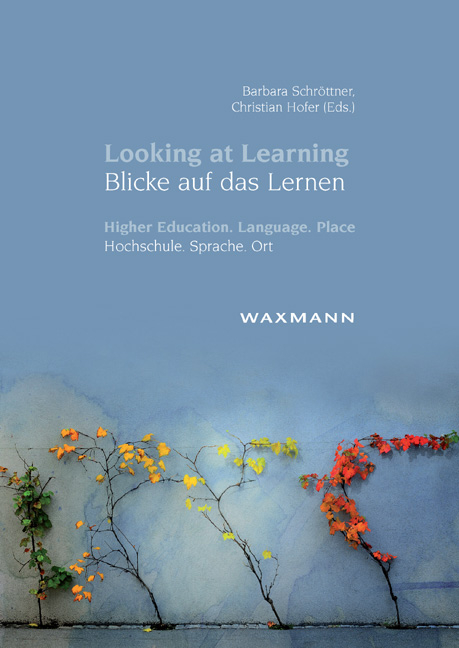
Looking at Learning - Blicke auf das Lernen. Higher Education. Language. Place - Hochschule. Sprache. Ort (eBook)
324 Seiten
Waxmann Verlag GmbH
978-3-8309-7430-7 (ISBN)
Angekommen im neuen Jahrzehnt sehen sich Bildungsinstitutionen und lernende Individuen mit Phänomenen des Wandels und des Umbruchs sowie mit Widersprüchen konfrontiert. Traditionelle Lern- und Bildungskonzepte müssen deshalb neu überdacht und den aktuellen Begebenheiten angepasst werden. In diesem Buch, das sowohl deutsche als auch englische Beiträge versammelt, blicken AutorInnen unterschiedlicher wissenschaftlicher Disziplinen auf das Lernen anhand der Schwerpunkte Hochschule, Sprache, Ort.
Inhalt 6
Acknowledgements 8
Preface 10
Learning and Globalization 16
Opening 16
Learning and Globalized Realities 17
Learning and Global Educational Flows 19
Learning and Knowledge Society 20
Learning and Key Competences 22
Learning and Global Crisis 26
Concluding Thoughts 26
Bibliography 27
I Learning and Higher Education 30
Lernen als Privileg 32
Dankbare und undankbare Lernende 32
Vorlesung 33
Transformation 34
Ist Lernen ein Privileg? 35
Lernen durch Widerspruch 35
Lernen bei „Meinesgleichen 36
Soziales Lernen 37
Demokratie erlernen 38
Module planen 38
Lernkapazitäten ausbauen 39
Bibliographie 40
Lernen und Zukunft 42
Abstract 42
Einleitung – Herausforderungen für Universitäten 42
Die Rolle und die Funktion der Universität 44
Handeln in der Wissenschaftsgesellschaft 46
Neue Formen der Wissensproduktion 50
(Lebenslang) Lernen an der Universität 52
Bibliographie 54
Learning and Self-Direction 56
Abstract 56
Keywords 56
Introduction 56
The Base: Learning 58
The Door: Self-Directed Learning 61
The Key: Learner-Centred Teaching 63
The Case Study – and its Strategies 66
Conclusion 68
Bibliography 70
Lernen und Philosophie(ren) 72
Abstract 72
Erlebnis Lernen 72
Das lehrendengesteuerte Philosophie(ren)lernen 73
Das höhere, transsubstantiierte Wissen 76
Der Funke des Verstehens 78
Auf dem Zauberberg des philosophischen Wissens 80
Bibliographie 81
Lernen und Management 84
Abstract 84
Rahmenbedingungen des Bildungsmanagements 84
Prozessorientiertes Arbeiten im Lehrmanagement 91
Erfahrungsgeleitetes Lernen im Personal- und Qualitätsmanagement 96
Bibliographie 100
Internetquellen 101
Lernen und Wissenschaftliche Weiterbildung mit E-Learning 102
Abstract 102
Bibliographie 110
II Learning and Language 112
Lernen und Didaktik 114
Abstract 114
Annäherungsbemühungen 114
Konstruktivistische Aspekte und Grundbegriffe 116
Methodische Vorschläge für eine konstruktivistische Sprachenlehre 120
Bibliographie 126
Learning and Space 128
Abstract 128
Introduction 128
Case Study 130
Conclusion and Implications 133
A Story Retold 134
Bibliography 134
Lernen und Persönlichkeitsentwicklung 136
Abstract 136
Einleitung 136
Rahmenbedingungen eines Auslandssemesters 137
Besonderheiten studienbegleitenden DaF-Unterrichts 138
Verunsicherung 138
Heterogenität als Herausforderung 139
Gängige und aktuelle Forschungskonzepte und deren Relevanz für den DaF- Unterricht 140
Identität 140
Persönlichkeitsentwicklung 141
Sicherstellung von Handlungskompetenz 142
Interkulturalität 143
Heterogenität und Eigenverantwortlichkeit 143
Konfrontation mit Kultur 144
Persönlichkeitsentwicklung durch Schreiben – ein Schreibprojekt 145
Textverständnis 146
Authentizität von Texten 147
Schreibkompetenz 147
Bibliographie 149
Learning and Styles 152
Abstract 152
Introduction 152
The Inclusive Classroom 153
Some Common Misconceptions 154
Modalities 155
Characteristics of Learner Types 156
Learning Tips and Activities for Different Learner Types 158
The Cognitive Approach 159
Field-Dependent and Field-Independent Learner Types 160
Global and Analytic Learners 161
Conclusion 162
Bibliography 163
Lernen und Literatur 164
Abstract 164
Einleitung: Zum Verhältnis von Literaturunterricht, Literaturdidaktik, Literaturtheorie 164
Literaturtheoretische Modelle: ein Überblick 166
Literaturtheoretisch beeinflusste Literaturdidaktik 169
Selbstreflexive Literatur als Illustration literaturtheoretischer Konzepte 172
Bibliographie 176
Lernen und Hören 180
Abstract 180
Einleitung 180
Das audiovokale Training und das Projekt FauvoT 181
Die neue Methode im Sprachunterricht 183
Zur Auswertung der Ergebnisse 184
Ergebnisse aus der Evaluation der Methode durch die Studierenden 189
Schlussbemerkung 192
Bibliographie 192
III Learning and Place 194
Learning and the World Community 196
Abstract 196
Opening: Seeing the World Relationally 196
The Concept of Citizenship 198
Economic Citizenship and its Implications 199
Citizenship and Multiculturalism 200
Citizenship, Identity Building and Transversal Politics 201
Active Citizenship and Global Consciousness 203
International Nongovernmental Initiatives 205
Nongovernmental Advocacy in Education 206
(Interpretative) Democracy in Education 207
Learning for the World Community: Conclusion 208
Bibliography 209
Lernen und Geographie 212
Abstract 212
Einleitung 212
Geographische Wenden 214
Geographien des Lernens 218
Bibliographie 220
Lernen ohne Schrift 224
Abstract 224
Das Wertesystem der Maori 225
VermittlerInnen des Wissens 226
Dieselben Werte, veränderte Zeiten 231
Bibliographie 238
Ausstellungskataloge 239
Sonstiges 239
Abbildungen 239
Learning and Conflict Analysis Prefi guring Alternative Analytical Interpretive Horizons 240
Abstract 240
Introduction: Clarifying the Approach 241
Normalized Approaches to Conflict 245
Realpolitik in Conflict Analysis 247
Conflict Mapping 248
Reassessing Primary, Secondary and Other Actors in Conflict 250
Shadow-Primary Actor 252
Interest Proximity and Realpolitik Discourse 253
By Way of Conclusion 254
Bibliography 255
Learning and Curriculum Knowledge 258
Abstract 258
Introduction 258
Conceptual Framework 261
Research Methodology 262
Findings 263
Discussion & Concluding Remarks
Bibliography 271
Learning and Multiculturalism 276
Abstract 276
Introduction 276
Education System in Spain 277
Intercultural Education 280
Intercultural Competence 281
Spanish Public Education System and Intercultural Education 282
Conclusions 286
Bibliography 286
Learning and International Setting 290
Abstract 290
International Research Context 291
Research Context in China 291
The Research Project 293
Methodology 294
The Findings 295
Discussion 296
Concluding Remarks 298
Bibliography 299
Learning and Information Competence 302
Abstract 302
Background 303
Purpose and Design 306
Methodology 307
Results 308
Conclusion 315
Bibliography 316
Notes on Contributors 320
Learning and the World Community (S. 195-196)
Barbara Schröttner
Individuals as Global Actors? Reality is a question of perspective; the further you get from the past, the more concrete and plausible it seems – but as you approach the present, it inevitably seems more and more incredible
(Salman Rushdie 1947; Midnight’s Children)
Abstract
Today we live in a world in which there is an increasing need for learners to develop global consciousness as individuals form the cultural basis of a civil society; this encompasses global sensitivity, global understanding and global self-representation. Th e aim of this analysis is to show that learners have to take on a more active role in approaching the challenges of the 21st century so that they are able to become more dialogical, participative and critical global citizens.
This article is moreover concerned with the necessity to refl ect on and truly see other cultures as this is necessary in contemporary learning environments and, because individuals are dialogically constructed, for identity formation processes. It is in this context that this study emphasizes the fact that appreciating individual cultural diversity as a strength and approaching it with participative action in the sense of an active citizenship should be at the centre of learning practices.
From this viewpoint, building a global democratic civil society needs sustained interaction and collaboration as well as new forms of communication, decision making and direct individual participation among formal and informal actors at the community level, the national level and the international level. And fi - nally, because of the intensity of globalization dynamics and the increase of cross-border activities it should be taken into consideration that there is a need for the formation of a transnational civil society and citizenship which focuses on translocal solidarity, identityformation processes, new forms of political organization and overall on innovative, participative and dialogical learning practices.
Opening: Seeing the World Relationally
Education has been confronted with the demands of the state, specifi cally to prepare citizens for participation in the economy and in politics. Th e two traditional bases of formalized educational systems are thus economies and governance. Today globalization processes lessen national sovereignty and put limits on state autonomy; this can be observed in the tension between global and local dynamics and in almost every decision and policy domain in the social, cultural and economic spheres. However globalization not only blurs national boundaries but also changes loyalties within and outside a country (Torres, 2009: 114).
| Erscheint lt. Verlag | 1.1.2011 |
|---|---|
| Sprache | deutsch |
| Themenwelt | Geisteswissenschaften |
| Sozialwissenschaften ► Pädagogik ► Erwachsenenbildung | |
| ISBN-10 | 3-8309-7430-2 / 3830974302 |
| ISBN-13 | 978-3-8309-7430-7 / 9783830974307 |
| Informationen gemäß Produktsicherheitsverordnung (GPSR) | |
| Haben Sie eine Frage zum Produkt? |
 PDF (Ohne DRM)
Größe: 2,8 MB
Digital Rights Management: ohne DRM
Dieses eBook enthält kein DRM oder Kopierschutz. Eine Weitergabe an Dritte ist jedoch rechtlich nicht zulässig, weil Sie beim Kauf nur die Rechte an der persönlichen Nutzung erwerben.
Dateiformat: PDF (Portable Document Format)
Mit einem festen Seitenlayout eignet sich die PDF besonders für Fachbücher mit Spalten, Tabellen und Abbildungen. Eine PDF kann auf fast allen Geräten angezeigt werden, ist aber für kleine Displays (Smartphone, eReader) nur eingeschränkt geeignet.
Systemvoraussetzungen:
PC/Mac: Mit einem PC oder Mac können Sie dieses eBook lesen. Sie benötigen dafür einen PDF-Viewer - z.B. den Adobe Reader oder Adobe Digital Editions.
eReader: Dieses eBook kann mit (fast) allen eBook-Readern gelesen werden. Mit dem amazon-Kindle ist es aber nicht kompatibel.
Smartphone/Tablet: Egal ob Apple oder Android, dieses eBook können Sie lesen. Sie benötigen dafür einen PDF-Viewer - z.B. die kostenlose Adobe Digital Editions-App.
Zusätzliches Feature: Online Lesen
Dieses eBook können Sie zusätzlich zum Download auch online im Webbrowser lesen.
Buying eBooks from abroad
For tax law reasons we can sell eBooks just within Germany and Switzerland. Regrettably we cannot fulfill eBook-orders from other countries.
aus dem Bereich