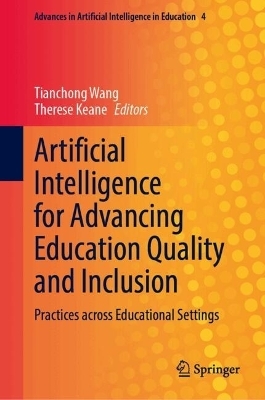
Artificial Intelligence for Advancing Education Quality and Inclusion
Springer International Publishing (Verlag)
978-3-032-12173-8 (ISBN)
- Noch nicht erschienen - erscheint am 10.03.2026
- Versandkostenfrei
- Auch auf Rechnung
- Artikel merken
This volume illuminates the transformative potential of Artificial Intelligence (AI) in shaping the future of learning, particularly in terms of advancing quality and inclusion across educational settings. It explores the diverse ways AI technologies can be harnessed to enhance pedagogical practices, enrich learning experiences, improve educational outcomes, widen access to quality knowledge sources, and empower minds for all. It thereby aligns with the broader objectives of promoting education quality and inclusion for all as outlined in the United Nations' SDG4 - Education 2030 agenda. This book combines multidisciplinary perspectives, offering a comprehensive view on AI in Education (AIED) practices geared towards quality and inclusion. Through a curated collection of evidence-based research, the volume offers pragmatic insights into the intricate AIED nexus.
Dr. Tianchong Wang is a Lecturer in STEM in Innovative Education Futures in the College of Education, Psychology and Social Work at Flinders University, Australia. He earned an EdD from the Chinese University of Hong Kong, an MSc from the University of Hong Kong, and a BA (Hons) from Hong Kong Baptist University. Dr. Wang's academic work is dedicated to exploring technology-enhanced practices that enhance education quality, equity, and inclusion, in alignment with the Education 2030 agenda. He advises and consults for governments and international organisations and engages in teacher capacity-building activities in the Global South. Dr. Wang's research primarily focuses on blended learning and Artificial Intelligence in Education (AIEd). He co-developed UNESCO's framework for blended learning and pioneered the first master's level AIEd course in Hong Kong. Recently, he served as a Consultant and the Chief Rapporteur for UNESCO s Empowering Minds: A Round Table on Generative AI and Education in Asia-Pacific , as well as the international expert for UNESCO s Fostering STEM Education in Africa and Small Island Developing States (SIDS) initiative.
Therese Keane is Professor of STEM Education in the School of Education at La Trobe University, Australia, and a nationally and internationally recognised leader in ICT education and gender equity in STEM. With over 30 years of experience as a Computer Science teacher, Director of ICT, and researcher, she has dedicated her career to empowering girls and women in technology, earning numerous international, national, and state awards. Her research and leadership sit at the intersection of emerging digital technologies, education, and gender, examining how children, young people, teachers, and school leaders learn and teach with technologies such as AI, social and humanoid robots, computational thinking, and virtual reality. She has led several high-profile projects addressing gender disparity in computing and using AI, including the creation of teacher, parent, and youth toolkits designed to inspire and sustain participation in STEM. Therese is Chair of IFIP (International Federation of Information Processing) TC3 (Technical Committee 3 Education) Working Group 3.3 (Research into Educational Applications of ICT) and Deputy Editor of Education and Information Technologies, the official IFIP journal.
Part I. Overview and Global Perspectives.- Chapter 1. Innovative Approaches: Advances in Artificial Intelligence in Education.- Chapter 2. A Desk Review of Generative AI in K-12 Education: Current State of Knowledge and Global Integration Approaches.- Chapter 3. Beyond the Basics: Unravelling AI Education Policies and Practices in Asia-Pacific.- Part II. Teacher Preparation and Professional Development.- Chapter 4. Teachers' AI Competency: Reflecting TPACK Implications for Quality and Inclusion.- E-TPCK: Teachers developing knowledge of Artificial Intelligence through quality engagement.- Chapter 6. Australian initial teacher educators perspectives on artificial intelligence.- Chapter 7. Who Is Guiding This Ship?: Disciplinary Professional Organisations Guidance for Teachers Using Generative Artificial Intelligence to Develop Culturally Responsive Materials.- Chapter 8. Enchanting Learning: Generative AI and Fairy Tale Interpretations in Teacher Education.- Chapter 9. Teacher-led innovations with generative AI: A case study of Australian teachers.- Part III. Age-Appropriate AI Education and Curricula.- Chapter 10. Building Foundations: AI literacy for young children.- Chapter 11. AI curricula in primary and early childhood education: A cross country analysis of implementation.- Chapter 12. Develop an Artificial Intelligence (AI) Literacy program for Lower Primary School Students in the AI Era: Suggestions for Primary School Teachers.- Chapter 13. Computational Thinking in Engineering Design (CTED): An Inclusive Teaching and Learning Framework for Early Childhood STEAM Education in the Industrial 4.0 Era.- Chapter 14. Concealing Machine Learning Concepts from K-12 Students.- Part IV. AI-Enhanced Pedagogy and Subject-Specific Applications.- Chapter 15. Signature pedagogies for AI: Exploring Multidisciplinary Case Studies and Pedagogical Implications.- Chapter 16. AI Literacy and Differentiated Learning in Programming among Lower Secondary School Students Interacting with LLMs.- Chapter 17.- Using Chatbots to empower mathematics learning.- Chapter 18. Leveraging Artificial Intelligence in Education: A Pathway to Enhanced Teaching and Learning in Schools.- Chapter 19. EFL Students' Attitudes and Contradictions in a Machine-in-the-loop Writing Activity System.- Part V. AI-Driven Learning Platforms and Assessment.- Chapter 20. Scaffolding problem solving: An AI approach.- Chapter 21. Reverse Engineering Lesson Planning using AI with Novice Pre-service Teachers.- Chapter 22. Reconceptualising Higher Education Learning and Assessment in the Era of AI: New Approaches, New Capabilities.- Chapter 23. Collaborative Natural Language Processing for Automatic Scoring of Open-ended Questions in Science Education.- Part VI. Equity, Inclusion, and Social Considerations.- Chapter 24. Transformation of communication in school environments through the application of generative AI on an informed basis.- Chapter 25. Enhancing Digital Learning Capabilities in the Context of Generative AI in Rural Communities: Empowerment through Learning Support in a Japanese Island Setting Using the Capability-Driven Digital Education Framework.- Chapter 26. Exploring the potential of AI in nurturing learner empathy, pro-social values and environmental stewardship.- Chapter 27. Understanding the Double-Edged Sword: Student Perspectives on Generative AI and Gender Inclusion in Primary and Secondary Schools (Preparatory- Year 11).- Chapter 28. Evaluation of ChatGPT's Role in Personalised Learning within the Universal Design for Learning Framework.- Chapter 29. Teachers perspective on AI-based Multi-Agent Simulation Design to Combat School Bullying.- Chapter 30. Integrating Generative AI with digital learning tools for inclusive education.- Part VII. Current and Future Directions.- Chapter 31. Current and Future Direction of AI
| Erscheinungsdatum | 29.11.2025 |
|---|---|
| Reihe/Serie | Advances in Artificial Intelligence in Education |
| Zusatzinfo | XXIV, 518 p. 59 illus., 43 illus. in color. |
| Verlagsort | Cham |
| Sprache | englisch |
| Maße | 155 x 235 mm |
| Themenwelt | Schulbuch / Wörterbuch ► Unterrichtsvorbereitung ► Unterrichts-Handreichungen |
| Sozialwissenschaften ► Pädagogik ► Schulpädagogik / Grundschule | |
| Schlagworte | AI and female inclusion in K-12 computing education • AI curricula in primary and early childhood education • AIED • AI literacy in early childhood education • AI usage by teachers in classrooms in Australia • ChatGPT-3 language technology • 'Command prompting' • ‘Command prompting’ • GenAI for developing higher order thinking skills • GEN AI LLMs for K-12 learners • Generative AI in rural communities • How to make AI education accessible and inclusive • Incorporating GenAI in learning-focussed activities in Australia • Integrating Artificial Intelligence in secondary education • Large Language Models (LLMs) in informatics and IT education • Practical applications of AI in education • Pre-service teachers using AI lesson planning tools • Quality and inclusion in education • Reshaping initial teacher education content presentation • SDG4 - Education 2030 agenda • The ATLAS Platform |
| ISBN-10 | 3-032-12173-6 / 3032121736 |
| ISBN-13 | 978-3-032-12173-8 / 9783032121738 |
| Zustand | Neuware |
| Informationen gemäß Produktsicherheitsverordnung (GPSR) | |
| Haben Sie eine Frage zum Produkt? |
aus dem Bereich