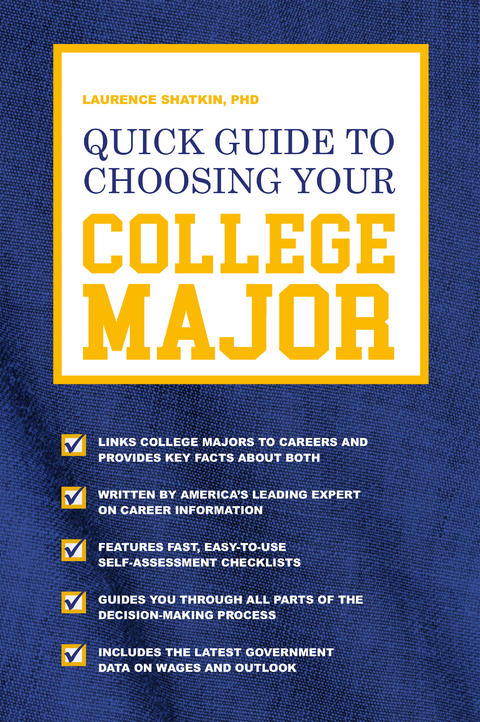
Quick Guide to Choosing Your College Major (eBook)
280 Seiten
Meyer & Meyer Fachverlag und Buchhandel GmbH
978-1-78255-495-0 (ISBN)
Over the past 35 years, Dr. Laurence Shatkin has established a reputation as one of the nation's leading career information experts. He has appeared frequently on national news programs and in major print publications to share his expertise about trends in the world of work and in college majors. In addition to writing books, he has been an award-winning career information systems developer.
This easy-to-use guide moves from self-assessment to information to decision making. The decision-making process begins with an explanation of what a college major is and what should be considered when making a decision. The next chapters offer three quick exercises to help readers clarify dimensions that are relevant to the choice of a major: their personality type, their strongest skills, and their favorite high school courses. Using the results of these exercises, readers construct a "e;hot list"e; of the college majors that seem to suit them the most, plus any others that look interesting. Then they explore their possible choices by reading fact-packed descriptions of 61 popular college majors and the 164 occupations and 95 job specializations linked to these majors. Finally, readers fill out a decision-making checklist, comparing the results of their self-assessment exercises with the facts they have learned about various majors. They weigh the pros and cons to reach a tentative conclusion and receive hints about how to do additional exploration to confirm their decision. With Quick Guide to Choosing Your College Major, the reader will be able to determine their future path fast!
Over the past 35 years, Dr. Laurence Shatkin has established a reputation as one of the nation's leading career information experts. He has appeared frequently on national news programs and in major print publications to share his expertise about trends in the world of work and in college majors. In addition to writing books, he has been an award-winning career information systems developer.
CHAPTER 1
WHAT IS A COLLEGE MAJOR, AND WHAT GOES INTO MY DECISION?
Before you choose a major, be sure you understand what this commitment means and how to approach it in a thoughtful manner. If you’re really pressed for time, you may skip this chapter, but many readers will want to skim it, at least.
WHY DO I HAVE TO DECLARE A MAJOR?
The simplest answer to this question is that most colleges require it. Some offer a general studies major for those who are unable or unwilling to commit to a particular program of study. But you probably are reading this book because you want to prepare for a particular career or at least concentrate on one field of knowledge, so you want to commit to a specific major.
At most colleges, you declare your major by the end of your sophomore year. However, you can benefit from having a specific major in mind before then: You can try out introductory courses and get a taste for the subject that the major focuses on.
In fact, it can be very helpful for you to have a major in mind while you’re still in high school and deciding which colleges to apply to. Some colleges are better places than others to study certain majors because of factors on which they excel, such as their course offerings, the experience of their instructors, their research facilities (libraries and laboratories), or their connections with employers. Having a major in mind while you’re in high school also can help you choose high school courses that will prepare you for the program you’ll enter in college—for example, taking math as preparation for a science major.
WHAT IS A MAJOR?
A major is a program of study that meets certain requirements. Usually the major is defined by the department offering it (for example, English by the English department), but some interdisciplinary majors have a focus that bridges several departments.
Most colleges and universities impose several different kinds of requirements for majors:
Requirements for all degree candidates. These are courses (and, in some cases, experiences such as internships) that the college wants everyone to take in order to get a well-rounded college education rather than just narrowly focused career preparation. For example, many colleges expect all bachelor’s degree candidates to acquire some background in math, natural science, social science, and the humanities. Students usually have considerable freedom in choosing courses to meet these area requirements. If a required subject seems challenging or uninteresting to you, often you can meet the requirement with an introductory or survey course. Sometimes you can choose between a bachelor of arts (BA) or a bachelor of science (BS) degree; the BS degree usually has fewer area requirements. Some fields have highly specialized bachelor’s degrees, such as a bachelor’s in engineering (BEng). Most colleges also require you to maintain a certain minimum grade-point average and show progress toward completing some kind of degree. You won’t get by on a “partyology” major.
Requirements to enter the major. Some majors are open to everyone who enrolls at the college, but for other majors, certain relevant high school courses must be on your transcript. Still other majors require you to complete a year or two of college before being admitted, during which time you must complete prerequisite courses. For example, to enter an engineering program, you may need to take calculus and physics courses. Your overall grade-point average or perhaps the grades in prerequisite courses may need to be above average.
Requirements to complete the major. In most majors, you take a combination of courses from within the department and from other departments. For example, in an agronomy program you would study plant nutrition and weed control and also chemistry, genetics, and statistics. Toward the end of the program, you may need to participate in some kind of supervised hands-on experience or show your ability to do research by completing a senior project or thesis. In some very career-oriented programs, a professional association specifies what all colleges should require, but major requirements in most fields vary from one college to the next. Don’t assume that your college requires exactly the same courses listed in chapter 6 of this book.
Concentrations within the major. Often it is possible to choose a specialization within a major. Sometimes it’s required. For example, students majoring in theater arts may need to choose a concentration in directing, acting, design and technical theater, or playwriting. Each concentration has its own course requirements beyond the core courses that everyone in the major must take.
WHAT DOES IT MEAN TO CHOOSE A MINOR OR A DUAL MAJOR?
Students choose a minor or dual major for several reasons. Some students are interested in two fields and want to explore both to some extent— maybe not in equal depth. Some students want to impress future employers by showing that they have a diverse set of skills, not just those associated with one major. They may be aiming for a high-paying niche career, such as the market researcher who is knowledgeable about a foreign culture or the computer network manager who can do a sophisticated statistical analysis of LAN traffic. Still other students want to take a chance on building a career in a field that interests them and, at the same time, acquire credentials for a “plan B” field in case their main interest turns out to be impractical in the job market. All of these reasons are valid.
The requirements you complete for a minor will give you a reasonable amount of background in the subject without covering as much ground as the requirements for the major. You could construct your own program of courses to become skilled in a subject outside of your major, but when possible, it’s better to have the formal credential of a minor on your transcript.
Meeting the requirements for dual majors is easiest when the two subjects are fairly similar and certain courses can serve both majors. On the other hand, students who want to pursue a dual major often have diverse interests with little overlap. In such cases, completing two majors can be tricky. Some required courses may not be offered every semester, so fitting them into four years may not be easy.
You should talk with an academic advisor no matter what your plans are for your major, but it is especially important to have this discussion if you want to elect a minor or dual major. You need to find out whether your plan will be practical and map out a path for completing it.
WHAT IF I HAVE TO CHANGE MY MAJOR?
You may want to—or need to—change your major because you have lost interest in it or are earning low grades. Doing this may prolong the time it will take you to get your degree, because your new major will impose its own set of requirements. Unless the new major is closely related to the old major, a lot of the course work you have completed will not count toward your new goal. You can avoid a setback of this kind by opting for a new major with very few specific requirements, but rightly or wrongly, most majors of that kind are not highly prized by employers.
You probably will need to work with an academic advisor to change your major, and this person usually will have access to a computerized “degree audit” that can analyze your transcript and show you how close you are to completing the requirements for various other majors.
The best strategy is to make a wise choice the first time you select your major, and that is one of the goals of this book. But if you have to make a change, the sooner you do so, the less ground you’ll lose.
WHAT FACTORS SHOULD I CONSIDER WHEN SELECTING A MAJOR?
Here are the most important questions you should ask yourself when selecting a major:
Will I be successful in the major?
Will I enjoy the major?
Will I be prepared for a rewarding and enjoyable career?
This book is organized to help you answer all three questions, with exercises that provide insights into your abilities and interests, together with information about career outcomes.
But don’t overlook some other practical considerations.
Time and expense are two related issues that you should keep in mind. Some careers, such as medicine, law, and teaching at the college level, require you to get an advanced degree. Many managerial roles are within reach only after several years of work experience, during which you become knowledgeable about an industry and acquire the people skills that college courses rarely cover. You need to consider whether you will have the ability, funds, and persistence to keep on track for the many years it will take you to reach your career goal.
Competition is another issue that you should not overlook. Highly rewarding...
| Erscheint lt. Verlag | 21.4.2020 |
|---|---|
| Verlagsort | Aachen |
| Sprache | englisch |
| Themenwelt | Sachbuch/Ratgeber ► Beruf / Finanzen / Recht / Wirtschaft |
| Schulbuch / Wörterbuch ► Lexikon / Chroniken | |
| Sozialwissenschaften ► Pädagogik | |
| Schlagworte | checklist • College • college major description • Decision • Guide • Self-Assessment |
| ISBN-10 | 1-78255-495-5 / 1782554955 |
| ISBN-13 | 978-1-78255-495-0 / 9781782554950 |
| Informationen gemäß Produktsicherheitsverordnung (GPSR) | |
| Haben Sie eine Frage zum Produkt? |
 EPUB (Adobe DRM)
Kopierschutz: Adobe-DRM
Adobe-DRM ist ein Kopierschutz, der das eBook vor Mißbrauch schützen soll. Dabei wird das eBook bereits beim Download auf Ihre persönliche Adobe-ID autorisiert. Lesen können Sie das eBook dann nur auf den Geräten, welche ebenfalls auf Ihre Adobe-ID registriert sind.
Details zum Adobe-DRM
Dateiformat: EPUB (Electronic Publication)
EPUB ist ein offener Standard für eBooks und eignet sich besonders zur Darstellung von Belletristik und Sachbüchern. Der Fließtext wird dynamisch an die Display- und Schriftgröße angepasst. Auch für mobile Lesegeräte ist EPUB daher gut geeignet.
Systemvoraussetzungen:
PC/Mac: Mit einem PC oder Mac können Sie dieses eBook lesen. Sie benötigen eine
eReader: Dieses eBook kann mit (fast) allen eBook-Readern gelesen werden. Mit dem amazon-Kindle ist es aber nicht kompatibel.
Smartphone/Tablet: Egal ob Apple oder Android, dieses eBook können Sie lesen. Sie benötigen eine
Geräteliste und zusätzliche Hinweise
Buying eBooks from abroad
For tax law reasons we can sell eBooks just within Germany and Switzerland. Regrettably we cannot fulfill eBook-orders from other countries.
aus dem Bereich