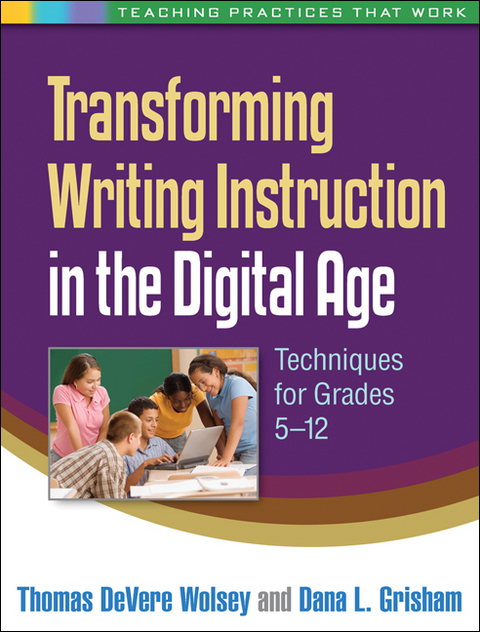
Transforming Writing Instruction in the Digital Age (eBook)
236 Seiten
Guilford Publications (Verlag)
978-1-4625-0468-8 (ISBN)
Thomas DeVere Wolsey, EdD, teaches online courses at Portland State University and elsewhere and is the founder of a consulting firm, the Institute to Advance International Education. Previously he worked in public schools for 20 years teaching English and social studies. His research explores how language informs thinking about content and how the interactions of students in digital and face-to-face environments change their learning. Dr. Wolsey is also interested in the intersections of traditional literacies with digital literacies, specifically focusing on how those literacies affect teacher preparation and professional development. Dana L. Grisham, PhD, is a member of the Core Adjunct Faculty at National University, where she teaches courses online in the master of arts program in reading for teachers. A retired professor from The California State University, she also coordinated the Graduate Reading Program at San Diego State University and served as Faculty Coordinator of the Center for the Advancement of Reading for the Office of the Chancellor. Her research focuses on the intersection of literacy and technology. Dr. Grisham is Associate Editor of Reading and Writing Quarterly.
Introduction Hashtags by TechniqueI. Getting Started with Tools and Teaching Technique 1. Resources: Anytime, Anywhere Technique 2. Management: Computers in the ClassroomTechnique 3. Management: The Hardware Technique 4. Direct Instruction Technique 5. A Word about Differentiation II. Writing and ThinkingTechnique 6. Embracing Writing: Knowledge-Transforming Writing Technique 7. Why Writing Is a Process, and How Technology Can HelpTechnique 8. Working with Sources: Keeping Track of Learning, and Leaving a Path for Others to Follow Technique 9. Working with Sources: Using Style GuidesIII. Writing to Understand: It’s All about the DisciplineTechnique 10. Discussion and WritingTechnique 11. Writing Short PiecesTechnique 12. Short Writing: Electronic Journals Technique 13. Blogs and Classroom Websites for Writing Technique 14. Online Literature Discussion (Threaded Discussion)Technique 15. Vocabulary and WritingTechnique 16. Collaborative Writing Technique 17. Are Those Kids Texting Again?IV. Inquiry and Long Thinking Meet the DisciplinesTechnique 18. FAQs about Writing in the Disciplines Technique 19. It’s All the Same, or Maybe Not?Technique 20. What Was That Essential Question Again? Technique 21. Learning Because I’m Writing: Logs and Journals Technique 22. Writing Is (Hard) Cognitive Work: Bloom’s Taxonomy Matters Technique 23. Internet InquiryTechnique 24. Prompts Technique 25. Prewriting: Composing before Writing with Pen or KeyboardTechnique 26. Prewriting with Graphic OrganizersTechnique 27. Feedback, Assessment, and TechnologyV. What about Literature and English Language Arts?Technique 28. Short Writing: Summaries in Response to ReadingTechnique 29. The Zen of Writing about Literature Technique 30. Persuasion: In This Essay, I’m Going to Convince You…Technique 31. Prompts for Writing: Language Arts VI. Composing with MultimediaTechnique 32. Visualize It! Technique 33. Podcasting: It’s Ear-resistibleVII. Wrapping It Up Technique 34. Advocacy for Technology and New Literacies Technique 35. High-Stakes Writing AssessmentsTechnique 36. Automated Tools Technique 37. Publication Appendix: Common Core Content Standards for Writing, Grades 6–12Glossary
| Erscheint lt. Verlag | 14.5.2012 |
|---|---|
| Reihe/Serie | Teaching Practices That Work |
| Vorwort | Bridget Dalton |
| Verlagsort | New York |
| Sprache | englisch |
| Maße | 200 x 200 mm |
| Themenwelt | Schulbuch / Wörterbuch ► Unterrichtsvorbereitung ► Unterrichts-Handreichungen |
| Geisteswissenschaften ► Sprach- / Literaturwissenschaft ► Literaturwissenschaft | |
| Geisteswissenschaften ► Sprach- / Literaturwissenschaft ► Sprachwissenschaft | |
| Sozialwissenschaften ► Pädagogik ► Schulpädagogik / Sekundarstufe I+II | |
| Schlagworte | adolescents • Assessments • Common Core State Standards • Composition • Computers • content areas • Creative Writing • digital • disciplines • Electronic Media • English • high schools • Internet inquiry • Language Arts • middle schools • Multimedia • New Literacies • Online • secondary education • Standards • "substance abuse, behavior change, psychotherapy, interventions, addictions, ambivalence, resistance, therapy, counseling field, counseling students, interviewing skills, meth addiction, life coaching, helping professionals, therapeutic relationship, helping professions, professional counselor, core concepts, social workers, transpersonal, rationales, person-centered, exam, cognitive-behavioral, court-ordered, modality, clinicians, evidence-based, revisions, trainers, therapists, counselors, seminar, exerci • Teaching Strategies • Technology • Writing instruction |
| ISBN-10 | 1-4625-0468-X / 146250468X |
| ISBN-13 | 978-1-4625-0468-8 / 9781462504688 |
| Informationen gemäß Produktsicherheitsverordnung (GPSR) | |
| Haben Sie eine Frage zum Produkt? |
 PDF (Adobe DRM)
Kopierschutz: Adobe-DRM
Adobe-DRM ist ein Kopierschutz, der das eBook vor Mißbrauch schützen soll. Dabei wird das eBook bereits beim Download auf Ihre persönliche Adobe-ID autorisiert. Lesen können Sie das eBook dann nur auf den Geräten, welche ebenfalls auf Ihre Adobe-ID registriert sind.
Details zum Adobe-DRM
Dateiformat: PDF (Portable Document Format)
Mit einem festen Seitenlayout eignet sich die PDF besonders für Fachbücher mit Spalten, Tabellen und Abbildungen. Eine PDF kann auf fast allen Geräten angezeigt werden, ist aber für kleine Displays (Smartphone, eReader) nur eingeschränkt geeignet.
Systemvoraussetzungen:
PC/Mac: Mit einem PC oder Mac können Sie dieses eBook lesen. Sie benötigen eine
eReader: Dieses eBook kann mit (fast) allen eBook-Readern gelesen werden. Mit dem amazon-Kindle ist es aber nicht kompatibel.
Smartphone/Tablet: Egal ob Apple oder Android, dieses eBook können Sie lesen. Sie benötigen eine
Geräteliste und zusätzliche Hinweise
Buying eBooks from abroad
For tax law reasons we can sell eBooks just within Germany and Switzerland. Regrettably we cannot fulfill eBook-orders from other countries.
aus dem Bereich