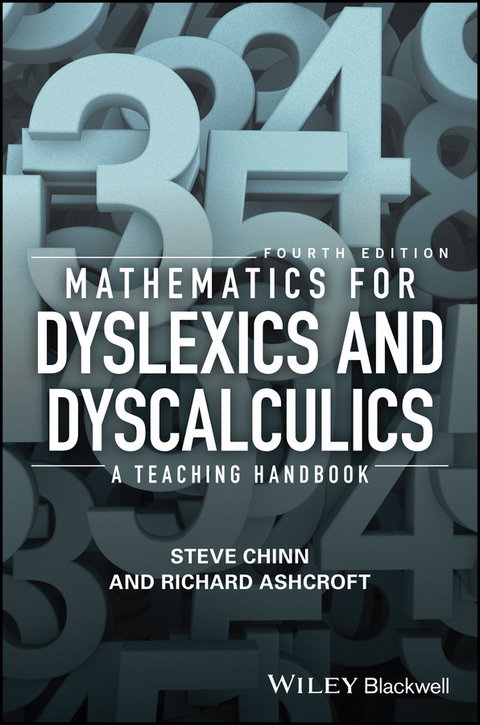
Mathematics for Dyslexics and Dyscalculics (eBook)
John Wiley & Sons (Verlag)
978-1-119-15998-8 (ISBN)
A seminal handbook in the field for more than 20 years, this new and updated edition of Mathematics for Dyslexicsand Dyscalculics contains the latest research and best practices for helping learners with numerical and mathematical difficulties.
- Provides a complete overview of theory and research in the fields of dyslexia and dyscalculia, along with detailed yet pragmatic methods to apply in the classroom
- Contains enhanced coverage of place value and the role of the decimal point, why fractions can challenge a developed logic for arithmetic, and the complexity of time along with new material on addressing anxiety, fear, motivation, and resilience in the classroom; and links to new resources including standardized tests and recommended reading lists
- Written by two mathematics teachers with 50 years of teaching experience between them, much of it in specialist settings for students with specific learning difficulties
- Offers effective teaching strategies for learners of all ages in a structured but accessible format
Steve Chinnis an independent lecturer, writer, and researcher, and Visiting Professor at the University of Derby, UK. He spent twenty-four years as head teacher of three specialist schools and was a mainstream teacher for fourteen years. He was Founder and Principal of Mark College in Somerset, UK, a specialist residential school for young people with specific learning difficulties. In 2011 he set up and chaired the BDA's first subcommittee on dyscalculia. He has received the Marion Welchman International Award for Services to Dyslexia, and the Lady Radnor Award for Lifetime Services to Dyslexia. He has lectured and taught in over 30 countries worldwide and has spoken at many major conferences. He is the author of numerous books, including The Trouble with Maths (3rdedition, 2016), The Routledge International Handbook of Dyscalculia and Mathematical Learning Difficulties(2015), More Trouble with Maths: A Complete Guide to Identifying and Diagnosing Mathematical Difficulties (2nd edition 2016), and The Fear of Maths (3rdedition, 2011).
Richard Ashcroft was Headmaster at Mark College, UK, a specialist residential school for young people with specific learning difficulties. He taught mathematics at the secondary school level for almost 25 years. During his teaching career, he developed a series of teaching resources specifically for dyslexic students. He retired in 2006.
A seminal handbook in the field for more than 20 years, this new and updated edition of Mathematics for Dyslexicsand Dyscalculics contains the latest research and best practices for helping learners with numerical and mathematical difficulties. Provides a complete overview of theory and research in the fields of dyslexia and dyscalculia, along with detailed yet pragmatic methods to apply in the classroom Contains enhanced coverage of place value and the role of the decimal point, why fractions can challenge a developed logic for arithmetic, and the complexity of time along with new material on addressing anxiety, fear, motivation, and resilience in the classroom; and links to new resources including standardized tests and recommended reading lists Written by two mathematics teachers with 50 years of teaching experience between them, much of it in specialist settings for students with specific learning difficulties Offers effective teaching strategies for learners of all ages in a structured but accessible format
STEVE CHINN is an independent lecturer, writer and researcher, and Visiting Professor at the University of Derby, UK. He spent 24 years as headteacher of three specialist schools and was a mainstream teacher for 14 years. He was Founder and Principal of Mark College in Somerset, UK, a specialist residential school for young people with specific learning difficulties. In 2011 he set up and chaired the BDA's first subcommittee on dyscalculia. He has received the Marion Welchman International Award for Services to Dyslexia, and the Lady Radnor Award for Lifetime Services to Dyslexia. He has lectured and taught in over 30 countries worldwide and is the author of numerous books. RICHARD ASHCROFT was headmaster at Mark College, UK, a specialist residential school for young people with specific learning difficulties. He taught mathematics at the secondary school level for almost 25 years. During his teaching career, he developed a series of teaching resources specifically for dyslexic students. He retired in 2006.
1
Dyscalculia, Dyslexia and Mathematics
Introduction
In 1981, when we moved from working in mainstream schools and began teaching in schools for dyslexic learners, our initial expectation was that teaching mathematics would be much the same as before. At that time we could not find any source of guidance to confirm or contradict this expectation. We thought dyslexia meant difficulties with language, not mathematics. Experience would, very quickly, change this impression.
Over the last 35 years, and the 23 years since we published the first edition of this book, we have accumulated experience, tried out new (and old) ideas, researched, read what little appropriate material was available (there is still far less published on learning difficulties in mathematics than on language (Gersten et al., 2007)), learned from our learners and have become convinced that difficulties in mathematics go hand in hand with the difficulties of dyslexia and, especially, that a different teaching attitude and approach is needed.
The first four chapters of this book look at some of the background that influenced the evolution of these teaching methods and continues to underpin their ongoing development. This requires a look at the learner, the subject (mathematics), the teacher and the pedagogy. The main mathematical focus of this book is number, primarily because this is the first area of mathematics studied by children and thus provides the first opportunity to fail. Our experience suggests that number remains the main source of difficulty for most of the learners we have worked with, even in secondary education. We also know that the foundations for all work to GCSE (the national examination for 16‐year‐old students in England), and beyond, are based in these early learning experiences. The evaluations and expectations of a child’s mathematical potential are often based, not always correctly, on performance in early work on number (e.g. Desoete and Stock, 2011). The remaining chapters describe some of the methods we use to teach our dyslexic learners, with the ever‐present caveat, that no one method will work for all learners.
One of the main reasons for the first four chapters is to address the complexity of learning profiles. This will explain why the methods described in the subsequent chapters are effective, but still will not meet the needs of every single child, and why teachers need the skill of responsive reactivity. There are now a number of researchers who have referred to this complexity and from a number of perspectives. Watson (2005) states:
There is no standard recipe for mathematical success. The joyous range of characteristics that make each child an individual ensure that this is true, so teachers need an understanding of the child and the subject to be able to adjust methods and improvise, from secure foundations and principles, to meet those individual needs.
Mabbott and Bisanz (2008) note that, ‘Children who experience difficulties in mathematics are a heterogeneous group’ and as Zhou and Cheng (2015) express so elegantly and succinctly, ‘mathematical competence is a constellation of abilities’. Kaufmann and a collection of international researchers (2013) writing together say that heterogeneity is a feature of developmental dyscalculia. Chapter 2 provides more detail on some of the reasons for this heterogeneity.
We also believe that a greater understanding of the ways dyslexic and dyscalculic students learn and fail mathematics will illuminate our understanding of how other children learn and fail mathematics. In other words, the reasons for failure are unlikely to be specific to dyslexic and dyscalculic learners. Poor performance in maths spreads beyond students identified as dyscalculic, for example Rashid and Brooks (2010) found low levels of attainment in a significant percentage of the population of 13–19‐year‐old students in England. The extrapolation from this is that many, if not all of the methods advocated in this book will also help many non‐dyslexic and non‐dyscalculic students to learn mathematics. We have long been advocates of the principle of learning from the ‘outliers’ (Murray et al., 2015).
Our aim has always been to teach mathematics in a mathematical way rather than seek out patronising collections of mnemonics and one‐off tricks.
Definitions of Dyslexia
The year 2016 marks the 120th anniversary of the publication of the first paper (Pringle‐Morgan, 1896, reproduced in the BDA Handbook 1996) describing a 14‐year‐old student with specific difficulties with reading, which Pringle‐Morgan labelled, based on Kussmaul’s study in 1878, as ‘congenital word blindness’. Pringle Morgan also described idiosyncratic difficulties for the young student in maths: ‘Interestingly he could multiply 749 by 867 quickly and correctly as well as working out (a + x)(a − x) = a2 − x2, yet failed to do 4 × ½.’
The issue of mathematics disappeared from definitions of dyslexia for a while, for example in 1968 the World Federation of Neurology defined dyslexia as: ‘A disorder manifested by a difficulty in learning to read, despite conventional instruction, adequate intelligence and socio‐cultural opportunity. It is dependent upon fundamental cognitive difficulties that are frequently of a constitutional character.’
But, by 1972 the Department of Education and Science for England and Wales included number abilities in its definition of specific reading (sic) difficulties. In the USA, the Interagency Conference’s (Kavanagh and Truss, 1988) definition of learning disabilities included ‘significant difficulties in the acquisition of mathematical abilities’ and, in the UK, Chasty (1989) defined specific learning difficulties as: ‘Organising or learning difficulties, which restrict the students competence in information processing, in fine motor skills and working memory, so causing limitations in some or all of the skills of speech, reading, spelling, writing, essay writing, numeracy and behaviour.’
In 1992 Miles and Miles, in their book Dyslexia and Mathematics, wrote: ‘The central theme of this book is that the difficulties experienced by dyslexics in mathematics are manifestations of the same limitations which also affect their reading and spelling.’
In 1995 Light and Defries (1995) highlighted the comorbidity of language and mathematical difficulties in dyslexic twins, one of the earliest mentions of the possibility of comorbid dyslexia and dyscalculia.
In the new millennium, it seems that the definitions of dyslexia are moving back to focus solely on language. This is likely to be due to the current interest in and awareness of dyscalculia and comorbidity and the trend in the UK to see ‘specific learning difficulties’ used as an umbrella term to cover dyslexia, dyscalculia, dyspraxia (developmental coordination disorder) and dysgraphia, rather than a label that was solely interchangeable with dyslexia. This is relevant for our perceptions of dyscalculia and mathematical learning difficulties. So, recently in the UK, the Rose Report’s (2009) definition of dyslexia focused on reading and spelling, with no mention of arithmetic or numeracy skills: ‘Dyslexia is a learning difficulty that primarily affects the skills involved in accurate and fluent word reading and spelling. Characteristic features of dyslexia are difficulties in phonological awareness, verbal memory and verbal processing speed.’ However, within the report, there are discussions on co‐occurring issues, which include difficulties with mental calculation.
In the USA, the International Dyslexia Association adopted a definition of dyslexia (2002), which also focused on language:
Dyslexia is a specific learning difficulty that is neurobiological in origin. It is characterised by difficulties with accurate and/or fluent word recognition and by poor spelling and decoding abilities. These difficulties typically result from a deficit in the phonological component of language that is often unexpected in relation to other cognitive abilities and the provision of effective classroom instruction. Secondary consequences may include problems in reading comprehension and reduced reading experience that can impede growth of vocabulary and background knowledge.
If dyslexia and dyscalculia are now to be defined as separate, distinct specific learning difficulties, then the concept of comorbidity (e.g. Cirino et al., 2015; Shin and Bryant, 2015) becomes very relevant. An important question for researchers is to decide whether the comorbidity is causal, independent or a different outcome resulting from the same neurological basis. The study by Moll et al. (2014) suggests that deficits in number skills are due to different underlying cognitive deficits in children with reading disorders compared to children with mathematics disorders. These deficits are, for reading disorders, a phonological deficit and, for mathematics disorders, a deficit in processing numbers.
Our classroom experience is that most of the dyslexics we have taught have had difficulties in at least some areas of mathematics. It should be noted that, in our school, the results from our specifically designed intervention, in terms of grades achieved in GCSE (the national exam for 16‐year‐old students in England) were from A* to D...
| Erscheint lt. Verlag | 18.1.2017 |
|---|---|
| Sprache | englisch |
| Themenwelt | Schulbuch / Wörterbuch |
| Geisteswissenschaften ► Psychologie | |
| Sozialwissenschaften ► Pädagogik ► Sonder-, Heil- und Förderpädagogik | |
| Schlagworte | ADHD • Bildungswesen • cognitive/thinking style • Dyskalkulie • dyslexia • Dyslexie • Dyspraxia • Education • Educational & School Psychology • educational psychology</p> • Erziehungs- u. Schulpsychologie • learning difficulties • learning support • Lehrpläne / Mathematik • <p>Dyscalculia • Math • Mathematical Operations • Mathematics • numeracy • Psychologie • Psychology • Sonderschule • Sonder- u. Förderschulen • special educational needs • teaching maths |
| ISBN-10 | 1-119-15998-9 / 1119159989 |
| ISBN-13 | 978-1-119-15998-8 / 9781119159988 |
| Informationen gemäß Produktsicherheitsverordnung (GPSR) | |
| Haben Sie eine Frage zum Produkt? |
 EPUB (Adobe DRM)
Kopierschutz: Adobe-DRM
Adobe-DRM ist ein Kopierschutz, der das eBook vor Mißbrauch schützen soll. Dabei wird das eBook bereits beim Download auf Ihre persönliche Adobe-ID autorisiert. Lesen können Sie das eBook dann nur auf den Geräten, welche ebenfalls auf Ihre Adobe-ID registriert sind.
Details zum Adobe-DRM
Dateiformat: EPUB (Electronic Publication)
EPUB ist ein offener Standard für eBooks und eignet sich besonders zur Darstellung von Belletristik und Sachbüchern. Der Fließtext wird dynamisch an die Display- und Schriftgröße angepasst. Auch für mobile Lesegeräte ist EPUB daher gut geeignet.
Systemvoraussetzungen:
PC/Mac: Mit einem PC oder Mac können Sie dieses eBook lesen. Sie benötigen eine
eReader: Dieses eBook kann mit (fast) allen eBook-Readern gelesen werden. Mit dem amazon-Kindle ist es aber nicht kompatibel.
Smartphone/Tablet: Egal ob Apple oder Android, dieses eBook können Sie lesen. Sie benötigen eine
Geräteliste und zusätzliche Hinweise
Buying eBooks from abroad
For tax law reasons we can sell eBooks just within Germany and Switzerland. Regrettably we cannot fulfill eBook-orders from other countries.
aus dem Bereich