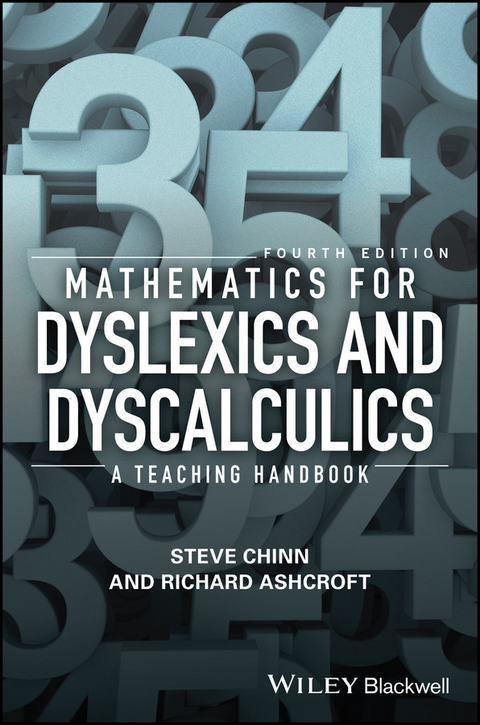
Mathematics for Dyslexics and Dyscalculics (eBook)
John Wiley & Sons (Verlag)
978-1-119-15997-1 (ISBN)
A seminal handbook in the field for more than 20 years, this new and updated edition of Mathematics for Dyslexicsand Dyscalculics contains the latest research and best practices for helping learners with numerical and mathematical difficulties.
- Provides a complete overview of theory and research in the fields of dyslexia and dyscalculia, along with detailed yet pragmatic methods to apply in the classroom
- Contains enhanced coverage of place value and the role of the decimal point, why fractions can challenge a developed logic for arithmetic, and the complexity of time along with new material on addressing anxiety, fear, motivation, and resilience in the classroom; and links to new resources including standardized tests and recommended reading lists
- Written by two mathematics teachers with 50 years of teaching experience between them, much of it in specialist settings for students with specific learning difficulties
- Offers effective teaching strategies for learners of all ages in a structured but accessible format
STEVE CHINN is an independent lecturer, writer and researcher, and Visiting Professor at the University of Derby, UK. He spent 24 years as headteacher of three specialist schools and was a mainstream teacher for 14 years. He was Founder and Principal of Mark College in Somerset, UK, a specialist residential school for young people with specific learning difficulties. In 2011 he set up and chaired the BDA's first subcommittee on dyscalculia. He has received the Marion Welchman International Award for Services to Dyslexia, and the Lady Radnor Award for Lifetime Services to Dyslexia. He has lectured and taught in over 30 countries worldwide and is the author of numerous books.
RICHARD ASHCROFT was headmaster at Mark College, UK, a specialist residential school for young people with specific learning difficulties. He taught mathematics at the secondary school level for almost 25 years. During his teaching career, he developed a series of teaching resources specifically for dyslexic students. He retired in 2006.
A seminal handbook in the field for more than 20 years, this new and updated edition of Mathematics for Dyslexicsand Dyscalculics contains the latest research and best practices for helping learners with numerical and mathematical difficulties. Provides a complete overview of theory and research in the fields of dyslexia and dyscalculia, along with detailed yet pragmatic methods to apply in the classroom Contains enhanced coverage of place value and the role of the decimal point, why fractions can challenge a developed logic for arithmetic, and the complexity of time along with new material on addressing anxiety, fear, motivation, and resilience in the classroom; and links to new resources including standardized tests and recommended reading lists Written by two mathematics teachers with 50 years of teaching experience between them, much of it in specialist settings for students with specific learning difficulties Offers effective teaching strategies for learners of all ages in a structured but accessible format
STEVE CHINN is an independent lecturer, writer and researcher, and Visiting Professor at the University of Derby, UK. He spent 24 years as headteacher of three specialist schools and was a mainstream teacher for 14 years. He was Founder and Principal of Mark College in Somerset, UK, a specialist residential school for young people with specific learning difficulties. In 2011 he set up and chaired the BDA's first subcommittee on dyscalculia. He has received the Marion Welchman International Award for Services to Dyslexia, and the Lady Radnor Award for Lifetime Services to Dyslexia. He has lectured and taught in over 30 countries worldwide and is the author of numerous books. RICHARD ASHCROFT was headmaster at Mark College, UK, a specialist residential school for young people with specific learning difficulties. He taught mathematics at the secondary school level for almost 25 years. During his teaching career, he developed a series of teaching resources specifically for dyslexic students. He retired in 2006.
Title Page 5
Copyright Page 6
Contents 9
Foreword 13
Chapter 1 Dyscalculia, Dyslexia and Mathematics 15
Introduction 15
Definitions of Dyslexia 17
The Evolution of Definitions of (Developmental) Dyscalculia 19
Comorbidity 23
Prevalence 24
What is mathematics? 26
What is the role of memory? 26
Counting 27
What distinguishes the dyscalculic learner from the garden?variety poor mathematician? 28
What are the predictors? 29
What is appropriate teaching? 31
What are the interactions and factors? (See also Chapter 2) 31
The Nature of Mathematics and the Ways it is Taught 33
Chapter 2 Factors that may Contribute to Learning Difficulties in Mathematics 37
Potential Areas of Difficulty in Learning Mathematics 38
Directional confusion 38
Sequencing problems 40
Visual difficulties 41
Spatial awareness 43
Short-term and working memory 43
Long-term memory 45
Speed of working 47
The vocabulary and language of mathematics 48
Cognitive style or thinking style (see Chapter 3) 52
Conceptual ability 52
Anxiety, withdrawal, self-image and the affective domain 54
General Principles of Intervention 58
Summary 60
Chapter 3 Cognitive (Thinking) Style in Mathematics 62
Introduction 62
Qualitative and Quantitative Style 63
The brain 64
Cognitive (Thinking) Style in the Classroom 65
The teacher’s role 67
The structure of mathematical abilities 67
Thinking styles 68
Examples 68
Inferences from the examples 71
Cognitive style and problems 73
Teachers and cognitive style 74
Summary 75
Chapter 4 Testing and Diagnosis 76
A Diagnostic Test Protocol 78
Structure of the Diagnostic Protocol 79
Counting and adding on tasks 80
Times table facts 81
Place value 82
The vocabulary and language of mathematics 83
Concepts/understanding 83
The four operations (+ ? × ÷) 83
Addition 84
Subtraction 84
Multiplication 85
Division 86
Word problems 86
Money 87
Attitude and Anxiety 87
Thinking Style or Cognitive Style 88
Tests for Dyscalculia 88
Summary of the Test Protocol 88
Chapter 5 Concept of Number 90
Introduction 90
Early Recognition of Numbers and Their Values 92
The Language of Mathematics (see also Chapter 2) 93
Early Number Work 93
Sorting/classifying 93
Correspondence between sets of objects 94
Correspondence between objects and numbers: counting 94
Visual Sense of Number 96
Visual Clues to Number Concept 97
Number Bonds/Combinations 98
Place Value 100
Grouping in tens 100
Tens alone 103
Grouping in hundreds 104
Grouping in thousands 104
Millions, billions and trillions 106
Reminders and reviews 106
Diagnostic ideas 106
Number Bonds/Combinations for Ten 107
Numbers Near Ten, Hundred or Thousand 108
Summary 109
Chapter 6 Addition and Subtraction: Basic Facts/Number Combinations 110
Introduction 110
Strategies for Learning/Remembering the Addition and Subtraction Facts 113
The zero facts: n + 0 and 0 + n 114
Adding on 1 and 2 115
Adding to ten adding on ten
Use of doubles 117
Number bonds/combinations for ten 118
Number bonds/combinations for nine 119
Adding on nine 120
Sharing doubles 121
Overview 121
Subtraction Facts 122
Extension 123
Chapter 7 The Times Tables Facts/Number Combinations 124
Introduction 124
Rote Learning Strategies 124
Use of music 126
Use of ‘fun’ games 126
The ARROW technique 126
Learning by Understanding 127
Numbers which do not appear 128
Limiting the task 128
The order in which to learn the facts 129
Check-backs/reviews 129
The Commutative Property 129
Learning the Table Square 131
Zero: 0 131
Progress check 132
One: 1 132
Progress check 133
Ten: 10 133
Progress check 135
Two: 2 136
Four: 4 139
Five: 5 140
Some practical work 142
Three: 3, six: 6 and seven: 7 142
Nine: 9 144
Eight: 8 147
Final notes 148
Developmental aspects 148
Times table facts and exams 149
Summary 149
Chapter 8 Computational Procedures for Addition and Subtraction 150
Estimation 152
Addition 152
A developmental programme for teaching addition and subtraction 153
Estimation in addition 158
Column addition 159
Mental arithmetic with addition 160
Teaching Subtraction as a Separate Exercise 161
Subtraction without regrouping 161
Subtraction with regrouping: the decomposition/regrouping/renaming method 161
The equal-additions method 164
Mental arithmetic with subtraction 164
Chapter 9 Multiplication 166
Introduction 166
The key concepts 167
Multiplying by Ten and Powers of Ten 167
Multiplication 171
Introducing the model 171
Two-digit numbers times one-digit numbers 171
Two digit times two digit 173
Mnemonics 176
Estimation 177
Extension 177
Chapter 10 Division: Whole Numbers 179
Introduction 179
Introduction to Division 180
Dividing two-digit numbers by one-digit numbers, with remainder 182
Dividing two and three-digit numbers with renaming (of tens and hundreds) 183
Some alternative algorithms 185
Estimating 186
Division by Powers of Ten 187
Division by Multiples of Powers of Ten 188
Conclusion 188
Chapter 11 Fractions, Decimals and Percentages: An Introduction 189
Introduction 189
Fractions 190
Terminology 191
What is a fraction? 191
Making fractions 194
Other fractions 196
Equal or equivalent fractions 196
Simplifying fractions 198
Decimals 201
First decimal place as tenths 202
Second decimal place as hundredths 202
Further decimal places 203
Converting decimals to fractions 204
Use of the number 25 205
Special decimals 205
The significance of zeros 205
Comparing decimals 206
Decimal number sequences 207
Converting fractions to decimals 208
Percentages 209
Percentages and whole things 209
An inclusive model for percentages, fractions and decimals 209
Comparing percentages 210
Converting percentages to fractions 210
Converting percentages to decimals 214
Converting decimals to percentages 215
Converting decimals to percentages 215
Special percentages 216
Overview 217
Chapter 12 Operating with Fractions 218
Introduction 218
Making Segment Sizes the Same 219
Comparing Fractions 221
Converting mixed fractions to top-heavy fractions 222
Converting top-heavy fractions to mixed fractions 223
Combining Fractions 224
Vertical and horizontal presentations of fraction problems 225
Adding Fractions 226
Fractions where the segments (denominators) are the same size 226
Adding fractions where the segments are of different size 227
Adding more than two fractions 228
Adding mixed fractions 229
Subtracting Fractions 230
Fractions where the segments are the same size 230
Fractions with different segment sizes 230
Subtracting mixed fractions 232
Mixed fractions where a bigger fraction part is subtracted from a smaller fraction part 233
Combined Additions and Subtractions 233
Advantages of the vertical layout for addition and subtraction of fractions 235
Multiplying by Fractions 235
Fraction times fraction 235
Fraction times whole number 237
Multiplying Mixed Fractions 238
The advantages of a horizontal layout for multiplication 240
Multiplying with fractions, an overview 241
Dividing with Fractions 241
Division by fractions 241
Division by making the segments the same size 242
Examples with mixed fractions 243
Dividing fractions by inverse multiplication 244
Chapter 13 Decimals 246
Introduction 246
Addition and Subtraction 246
Addition 246
Subtraction 248
Multiplication and Division by Powers of Ten 249
Multiplication by ten 249
Multiplication by hundred 250
Multiplication by thousand 251
Multiplication by other powers of ten 251
Division by ten 251
Direction of movement 252
Division by hundred, thousand and other powers of ten 252
Rationalisation (1) 253
Multiplication of decimals by decimals 254
Rationalisation (2) 255
Division of Decimals 256
Division by a whole number 256
Approximations/rounding 259
Converting harder fractions to decimals 261
Summary 263
Chapter 14 Percentages 264
Introduction 264
An Image of Percentage 264
Estimates from key values 269
Summary 270
Chapter 15 Time 271
What are the Potential Problems with Time? 272
Setting the scene: the overview 273
Reading the Time 274
Quarter past, half past and quarter to 274
Minutes past and minutes to 275
The 24-hour clock 275
Time Problems 278
Finishing-time problems 278
Summary 282
Chapter 16 Teaching the Full Curriculum 283
Introduction 283
Some General Principles 284
Sound foundations 284
Plan for the long term 284
Use illustrations of wide applicability 285
‘Maths is easy – only writing it down is hard’ 288
Teaching the Other Parts of the Curriculum 291
Using and applying mathematics 291
Algebra 292
Shape and space 294
Handling data 295
Combining the Parts of the Curriculum 296
Summary 300
Chapter 17 Attacking and Checking Questions 301
Practice Examples 301
Preliminary Checks 302
1. Recall/look up the correct formula and then check it 302
2. Use given information to check proposed/initial working 303
3. Make a rough estimate first 304
Attacking Questions 304
Methods of Attacking Questions 305
1. Use a refined estimate 305
2. Do not be afraid to take the long way round 306
3. Do what you are told 307
4. Draw a diagram 307
5. Draw a graph 309
6. Try to interpret (decimal) numbers as money, which is usually understood better 309
7. Temporarily replace awkward numbers with easy numbers to clarify the method (then replace the actual numbers) 310
8. In multi-part questions, answer the later parts even if you cannot answer the earlier parts 311
9. When using a formula, consider whether you prefer to rearrange before you substitute your values, or vice versa 311
Checking 312
Methods of checking 312
1. Is the answer sensible? 313
2. Repeat the operations 313
3. Reverse the operations 313
4. Use an entirely different method 313
5. Substitute the answer back into the question, especially when using an equation 314
6. Some questions are self-checking 315
Chapter 18 Important Elements of a Teaching Programme 317
Introduction 317
Consider the Pupils’ Needs 317
The Structure of the Course 318
Numeracy 319
General mathematical topics 320
Using and applying mathematics 321
The use of patterns 321
Mental arithmetic 321
Classroom Management: Making the Lessons Suit the Pupils 322
Spread of ability 322
Pupils’ mathematical cognitive styles 322
Evolving Expectations and Emphases 323
Lesson management 324
Teaching materials 324
Writing paper 326
Calculators 327
Internal Assessment 327
Monitoring progress 328
Diagnosis of difficulties 328
Pupils’ mathematical styles 329
Summary 329
Appendix 1 Books, Journals, Tests and Games 330
Books 330
Background 330
Teaching 331
Journals 332
Suppliers of Software 332
Video tutorials 333
Tests 333
Games 334
Appendix 2 Teaching Materials 335
Suppliers 336
Coloured overlays 337
References 338
Index 351
EULA 361
| Erscheint lt. Verlag | 18.1.2017 |
|---|---|
| Sprache | englisch |
| Themenwelt | Schulbuch / Wörterbuch |
| Geisteswissenschaften ► Psychologie | |
| Sozialwissenschaften ► Pädagogik ► Sonder-, Heil- und Förderpädagogik | |
| Schlagworte | ADHD • Bildungswesen • cognitive/thinking style • Dyskalkulie • dyslexia • Dyslexie • Dyspraxia • Education • Educational & School Psychology • educational psychology</p> • Erziehungs- u. Schulpsychologie • learning difficulties • learning support • Lehrpläne / Mathematik • Lehrpläne / Mathematik • <p>Dyscalculia • Math • Mathematical Operations • Mathematics • numeracy • Psychologie • Psychology • Sonderschule • Sonder- u. Förderschulen • Sonder- u. Förderschulen • special educational needs • teaching maths |
| ISBN-10 | 1-119-15997-0 / 1119159970 |
| ISBN-13 | 978-1-119-15997-1 / 9781119159971 |
| Informationen gemäß Produktsicherheitsverordnung (GPSR) | |
| Haben Sie eine Frage zum Produkt? |
 PDF (Adobe DRM)
Kopierschutz: Adobe-DRM
Adobe-DRM ist ein Kopierschutz, der das eBook vor Mißbrauch schützen soll. Dabei wird das eBook bereits beim Download auf Ihre persönliche Adobe-ID autorisiert. Lesen können Sie das eBook dann nur auf den Geräten, welche ebenfalls auf Ihre Adobe-ID registriert sind.
Details zum Adobe-DRM
Dateiformat: PDF (Portable Document Format)
Mit einem festen Seitenlayout eignet sich die PDF besonders für Fachbücher mit Spalten, Tabellen und Abbildungen. Eine PDF kann auf fast allen Geräten angezeigt werden, ist aber für kleine Displays (Smartphone, eReader) nur eingeschränkt geeignet.
Systemvoraussetzungen:
PC/Mac: Mit einem PC oder Mac können Sie dieses eBook lesen. Sie benötigen eine
eReader: Dieses eBook kann mit (fast) allen eBook-Readern gelesen werden. Mit dem amazon-Kindle ist es aber nicht kompatibel.
Smartphone/Tablet: Egal ob Apple oder Android, dieses eBook können Sie lesen. Sie benötigen eine
Geräteliste und zusätzliche Hinweise
Buying eBooks from abroad
For tax law reasons we can sell eBooks just within Germany and Switzerland. Regrettably we cannot fulfill eBook-orders from other countries.
aus dem Bereich