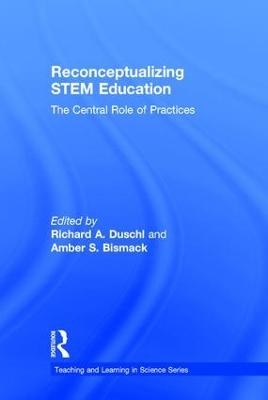
Reconceptualizing STEM Education
Routledge (Verlag)
978-1-138-90103-2 (ISBN)
Richard A. Duschl is the Kenneth B. Waterbury Chaired Professor in Secondary Education, Department of Curriculum and Instruction, College of Education, The Pennsylvania State University, USA. Amber S. Bismack is a Ph.D. student, Department of Educational Studies (Science Education), School of Education, The University of Michigan, USA.
CONTENTS
Introduction: Coordinating PreK-16 STEM Education Research and Practices for Advancing and Refining Reform Agendas
Richard A. Duschl, Amber S. Bismack, James Greeno and Drew H. Gitomer
Theme 1: Systems Thinking
Thinking about a System and Systems Thinking in Engineering
Thomas A. Litzinger
Diagnostic Instruction: Toward an Integrated System for Classroom Assessment
Jim Minstrell, Ruth Anderson, and Min Li
Response 1: Systems Thinking as a Design Problem
Marcela Borge
Response 2: Improving Learning about Systems Requires Designing for Change in Educational Systems
William R. Penuel
Theme 2: Model-Based Reasoning
Modeling Authentic STEM Research: A Systems Thinking Perspective
Annmarie R. Ward
Meeting the Standards for STEM Educations: Individual and National Needs
Spencer A. Benson
Response 1: Model-Based Reasoning in Professional Development
Hilda Borko
Response 2: "Where is the line?"
Brian P. Coppola
Theme 3: Quantitative Reasoning
Quantitative Reasoning in Mathematics Education: Directions in Research and Practice
Heather Lynn Johnson
Teachers Use of Data, Measurement, and Data Modeling in Quantitative Reasoning
Anthony J. Petrosino
Response 1: Quantitative Reasoning in STEM Disciplines
Robert Mayes
Response 2: Quantitative Reasoning: Capturing a Tension Between Structure and Variability
Rose Mary Zbiek
Theme 4: Equity, Epistemic, and Ethical Outcomes
Educational and Ethical Dilemmas for STEM Education in Pennsylvania’s Marcellus Shale Gasfield Communities
Catharine Biddle & Kai A. Schafft
Defining a Knowledge Base for Reasoning in Science: The role of procedural and epistemic knowledge
Jonathan Osborne
Response 1: Views from Above and Below: Access to Science Education
Nancy Brickhouse
Response 2: The Values of Science Literacy
Nancy Tuana
Theme 5: STEM Communication and Policy Outreach
Why People Care About Chickens and Other Lessons about Rhetoric, Public Science, and Informal Learning Environments
Stacey Pigg, William Hart-Davidson, Jeff Grabill, and Kirsten Ellenbogen
New Environments for Professional Development: Situating Science Learning and Teaching in a Framework and NGSS World
Jean Moon
Response 1: School-System Contexts for Professional Development
Edward J. Fuller
Response 2: Technology-supported Communication in Science: Conjectures on Expertise and Evaluation
Drew H. Gitomer
Reflections and Summary
Reflections on the Waterbury Summit: STEAM And Systems Thinking
Stephanie E. Vasko
Summary: Driving Change Forward
Amber S. Bismack, Yann Shiou Ong, Armend Tahirsylaj, and Richard A. Duschl
About the Authors
Waterbury Summit Participants
| Erscheint lt. Verlag | 13.1.2016 |
|---|---|
| Reihe/Serie | Teaching and Learning in Science Series |
| Zusatzinfo | 9 Tables, black and white; 35 Illustrations, black and white |
| Verlagsort | London |
| Sprache | englisch |
| Maße | 152 x 229 mm |
| Gewicht | 635 g |
| Themenwelt | Schulbuch / Wörterbuch |
| Sozialwissenschaften ► Pädagogik ► Bildungstheorie | |
| Sozialwissenschaften ► Pädagogik ► Schulpädagogik / Grundschule | |
| Sozialwissenschaften ► Pädagogik ► Schulpädagogik / Sekundarstufe I+II | |
| ISBN-10 | 1-138-90103-2 / 1138901032 |
| ISBN-13 | 978-1-138-90103-2 / 9781138901032 |
| Zustand | Neuware |
| Informationen gemäß Produktsicherheitsverordnung (GPSR) | |
| Haben Sie eine Frage zum Produkt? |
aus dem Bereich