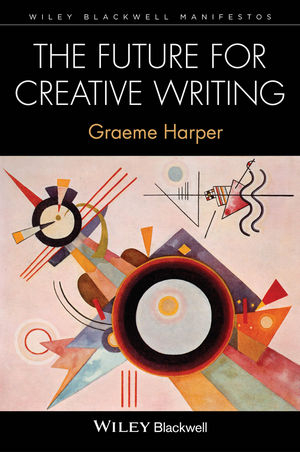
The Future for Creative Writing (eBook)
John Wiley & Sons (Verlag)
978-1-118-32584-1 (ISBN)
This is a compelling look at the current state and future direction of creative writing by a preeminent scholar in the field.
- Explores the practice of creative writing, its place in the world, and its impact on individuals and communities
- Considers the process of creative writing as an art form and as a mode of communication
- Examines how new technology, notably the internet and cell phones, is changing the ways in which creative work is undertaken and produced
- Addresses such topics as writing as a cultural production, the education of a creative writer, the changing nature of communication, and different attitudes to empowerment
Graeme Harper is a Professor of Creative Writing and Dean of The Honors College at Oakland University, Michigan, USA. A writer of fiction and a scriptwriter, he is an honorary professor in the United Kingdom, and was inaugural Chair of the Higher Education Committee at the UK’s National Association of Writers in Education (NAWE). He is the editor of The Companion to Creative Writing (Wiley Blackwell, 2013) and author of Inside Creative Writing: Interviews with Contemporary Writers (2012) and On Creative Writing (2010). He serves as editor for New Writing: the International Journal for the Practice and Theory of Creative Writing.
This is a compelling look at the current state and future direction of creative writing by a preeminent scholar in the field. Explores the practice of creative writing, its place in the world, and its impact on individuals and communities Considers the process of creative writing as an art form and as a mode of communication Examines how new technology, notably the internet and cell phones, is changing the ways in which creative work is undertaken and produced Addresses such topics as writing as a cultural production, the education of a creative writer, the changing nature of communication, and different attitudes to empowerment
Graeme Harper is a Professor of Creative Writing and Dean of The Honors College at Oakland University, Michigan, USA. A writer of fiction and a scriptwriter, he is an honorary professor in the United Kingdom, and was inaugural Chair of the Higher Education Committee at the UK's National Association of Writers in Education (NAWE). He is the editor of The Companion to Creative Writing (Wiley Blackwell, 2013) and author of Inside Creative Writing: Interviews with Contemporary Writers (2012) and On Creative Writing (2010). He serves as editor for New Writing: the International Journal for the Practice and Theory of Creative Writing.
Acknowledgments vii
Introduction 1
1 The Age of Creative Writing 17
2 Dynamism and the Creative Writer 35
3 Creative Writing Educating 53
4 Developing Creative Exposition 71
5 Selling and Buying Creative Writing 89
6 Speaking in Creative Writing 107
7 Living and Working as a Creative Writer 119
Conclusion 135
Selected Reading 143
Index 149
"Intellectually alert and deeply committed to its subject,
Graeme Harper offers a cogent and wide-ranging vision of what
creative writing can become in the 21st Century. His arguments
deserve to be widely discussed and debated. They challenge many of
our current assumptions about the purpose and value of creative
writing in higher education and elsewhere.'
--Jon Cook, University of East Anglia
"Deeply personal yet grounded in philosophy, Graeme
Harper's monograph on the future for creative writing
brightly situates the author at the intersections of culture,
therapy, spirituality, and creativity. This is essential
reading for anyone concerned about the future of the artist and
alphabetic text, or the ever-increasingly popularity of creative
writing as a discipline. Ultimately, this is an inspiring,
uplifting account of the ways creative writing fosters humanity and
human evolution."
--Joseph Moxley, University of South
Florida
"Not so long ago, the idea of a creative writer as a
creature operating within the academy was viewed as strange at
best, anathema at worst. Now, creative writing as an academic
discipline has spread across the Anglophone world and is making
inroads beyond. As founder and long-time editor of New
Writing, Graeme Harper has been uniquely situated to observe
- some might say to preside over - this remarkable
disciplinary explosion. The genius of his new book, The Future
of Creative Writing, is that it addresses not only our past
thinking and methodologies about and within the discipline of
creative writing, or even just those that are current, but also
those that might be coming. There is much here that is being
articulated and made visible for the first time. As the title
suggests, Graeme Harper is optimistic about The Future of
Creative Writing - and his book makes a powerful argument
for this optimistic view."
--Katherine Coles, University of Utah
1
The Age of Creative Writing
Living Beyond Ageing
The beginning of the 21st Century can rightly be referred to dually as the Age of Creative Writing and the Age of the Zombie. We might wonder if the two share a connection. By creative writing I am of course referring to the acts and actions of human beings, writing creatively. By zombie I am referring to the animated corpse that, despite its various laudatory and memorable appearances in numerous popular movies – the longing zombie, the lost zombie, the homemaker zombie, the comedian zombie, the loving zombie, the insatiably thirsty zombie, the child-like zombie, the friend zombie – is bereft of consciousness, beyond any further ageing, and essentially no more human than a gatepost.
Our recent enthusiasm for creative writing and our enthusiasm for zombies have been so thorough and so strong that it is a surprise there has not been occasional flesh-dripping protest against these, even outright pitchfork-defying revolt. Those working in academe might well admit to not being above some creative writing and zombie profiteering. Again we can wonder: is there a connection between these two things?
While creative writing has yet to draw quite the level of philosophical engagement that zombies have drawn, the answer to the connection question might lie within the debates located in zombie philosophy. For example, in his 2005 book Zombies and Consciousness Robert Kirk sets out to “dispose of the zombie idea once and for all” (Kirk: vii) but he nevertheless begins:
Zombies (the philosophical sort: this is not about voodoo) would be exactly like us in all physical and behavioral respects, but completely without consciousness. This seductive idea threatens the physicalist view of the world dominant in philosophy and science today.
Firstly, in his defense, Kirk’s is a serious philosophical study of consciousness. It examines what in philosophic circles is called the “zombie argument” or “zombie arguments” – in which philosophers explore “phenomenal states” and “experiential consciousness” (Bailey: 482). These philosophers, while briefly acknowledging the movie zombie and the zombie of Voodoo, in fact have far more interest in the nature of the human mind than in dripping flesh and moaning.
Secondly, though, what we might wonder does Kirk mean by the idea of the zombie threatening “the physicalist view of the world”?
The physicalist view of the world (for a thorough consideration of Physicalism, see Stoljar, 2010) at its most basic holds that the only things that exist in the world are those that are physical objects. Even states of mind are said to have material conditions, either in themselves or in that they create physical changes in us.
For a creative writer, this physicalist view seems immediately intriguing because, though it is obvious that writing is a physical act – and cannot exist otherwise because creative writing must at some point become inscribed to be creative writing at all – it is obvious also that activities beyond the physical are widely involved. It is likewise true that creative writing in its emphasis on the creative employs not only the human mind in that non-physical realm but what we most often have called the human imagination.
Are our imaginations, then, aspects of our minds and creative writing a physical manifestation of the imagination’s mind activities? This seems at least logically possible if slightly narrow in conception in that the imagination is situated somewhere between, or among, our higher cognitive functions and our emotions or emotional responses to the world, and in being so the imagination’s relationships with our physical actions are not necessarily singular. You can indeed draw from your imagination, you can stimulate it and encourage it by exposing yourself to certain experiences, but how you directly engage your imagination, engage with it or elements of it, and employ it at specific points in time is not entirely clear.
Nevertheless, it is certainly true that we do not have to be physically writing to be engaged in creative writing, and much that happens in undertaking creative writing happens before, during, and after the physical activities that inscribe it. These things happen in the mind and in the imagination – the two of which, we might consider, may or may not be thoroughly enmeshed with each other. This further raises the obvious question of when creative writing actually begins and when creative writing actually ends, and whether the physical manifestations of creative writing happening represent changes or continuities in that physical/non-physical relationship that is at creative writing’s core.
Returning to Robert Kirk’s comment, and noting this phenomenon whereby creative writing is both physical and non-physical, if zombies currently threaten the physicalist view of the world, then perhaps the rise in zombie popularity is related to something that is also connected to the present and future for creative writing. But what is that something?
The New Creative Writing Consciousness
Staggering through a field in grassy rural Pennsylvania, the zombies in George Romero’s Night of the Living Dead (1968) appear at first to be weary commuters finally heading home after a long day in the city. Perhaps they are ’60s creative writers escaping daily office jobs and trying to get home to their writing. If they are without consciousness, they are not without the appearance of personality, without a sense of personal space, or without character, and they are most certainly not without intention. But Romero’s film was then and this is now. Forty-five years is a long time in the life of the non-living, an entire death-time in the story of the animated ageless.
The opening of the 21st Century clearly witnessed both creative writing and zombie life leave behind what might be called in Romero terms “the Pennsylvanian period” – a 1960s weariness with the mundane day-to-day work – expand their popular reach (arms outstretched, for the zombies; fingers flying across keyboards for we creative writers) and take on something of the personality and challenges of our time. Creative writing and our new found love of zombies have admirably met those challenges head-on, not least in offering an appearance of similarity to our daily contemporary lives but in not really being mundane at all.
In the case of the zombie, witness their contemporary popularity in the bestselling paperbacks and Emmy-award-winning TV series, The Walking Dead. “In a world ruled by the dead, we are forced to finally start living”1 (Kirkman, 2009). Such optimism in this declaration of collaborative zombie–human life probably bears some concerted consideration. Consider Max Brooks’ The Zombie Survival Guide (2003) – allegedly a parody, but who in our time has not seen the scrawled cries for help on the crumbling concrete walls of environmentally challenged cities? Brooks is also the author of World War Z: An Oral History of the Zombie War (2006), later made into a film directed by Marc Foster and starring Brad Pitt. Add to this a random selection of other recent evidence: the Bowling Zombies Wooden Novelty Game by Front Porch Classics, described as “a zombie themed table top bowling game” in which you “knock over zombie-pins without knocking down the king-pin” – a “fun indoor activity and easy to play” (Amazon); The Zombie Combat Manual: A Guide to Fighting the Living Dead, Roger Ma’s quite obviously essential 2010 offering; and the Youtube video of “Doom and Gloom” a song from GRRR! (2012), the 50th anniversary compilation album by one of the most successful rock music acts of all time, The Rolling Stones, featuring zombies rampant in Louisiana in its opening sequence as casually as it features a septuagenarian rock and roll star singing “Baby take a chance/Baby won’t you dance with me/Yeah!” (Jagger/Richards). Whether over time zombies have become more or less conscious of us, there is no doubt we have become progressively and enthusiastically very conscious of them.
In the case of creative writing, witness the global growth of courses in creative writing at all levels of education, the increase in the numbers of books and journals and magazines concerned with the practice of creative writing, the considerable growth of exchanges of completed works of creative writing – whether distributed via commercial means or directly between creative writers and readers, between creative writers and other creative writers – as well as the growth in exchange of “works in progress,” discussions about creative writing, and creative writers exploring together. Whether over time creative writing has become more part of our consciousness, there is no doubt we have become progressively and enthusiastically very conscious of it.
This observation might strike creative writers as well as philosophers as notable, not least because of philosophic zombie arguments. Philosophic zombie arguments relate to ideas about both subjective conscious human experience and perception and are employed in exploring the role of our experiences in providing something...
| Erscheint lt. Verlag | 28.3.2014 |
|---|---|
| Reihe/Serie | Blackwell Manifestos | Wiley-Blackwell Manifestos |
| Sprache | englisch |
| Themenwelt | Schulbuch / Wörterbuch |
| Geisteswissenschaften ► Sprach- / Literaturwissenschaft ► Literaturwissenschaft | |
| Geisteswissenschaften ► Sprach- / Literaturwissenschaft ► Sprachwissenschaft | |
| Sozialwissenschaften ► Pädagogik ► Bildungstheorie | |
| Schlagworte | Bildungswesen • Education • Lehrpläne / Schreiben • Lehrpläne / Schreiben • Manifesto, written language, human communication, rhetoric, publishing, contemporary literature, book culture, higher education, creative industries, cultural studies, literary criticism, english, rhetoric, contemporary literature, communication, publishing, culture of the book, technology, blogging, exposition, book business, education, novelist, poetry, novel, poet, writer, memoir, memoirist, screenwriting, playwright, playwriting, screenwriter • Schreiben • Schreibunterricht • Writing |
| ISBN-10 | 1-118-32584-2 / 1118325842 |
| ISBN-13 | 978-1-118-32584-1 / 9781118325841 |
| Informationen gemäß Produktsicherheitsverordnung (GPSR) | |
| Haben Sie eine Frage zum Produkt? |
 EPUB (Adobe DRM)
Kopierschutz: Adobe-DRM
Adobe-DRM ist ein Kopierschutz, der das eBook vor Mißbrauch schützen soll. Dabei wird das eBook bereits beim Download auf Ihre persönliche Adobe-ID autorisiert. Lesen können Sie das eBook dann nur auf den Geräten, welche ebenfalls auf Ihre Adobe-ID registriert sind.
Details zum Adobe-DRM
Dateiformat: EPUB (Electronic Publication)
EPUB ist ein offener Standard für eBooks und eignet sich besonders zur Darstellung von Belletristik und Sachbüchern. Der Fließtext wird dynamisch an die Display- und Schriftgröße angepasst. Auch für mobile Lesegeräte ist EPUB daher gut geeignet.
Systemvoraussetzungen:
PC/Mac: Mit einem PC oder Mac können Sie dieses eBook lesen. Sie benötigen eine
eReader: Dieses eBook kann mit (fast) allen eBook-Readern gelesen werden. Mit dem amazon-Kindle ist es aber nicht kompatibel.
Smartphone/Tablet: Egal ob Apple oder Android, dieses eBook können Sie lesen. Sie benötigen eine
Geräteliste und zusätzliche Hinweise
Buying eBooks from abroad
For tax law reasons we can sell eBooks just within Germany and Switzerland. Regrettably we cannot fulfill eBook-orders from other countries.
aus dem Bereich