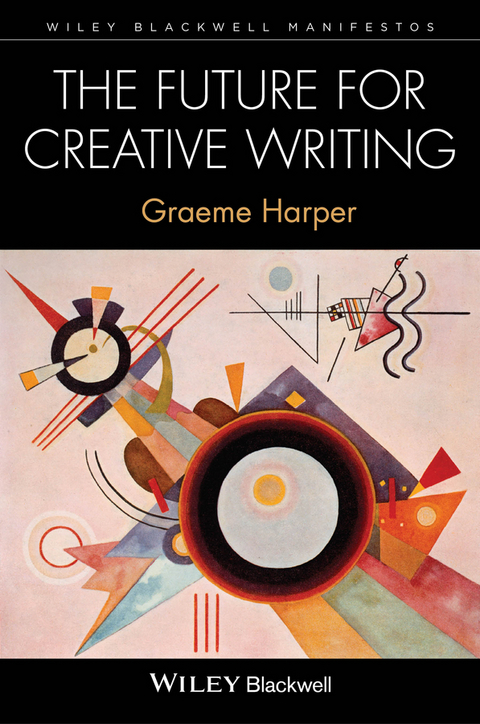
The Future for Creative Writing (eBook)
John Wiley & Sons (Verlag)
978-1-118-32583-4 (ISBN)
This is a compelling look at the current state and future direction of creative writing by a preeminent scholar in the field.
- Explores the practice of creative writing, its place in the world, and its impact on individuals and communities
- Considers the process of creative writing as an art form and as a mode of communication
- Examines how new technology, notably the internet and cell phones, is changing the ways in which creative work is undertaken and produced
- Addresses such topics as writing as a cultural production, the education of a creative writer, the changing nature of communication, and different attitudes to empowerment
Graeme Harper is a Professor of Creative Writing and Dean of The Honors College at Oakland University, Michigan, USA. A writer of fiction and a scriptwriter, he is an honorary professor in the United Kingdom, and was inaugural Chair of the Higher Education Committee at the UK’s National Association of Writers in Education (NAWE). He is the editor of The Companion to Creative Writing (Wiley Blackwell, 2013) and author of Inside Creative Writing: Interviews with Contemporary Writers (2012) and On Creative Writing (2010). He serves as editor for New Writing: the International Journal for the Practice and Theory of Creative Writing.
This is a compelling look at the current state and future direction of creative writing by a preeminent scholar in the field. Explores the practice of creative writing, its place in the world, and its impact on individuals and communities Considers the process of creative writing as an art form and as a mode of communication Examines how new technology, notably the internet and cell phones, is changing the ways in which creative work is undertaken and produced Addresses such topics as writing as a cultural production, the education of a creative writer, the changing nature of communication, and different attitudes to empowerment
Graeme Harper is a Professor of Creative Writing and Dean of The Honors College at Oakland University, Michigan, USA. A writer of fiction and a scriptwriter, he is an honorary professor in the United Kingdom, and was inaugural Chair of the Higher Education Committee at the UK's National Association of Writers in Education (NAWE). He is the editor of The Companion to Creative Writing (Wiley Blackwell, 2013) and author of Inside Creative Writing: Interviews with Contemporary Writers (2012) and On Creative Writing (2010). He serves as editor for New Writing: the International Journal for the Practice and Theory of Creative Writing.
Acknowledgments vii
Introduction 1
1 The Age of Creative Writing 17
2 Dynamism and the Creative Writer 35
3 Creative Writing Educating 53
4 Developing Creative Exposition 71
5 Selling and Buying Creative Writing 89
6 Speaking in Creative Writing 107
7 Living and Working as a Creative Writer 119
Conclusion 135
Selected Reading 143
Index 149
"Intellectually alert and deeply committed to its subject,
Graeme Harper offers a cogent and wide-ranging vision of what
creative writing can become in the 21st Century. His arguments
deserve to be widely discussed and debated. They challenge many of
our current assumptions about the purpose and value of creative
writing in higher education and elsewhere.'
--Jon Cook, University of East Anglia
"Deeply personal yet grounded in philosophy, Graeme
Harper's monograph on the future for creative writing
brightly situates the author at the intersections of culture,
therapy, spirituality, and creativity. This is essential
reading for anyone concerned about the future of the artist and
alphabetic text, or the ever-increasingly popularity of creative
writing as a discipline. Ultimately, this is an inspiring,
uplifting account of the ways creative writing fosters humanity and
human evolution."
--Joseph Moxley, University of South
Florida
"Not so long ago, the idea of a creative writer as a
creature operating within the academy was viewed as strange at
best, anathema at worst. Now, creative writing as an academic
discipline has spread across the Anglophone world and is making
inroads beyond. As founder and long-time editor of New
Writing, Graeme Harper has been uniquely situated to observe
- some might say to preside over - this remarkable
disciplinary explosion. The genius of his new book, The Future
of Creative Writing, is that it addresses not only our past
thinking and methodologies about and within the discipline of
creative writing, or even just those that are current, but also
those that might be coming. There is much here that is being
articulated and made visible for the first time. As the title
suggests, Graeme Harper is optimistic about The Future of
Creative Writing - and his book makes a powerful argument
for this optimistic view."
--Katherine Coles, University of Utah
| Erscheint lt. Verlag | 14.3.2014 |
|---|---|
| Reihe/Serie | Blackwell Manifestos | Wiley-Blackwell Manifestos |
| Sprache | englisch |
| Themenwelt | Schulbuch / Wörterbuch |
| Geisteswissenschaften ► Sprach- / Literaturwissenschaft ► Literaturwissenschaft | |
| Geisteswissenschaften ► Sprach- / Literaturwissenschaft ► Sprachwissenschaft | |
| Sozialwissenschaften ► Pädagogik ► Bildungstheorie | |
| Schlagworte | Bildungswesen • Education • Lehrpläne / Schreiben • Lehrpläne / Schreiben • Manifesto, written language, human communication, rhetoric, publishing, contemporary literature, book culture, higher education, creative industries, cultural studies, literary criticism, english, rhetoric, contemporary literature, communication, publishing, culture of the book, technology, blogging, exposition, book business, education, novelist, poetry, novel, poet, writer, memoir, memoirist, screenwriting, playwright, playwriting, screenwriter • Schreiben • Schreibunterricht • Writing |
| ISBN-10 | 1-118-32583-4 / 1118325834 |
| ISBN-13 | 978-1-118-32583-4 / 9781118325834 |
| Informationen gemäß Produktsicherheitsverordnung (GPSR) | |
| Haben Sie eine Frage zum Produkt? |
 PDF (Adobe DRM)
Kopierschutz: Adobe-DRM
Adobe-DRM ist ein Kopierschutz, der das eBook vor Mißbrauch schützen soll. Dabei wird das eBook bereits beim Download auf Ihre persönliche Adobe-ID autorisiert. Lesen können Sie das eBook dann nur auf den Geräten, welche ebenfalls auf Ihre Adobe-ID registriert sind.
Details zum Adobe-DRM
Dateiformat: PDF (Portable Document Format)
Mit einem festen Seitenlayout eignet sich die PDF besonders für Fachbücher mit Spalten, Tabellen und Abbildungen. Eine PDF kann auf fast allen Geräten angezeigt werden, ist aber für kleine Displays (Smartphone, eReader) nur eingeschränkt geeignet.
Systemvoraussetzungen:
PC/Mac: Mit einem PC oder Mac können Sie dieses eBook lesen. Sie benötigen eine
eReader: Dieses eBook kann mit (fast) allen eBook-Readern gelesen werden. Mit dem amazon-Kindle ist es aber nicht kompatibel.
Smartphone/Tablet: Egal ob Apple oder Android, dieses eBook können Sie lesen. Sie benötigen eine
Geräteliste und zusätzliche Hinweise
Buying eBooks from abroad
For tax law reasons we can sell eBooks just within Germany and Switzerland. Regrettably we cannot fulfill eBook-orders from other countries.
aus dem Bereich