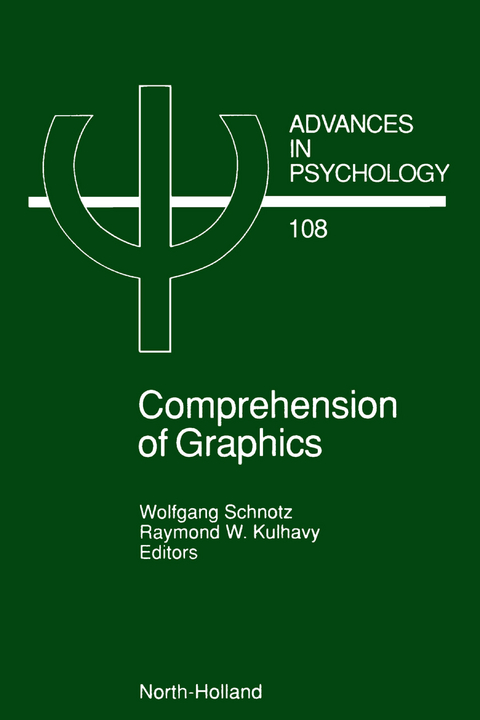
Comprehension of Graphics (eBook)
344 Seiten
Elsevier Science (Verlag)
978-0-08-086762-5 (ISBN)
The comprehension of graphics is not only a stimulating topic in the fields of science and instructional psychology, but also in related disciplines such as semiotics, and artificial intelligence. Research on the comprehension of graphics complements the scientific investigation of cognitive processes in text comprehension, which has contributed much to our understanding of human cognition and learning. Ultimately, a better understanding of the cognitive processes involved in the comprehension of graphics will have an impact not only on cognitive theory, but also on educational practice.
Graphic displays such as charts, graphs, diagrams, and maps play in important role today in the design and presentation of instructional materials education. There is also a strong need in scientific, technical and administrative fields to visually present facts, laws, principles etc. The increasing use of computer-based learning environments has also become an important field where the visual presentation of information plays a central role. Despite the importance of graphical displays as a means of communication and the fact that research about learning and cognition has advanced rapidly in the past two decades, the comprehension of graphics is still a rather unexplored area.The comprehension of graphics is not only a stimulating topic in the fields of science and instructional psychology, but also in related disciplines such as semiotics, and artificial intelligence. Research on the comprehension of graphics complements the scientific investigation of cognitive processes in text comprehension, which has contributed much to our understanding of human cognition and learning. Ultimately, a better understanding of the cognitive processes involved in the comprehension of graphics will have an impact not only on cognitive theory, but also on educational practice.
Front Cover 1
Comprehension of Graphics 4
Copyright Page 5
Content 24
Preface 8
Acknowledgements 18
List of Contributors 20
Part I Graphical Codes and Graphics Processing 28
Chapter 1 Contributions of Perceptual and Cognitive Processes to the Comprehension of Graphics 30
Chapter 2 Codes of Instructional Pictures 56
Chapter 3 Spatial Metaphors and Logical Pictures 70
Chapter 4 Comprehending and Using Maps: Are there Two Modes of Map Processing? 90
Chapter 5 Identifying and Simulating Cognitive Strategies for the Description of Spatial Networks 104
Part II Graphics and Mental Representations 122
Chapter 6 Representation and Processing of the Spatial Layout of Objects with Verbal and Nonverbal Input 124
Chapter 7 Size in Picture and Text 140
Chapter 8 Visual Aids to Knowledge Construction: Building Mental Representations from Pictures and Words 152
Chapter 9 Illustrations, Mental Models, and Comprehension of Instructional Text 166
Chapter 10 Reference Maps as a Framework for Remembering Text 180
Part III Differential and Developmental Aspects 190
Chapter 11 The Mnemonic Benefit of Pictures in Text: Selective Enrichment for Differentially Skilled Readers 192
Chapter 12 The Use of Graphics and Texts in Constructing Mental Models 212
Chapter 13 Cognitive Processes in Understanding Line Graphs 234
Chapter 14 On Children's Understanding of an Economic Concept: The Role of Graphics in Evaluation 254
Chapter 15 Visualized Analogies and Memory for New Information in First Graders 278
Part IV Instructional Aspects 296
Chapter 16 The Supplantation of Mental Images through Graphics: Instructional Effects on Spatial Visualization Skills of Adults 298
Chapter 17 Enhancing Graphic-Effects in Instructional Texts: Influencing Learning Activities 318
Chapter 18 Systematic Forced Processing of Text and Graphic Information 330
Concluding Remarks 348
Author Index 354
Subject Index 368
| Erscheint lt. Verlag | 1.8.1994 |
|---|---|
| Sprache | englisch |
| Themenwelt | Schulbuch / Wörterbuch ► Unterrichtsvorbereitung ► Unterrichts-Handreichungen |
| Geisteswissenschaften ► Psychologie ► Allgemeine Psychologie | |
| Geisteswissenschaften ► Psychologie ► Entwicklungspsychologie | |
| Geisteswissenschaften ► Psychologie ► Verhaltenstherapie | |
| Geisteswissenschaften ► Sprach- / Literaturwissenschaft ► Sprachwissenschaft | |
| Mathematik / Informatik ► Informatik ► Software Entwicklung | |
| Informatik ► Theorie / Studium ► Künstliche Intelligenz / Robotik | |
| Sozialwissenschaften ► Pädagogik | |
| ISBN-10 | 0-08-086762-6 / 0080867626 |
| ISBN-13 | 978-0-08-086762-5 / 9780080867625 |
| Informationen gemäß Produktsicherheitsverordnung (GPSR) | |
| Haben Sie eine Frage zum Produkt? |
 PDF (Adobe DRM)
Kopierschutz: Adobe-DRM
Adobe-DRM ist ein Kopierschutz, der das eBook vor Mißbrauch schützen soll. Dabei wird das eBook bereits beim Download auf Ihre persönliche Adobe-ID autorisiert. Lesen können Sie das eBook dann nur auf den Geräten, welche ebenfalls auf Ihre Adobe-ID registriert sind.
Details zum Adobe-DRM
Dateiformat: PDF (Portable Document Format)
Mit einem festen Seitenlayout eignet sich die PDF besonders für Fachbücher mit Spalten, Tabellen und Abbildungen. Eine PDF kann auf fast allen Geräten angezeigt werden, ist aber für kleine Displays (Smartphone, eReader) nur eingeschränkt geeignet.
Systemvoraussetzungen:
PC/Mac: Mit einem PC oder Mac können Sie dieses eBook lesen. Sie benötigen eine
eReader: Dieses eBook kann mit (fast) allen eBook-Readern gelesen werden. Mit dem amazon-Kindle ist es aber nicht kompatibel.
Smartphone/Tablet: Egal ob Apple oder Android, dieses eBook können Sie lesen. Sie benötigen eine
Geräteliste und zusätzliche Hinweise
Buying eBooks from abroad
For tax law reasons we can sell eBooks just within Germany and Switzerland. Regrettably we cannot fulfill eBook-orders from other countries.
aus dem Bereich