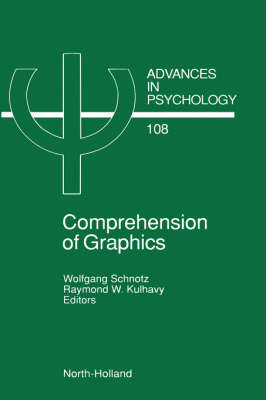
Comprehension of Graphics
North-Holland (Verlag)
978-0-444-81792-1 (ISBN)
- Titel ist leider vergriffen;
keine Neuauflage - Artikel merken
Graphic displays such as charts, graphs, diagrams, and maps play in important role today in the design and presentation of instructional materials education. There is also a strong need in scientific, technical and administrative fields to visually present facts, laws, principles etc. The increasing use of computer-based learning environments has also become an important field where the visual presentation of information plays a central role. Despite the importance of graphical displays as a means of communication and the fact that research about learning and cognition has advanced rapidly in the past two decades, the comprehension of graphics is still a rather unexplored area.The comprehension of graphics is not only a stimulating topic in the fields of science and instructional psychology, but also in related disciplines such as semiotics, and artificial intelligence. Research on the comprehension of graphics complements the scientific investigation of cognitive processes in text comprehension, which has contributed much to our understanding of human cognition and learning. Ultimately, a better understanding of the cognitive processes involved in the comprehension of graphics will have an impact not only on cognitive theory, but also on educational practice.
Part I. Graphical Codes and Graphics Processing. 1. Contributions of perceptual and cognitive processes to the comprehension of graphics (W. Winn). 2. Codes of instructional pictures (B. Wiedemann). 3. Spatial metaphors and logical pictures (A. Fenk). 4. Comprehending and using maps: Are there two modes of map processing? (J.R. Kirby). 5. Identifying and simulating cognitive strategies for the description of spatial networks (M. Denis, F. Robin, M. Zock, A. Laroui). Part II. Graphics and Mental Representations. 6. Representation and processing of the spatial layout of objects with verbal and nonverbal input (H.D. Zimmer). 7. Size in picture and text (J. Engelkamp, G. Mohr). 8. Visual aids to knowledge construction: Building mental representations from pictures and words (R.E. Mayer). 9. Illustrations, mental models, and comprehension of instructional text (Y. Gyselinck, H. Tardieu). 10. Reference maps as a framework for remembering text (R.W. Kulhavy, W.A. Stock, L.C. Caterino). Part III. Differential and Developmental Aspects. 11. The mnemonic benefit of pictures in text: Selective enrichment for differentially skilled readers (M.A. McDaniel, P.J. Waddill). 12. The use graphics and texts in constructing mental models (W. Schnotz, E. Picard, M. Henninger). 13. Cognitive processes in understanding line graphs (U. Maichle). 14. On children's understanding of an economic concept: The role of graphics in evaluation (C. Grobbo). 15. Visualized analogies and memory for new information in first graders (M.-D. Gineste). Part IV. Instructional Aspects. 16. The supplantation of mental images through graphics: Instructional effects on spatial visualization skills of adults (N.M. Seel, G. Dörr). 17. Enhancing graphic-effects in instructional texts: Influencing learning activities (J. Peeck). 18. Systematic forced processing of text and graphic information (P.J. Moore, J.J. Scevak). Concluding remarks. Author index. Subject index.
| Erscheint lt. Verlag | 1.8.1994 |
|---|---|
| Reihe/Serie | Advances in Psychology |
| Sprache | englisch |
| Gewicht | 10 g |
| Themenwelt | Geisteswissenschaften ► Psychologie ► Allgemeine Psychologie |
| Geisteswissenschaften ► Psychologie ► Verhaltenstherapie | |
| Informatik ► Theorie / Studium ► Künstliche Intelligenz / Robotik | |
| ISBN-10 | 0-444-81792-1 / 0444817921 |
| ISBN-13 | 978-0-444-81792-1 / 9780444817921 |
| Zustand | Neuware |
| Informationen gemäß Produktsicherheitsverordnung (GPSR) | |
| Haben Sie eine Frage zum Produkt? |
aus dem Bereich