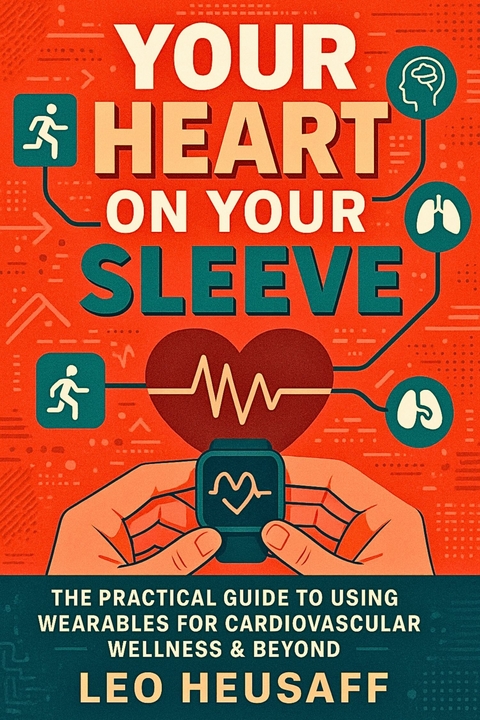
Your Heart on Your Sleeve (eBook)
122 Seiten
JNR Publishing (Verlag)
978-0-00-113138-5 (ISBN)
Wear Your Heart Health Journey with Confidence!
That device on your wrist is collecting a wealth of information about your body's most vital organ, 24/7. But are you leveraging that data to truly enhance your cardiovascular wellness and overall health? Authored by Leo Heusaff, Your Heart on Your Sleeve is the practical, easy-to-understand guide designed to empower you to do just that.
Move beyond simply tracking steps or checking notifications. This book translates the complex world of wearable technology – from PPG heart rate monitoring and smartwatch ECG analysis to HRV stress tracking and sleep stage detection – into actionable knowledge. Learn not just what your device measures, but why it matters and how you can use these insights proactively to improve fitness, reduce stress, sleep better, monitor heart rate variability, and engage more effectively with your healthcare providers regarding your cardiovascular health.
This essential guide empowers you to:
* Understand the Tech Easily: Get clear explanations of how optical sensors (PPG for heart rate), electrical sensors (ECG for rhythm), accelerometers (for activity tracking), and other key technologies work in your smartwatch or fitness tracker.
* Master Your Health Metrics: Confidently interpret your Resting Heart Rate (RHR), Heart Rate Variability (HRV), workout zones, SpO2 levels, sleep data, and ECG classifications (Normal Sinus Rhythm vs. potential AFib flags).
* Improve Key Health Pillars: Apply data-driven strategies to enhance cardiovascular fitness, achieve more restorative sleep, build resilience to stress using HRV biofeedback, and boost overall energy levels.
* Recognize Limitations & Avoid Anxiety: Understand what your wearable can't do (it's not a diagnostic medical device!) and manage data effectively without unnecessary worry.
* Collaborate with Your Doctor: Learn the best ways to prepare for appointments and share relevant trends and specific readings (like ECG reports or heart rate logs) to enhance your medical care and heart health management.
2
Chapter 1: Heart Health Essentials
Before we dive into the fascinating world of wearable technology, we need to establish a foundation of cardiovascular knowledge. Think of this chapter as your heart’s owner’s manual – the essential information you need to understand what your wearable is actually measuring and why it matters.
Don’t worry, we’re not about to turn this into medical school. Instead, we’ll focus on the practical knowledge that directly relates to what you’ll see on your wrist and in your apps. By the end of this chapter, you’ll understand the key players in your cardiovascular system and why the metrics your wearable tracks are so important for your health.
Your Heart: The Ultimate Multitasker
Your heart is essentially a four-chambered muscular pump that works non-stop for your entire life. To put this in perspective, your heart beats approximately 100,000 times per day, pumping about 2,000 gallons of blood through roughly 60,000 miles of blood vessels. It’s like having a tireless marathon runner living in your chest, except this runner never gets to rest, never calls in sick, and never asks for a vacation.
The heart has four chambers working in perfect coordination. The two upper chambers, called atria, receive blood returning from your body and lungs. Think of them as the heart’s receiving departments. The two lower chambers, called ventricles, are the powerhouses that pump blood out to your lungs and the rest of your body. The right side handles blood going to and from the lungs for oxygen pickup, while the left side manages the high-pressure job of pumping oxygenated blood to every other part of your body.
What makes this system truly remarkable is its electrical control system. Your heart has its own built-in pacemaker called the sinoatrial (SA) node, located in the upper right chamber. This natural pacemaker generates electrical impulses that spread through the heart muscle in a precisely timed sequence, causing the chambers to contract in the perfect rhythm needed for efficient pumping.
This electrical system is what your wearable’s ECG feature is listening to when it captures your heart rhythm. When everything works perfectly, you get what doctors call normal sinus rhythm – a regular, coordinated heartbeat that efficiently moves blood throughout your body. When something disrupts this electrical system, you might experience irregular rhythms that your wearable can sometimes detect.
The Numbers That Matter
Now let’s talk about the key metrics your wearable tracks and why they’re windows into your cardiovascular health.
Heart Rate: More Than Just Counting Beats
Heart rate seems simple – it’s just how fast your heart beats, measured in beats per minute (BPM). But this simple number tells a surprisingly complex story about your health, fitness, and current state.
Your resting heart rate (RHR) is perhaps the most important number your wearable tracks. This is your heart rate when you’re completely relaxed, typically measured first thing in the morning or during deep sleep. Think of RHR as your heart’s idling speed – how fast it needs to run to keep your body functioning when you’re not asking it to do any extra work.
A lower resting heart rate generally indicates better cardiovascular fitness. When your heart is stronger and more efficient, it doesn’t need to beat as frequently to pump the same amount of blood. Elite athletes often have resting heart rates in the 40s or even 30s, while the average sedentary adult sits somewhere between 60 and 100 BPM. Your specific number depends on factors like genetics, fitness level, age, medications, stress levels, and overall health.
What makes RHR particularly valuable is how it changes over time. When you start exercising regularly, you’ll typically see your RHR gradually decrease as your cardiovascular fitness improves. Conversely, increases in your RHR might signal overtraining, illness, stress, dehydration, or other factors affecting your body. This makes RHR one of the most practical metrics for tracking your cardiovascular health progress and catching potential issues early.
During exercise, your heart rate response tells another important story. How quickly your heart rate rises to meet demand, how high it goes during intense effort, and especially how quickly it recovers afterward all provide insights into your cardiovascular fitness and health.
Heart Rate Variability: The Hidden Health Metric
Here’s where things get really interesting. You might assume that a healthy heart beats like a metronome – perfectly regular, like a drum machine keeping steady time. Actually, the opposite is true. A healthy heart displays subtle variations in the timing between beats, and these variations provide incredible insights into your overall health and readiness.
Heart Rate Variability (HRV) measures these tiny fluctuations in the time between heartbeats. Even when your average heart rate is 60 BPM, the actual intervals between beats might vary from 950 milliseconds to 1,050 milliseconds. This variation is controlled by your autonomic nervous system – the automatic control system that manages functions like heart rate, breathing, and digestion without conscious thought.
Your autonomic nervous system has two main branches that work like a cardiovascular seesaw. The sympathetic branch is your “fight or flight” system, speeding up your heart and preparing your body for action or stress. The parasympathetic branch is your “rest and digest” system, slowing your heart and promoting recovery and restoration. Higher HRV generally indicates better balance between these systems and greater adaptability to stress.
Think of HRV as a measure of your body’s resilience and recovery capacity. When you’re well-rested, unstressed, and healthy, your HRV tends to be higher. When you’re overtrained, stressed, ill, or fatigued, your HRV typically decreases. This makes HRV incredibly valuable for making decisions about training intensity, recognizing early signs of illness, and understanding how lifestyle factors like sleep and stress affect your physiology.
Blood Pressure: The Force Behind the Flow
Blood pressure represents the force your circulating blood exerts against your artery walls. It’s measured as two numbers: systolic pressure (the top number) represents the pressure when your heart contracts and pushes blood out, while diastolic pressure (the bottom number) represents the pressure when your heart relaxes between beats.
Normal blood pressure is generally considered to be around 120/80 mmHg or lower. High blood pressure (hypertension) is often called the “silent killer” because it usually has no symptoms but significantly increases your risk of heart attack, stroke, kidney disease, and other serious health problems. The higher your blood pressure, the harder your heart has to work and the more stress is placed on your arteries.
While most current wearables don’t measure blood pressure accurately (though this is an active area of development), understanding blood pressure is crucial because the lifestyle factors that improve blood pressure – regular exercise, stress management, good sleep, healthy diet – are exactly the behaviors that wearables can help you track and improve.
Rhythm and Electrical Activity
Your heart’s electrical system creates the rhythm that drives each heartbeat. When this system works perfectly, you get normal sinus rhythm – regular, coordinated beats that efficiently pump blood. When something disrupts this electrical system, you get arrhythmias – irregular heart rhythms that can range from harmless to life-threatening.
The most common arrhythmia that wearables can detect is atrial fibrillation (AFib), where the upper chambers of the heart quiver chaotically instead of beating effectively. AFib significantly increases stroke risk because blood can pool and clot in the quivering chambers. This is why the ECG features on many wearables focus specifically on detecting potential signs of AFib.
It’s crucial to understand that wearable ECG features are screening tools, not diagnostic devices. They can identify patterns that might warrant further medical evaluation, but they cannot replace proper medical diagnosis or provide comprehensive rhythm analysis. Think of your wearable’s ECG as a smoke detector – useful for alerting you to potential issues, but you still need the fire department (your doctor) to assess and handle any actual problems.
The Cardiovascular Risk Factors You Can Influence
Understanding the major risk factors for cardiovascular disease helps explain why the data your wearable collects is so valuable. While you can’t change factors like age, gender, or genetics, you have significant control over the lifestyle factors that profoundly impact your heart health.
Physical inactivity is one of the most important modifiable risk factors. Regular aerobic exercise strengthens your heart muscle, improves your RHR, enhances HRV, helps control blood pressure, and provides countless other cardiovascular benefits. Your wearable’s activity tracking features directly address this risk factor by helping you monitor and increase your daily movement and exercise intensity.
Poor sleep quality and insufficient sleep duration increase cardiovascular risk through multiple mechanisms. Sleep deprivation raises stress...
| Erscheint lt. Verlag | 1.1.2026 |
|---|---|
| Sprache | englisch |
| Themenwelt | Sachbuch/Ratgeber ► Gesundheit / Leben / Psychologie ► Esoterik / Spiritualität |
| ISBN-10 | 0-00-113138-9 / 0001131389 |
| ISBN-13 | 978-0-00-113138-5 / 9780001131385 |
| Informationen gemäß Produktsicherheitsverordnung (GPSR) | |
| Haben Sie eine Frage zum Produkt? |
 EPUB (Adobe DRM)
Größe: 2,3 MB
Kopierschutz: Adobe-DRM
Adobe-DRM ist ein Kopierschutz, der das eBook vor Mißbrauch schützen soll. Dabei wird das eBook bereits beim Download auf Ihre persönliche Adobe-ID autorisiert. Lesen können Sie das eBook dann nur auf den Geräten, welche ebenfalls auf Ihre Adobe-ID registriert sind.
Details zum Adobe-DRM
Dateiformat: EPUB (Electronic Publication)
EPUB ist ein offener Standard für eBooks und eignet sich besonders zur Darstellung von Belletristik und Sachbüchern. Der Fließtext wird dynamisch an die Display- und Schriftgröße angepasst. Auch für mobile Lesegeräte ist EPUB daher gut geeignet.
Systemvoraussetzungen:
PC/Mac: Mit einem PC oder Mac können Sie dieses eBook lesen. Sie benötigen eine
eReader: Dieses eBook kann mit (fast) allen eBook-Readern gelesen werden. Mit dem amazon-Kindle ist es aber nicht kompatibel.
Smartphone/Tablet: Egal ob Apple oder Android, dieses eBook können Sie lesen. Sie benötigen eine
Geräteliste und zusätzliche Hinweise
Buying eBooks from abroad
For tax law reasons we can sell eBooks just within Germany and Switzerland. Regrettably we cannot fulfill eBook-orders from other countries.
aus dem Bereich