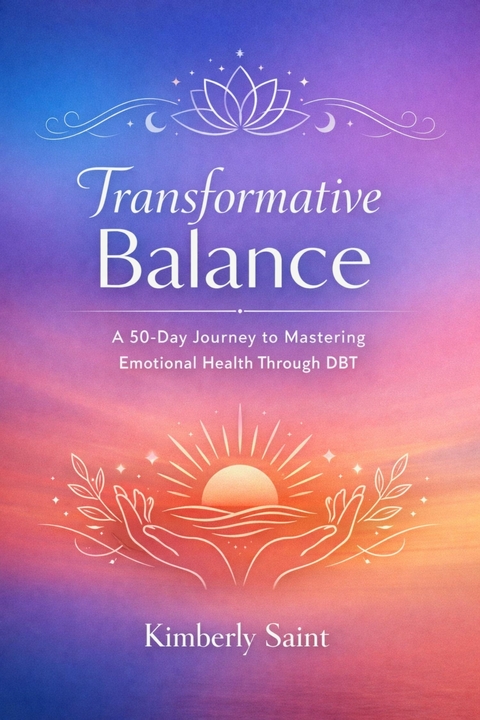
Transformative Balance (eBook)
147 Seiten
JNR Publishing (Verlag)
978-0-00-113137-8 (ISBN)
Transform your emotional life in just 50 days with Transformative Balance
A revolutionary DBT journey designed by Kimberly Saint. This intensive guide provides you with proven, evidence-based strategies to build mindfulness, develop distress tolerance, and master emotional regulation.
* Follow a clear, daily roadmap that guides you through practical DBT skills.
* Experience transformative exercises that harness neuroplasticity for lasting change.
* Learn how to reduce self-destructive behaviors and build healthier relationships.
* Equip yourself with skills to overcome stress, anxiety, and impulsiveness.
* Enjoy engaging journaling prompts that enhance self-reflection and mindful practice.
Ready to take control?Grab your copy now and begin your journey to a calmer, more balanced life!
More Inside:
Within these pages, you’ll discover dynamic chapters covering essential DBT skills—from observing and describing your emotions to the practical use of TIP, STOP, and acceptance techniques. Sample chapters include “Laying the Foundations of DBT,” “Cultivating Mindfulness in Daily Life,” and “Overcoming Crisis with Distress Tolerance.” Each chapter is packed with actionable steps, reflective exercises, and real-life success strategies, ensuring you not only learn but also apply each skill effectively.
Transformative Balance equips you with the tools to face emotional challenges head on—empowering you to build a life that feels truly worth living.
1
Introduction
The Transformative Power of Dialectical Behavior Therapy
When Marsha Linehan first developed Dialectical Behavior Therapy (DBT) in the late 1980s, she could hardly have imagined how profoundly it would transform the landscape of mental health treatment. What began as a specific approach to helping individuals with borderline personality disorder and chronic suicidality has evolved into one of the most extensively researched and widely applied therapeutic modalities in contemporary psychology.
At its core, DBT offers something revolutionary: a path forward when other approaches have failed. For those struggling with emotional dysregulation, impulsivity, relationship difficulties, and self-destructive behaviors, DBT provides not just hope but concrete, practical tools for building a life worth living.
This book—designed as an intensive 50-day journey through the essential skills of DBT—represents both the culmination of decades of clinical refinement and the beginning of your personal transformation. Whether you’re working alongside a therapist, participating in a DBT skills group, or using this guide as a structured supplement to your existing treatment, these pages offer a roadmap to developing the capabilities that can fundamentally change how you experience your emotions, navigate relationships, and move through the world.
The DBT Difference: Why This Approach Works
“But I’ve tried everything,” you might be thinking. “How is this any different?”
The difference lies in DBT’s unique balance of seemingly opposing forces. Unlike approaches that focus solely on acceptance or exclusively on change, DBT embraces the fundamental dialectic that gives it its name: you can fully accept yourself exactly as you are right now and work toward becoming the person you want to be.
This synthesis of acceptance and change creates a therapeutic environment where judgment falls away and skill-building takes center stage. DBT isn’t about fixing what’s “wrong” with you—it’s about adding tools to your emotional and interpersonal toolkit.
Research consistently demonstrates DBT’s effectiveness across various populations and presenting problems. Studies show significant improvements in:
- Reducing self-harm and suicidal behaviors
- Decreasing hospitalization rates
- Improving emotion regulation capabilities
- Enhancing interpersonal functioning
- Building distress tolerance skills
- Developing mindfulness practices
- Creating lives that feel meaningful and worthwhile
But statistics alone can’t capture the lived experience of mastering DBT skills. Former clients often describe the process as “finally learning the emotional skills everyone else seemed to be born knowing” or “gaining a new language for understanding myself and others.” One individual described their DBT journey as “like getting glasses after a lifetime of blurry vision—suddenly everything came into focus.”
The 50-Day Intensive Approach: Why Daily Practice Matters
You might wonder why this book takes a 50-day intensive approach rather than presenting skills in a more general format. The answer lies in how our brains form new habits and neural pathways.
Neuroplasticity—our brain’s ability to reorganize itself by forming new neural connections—requires consistent practice and application. When we engage in deliberate, focused skill practice on a daily basis, we accelerate this process of neural reorganization. What once felt awkward and foreign gradually becomes second nature.
Fifty days provides the optimal window for this transformation. It’s long enough to allow for meaningful change but contained enough to create a sense of momentum and accomplishment. The structure of daily skill practice serves several important functions:
- Overcoming inertia: Daily practice bypasses the “I’ll do it tomorrow” trap that often derails self-improvement efforts.
- Building competence through consistency: Small daily efforts compound over time, creating a foundation of genuine skill mastery.
- Creating embodied knowledge: Regular practice transitions skills from intellectual understanding to embodied knowing—from “I understand this concept” to “This response is now natural for me.”
- Establishing measurement points: Daily practice provides concrete evidence of progress and helps identify specific areas that need additional attention.
- Cultivating self-efficacy: Each day of successful practice builds confidence in your ability to manage challenges effectively.
This 50-day structure isn’t arbitrary—it’s strategically designed to move you through the complete skill set in a way that builds competence while maintaining momentum. Each section introduces skills in a sequence that allows earlier practices to support later ones, creating an integrated approach to emotional and interpersonal functioning.
How to Use This Book Effectively
To gain maximum benefit from this intensive practice guide, consider the following recommendations:
Commit fully to the process. While it may be tempting to skip ahead or practice only the skills that immediately appeal to you, the 50-day structure is intentional. Each skill builds upon previous ones, creating a comprehensive approach to emotional well-being.
Create a dedicated practice environment. Designate a specific time and space for your daily practice. This might be a quiet corner of your home, a peaceful outdoor setting, or any environment where you can focus without excessive distraction.
Use the companion journal. Throughout this book, you’ll find journaling prompts designed to deepen your understanding and application of each skill. Whether you use a physical notebook or digital document, consistent recording of your experiences provides valuable insight into your progress.
Practice self-compassion. There will be days when practice feels difficult or when you struggle to implement a particular skill. This is not only normal but expected. Treat these moments not as failures but as valuable information about where you might need additional support or practice.
Involve support people when appropriate. While many DBT skills can be practiced independently, some interpersonal skills benefit from practice with others. Consider identifying trusted individuals who might participate in role-plays or provide feedback on your skill application.
Connect with professional support. This book is designed as a companion to professional therapy, not a replacement for it. If you’re currently working with a therapist, consider sharing this book and discussing how to integrate the daily practices into your treatment plan.
Track your progress. At the beginning and end of each 10-day section, you’ll find assessment measures to help you gauge your progress. These aren’t tests to pass or fail but tools to help you recognize growth and identify areas for continued practice.
Who This Book Is For
While DBT was originally developed for individuals with borderline personality disorder, its applications have expanded significantly. This book may be particularly helpful for:
- Individuals experiencing emotional intensity or instability
- Those struggling with impulsive behaviors
- People navigating challenging relationship patterns
- Anyone seeking greater mindful awareness in daily life
- Individuals looking to enhance their distress tolerance capabilities
- Those working to reduce self-destructive behaviors
- People seeking to build a more fulfilling, value-driven life
It’s worth noting what this book is not: It is not a substitute for comprehensive DBT treatment, which typically includes individual therapy, skills training group, phone coaching, and a therapist consultation team. Rather, this guide offers a structured approach to skill practice that can enhance formal treatment or provide valuable tools for those who have completed treatment and wish to strengthen their skills.
The Road Ahead: What to Expect
As you embark on this 50-day journey, you’re likely to experience both challenges and breakthroughs. The path isn’t always linear—you may find certain skills come naturally while others require persistent effort. This variation is normal and expected.
In the early days, you might notice increased awareness of emotions and patterns that were previously automatic. This heightened awareness can sometimes feel uncomfortable, as though things are getting worse rather than better. In reality, this awareness represents an important first step—you can’t change patterns you don’t recognize.
As you progress through the middle sections, you’ll likely notice subtle shifts in how you respond to triggering situations....
| Erscheint lt. Verlag | 1.1.2026 |
|---|---|
| Sprache | englisch |
| Themenwelt | Sachbuch/Ratgeber ► Gesundheit / Leben / Psychologie ► Esoterik / Spiritualität |
| ISBN-10 | 0-00-113137-0 / 0001131370 |
| ISBN-13 | 978-0-00-113137-8 / 9780001131378 |
| Informationen gemäß Produktsicherheitsverordnung (GPSR) | |
| Haben Sie eine Frage zum Produkt? |
 EPUB (Adobe DRM)
Größe: 1,9 MB
Kopierschutz: Adobe-DRM
Adobe-DRM ist ein Kopierschutz, der das eBook vor Mißbrauch schützen soll. Dabei wird das eBook bereits beim Download auf Ihre persönliche Adobe-ID autorisiert. Lesen können Sie das eBook dann nur auf den Geräten, welche ebenfalls auf Ihre Adobe-ID registriert sind.
Details zum Adobe-DRM
Dateiformat: EPUB (Electronic Publication)
EPUB ist ein offener Standard für eBooks und eignet sich besonders zur Darstellung von Belletristik und Sachbüchern. Der Fließtext wird dynamisch an die Display- und Schriftgröße angepasst. Auch für mobile Lesegeräte ist EPUB daher gut geeignet.
Systemvoraussetzungen:
PC/Mac: Mit einem PC oder Mac können Sie dieses eBook lesen. Sie benötigen eine
eReader: Dieses eBook kann mit (fast) allen eBook-Readern gelesen werden. Mit dem amazon-Kindle ist es aber nicht kompatibel.
Smartphone/Tablet: Egal ob Apple oder Android, dieses eBook können Sie lesen. Sie benötigen eine
Geräteliste und zusätzliche Hinweise
Buying eBooks from abroad
For tax law reasons we can sell eBooks just within Germany and Switzerland. Regrettably we cannot fulfill eBook-orders from other countries.
aus dem Bereich