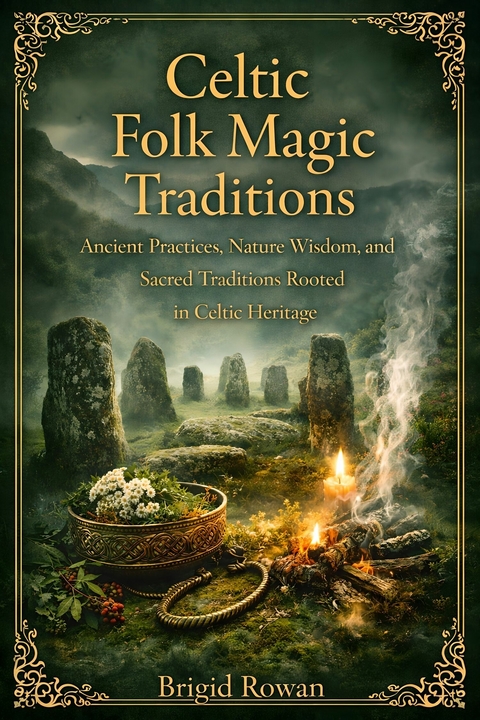
Celtic Folk Magic Traditions (eBook)
142 Seiten
Publishdrive (Verlag)
978-1-970565-53-9 (ISBN)
Long before written spells or modern spirituality, Celtic folk magic lived in the land itself-in forests and fields, sacred wells and standing stones, and the turning of the seasons.
Celtic Folk Magic Traditions invites you into this ancient world, where spiritual life was shaped by nature, myth, and the quiet wisdom of the earth.
Drawing from Irish, Scottish, Welsh, and Breton traditions, this book explores how Celtic communities understood protection, balance, and sacred connection through nature-based practices and seasonal observances. These traditions honored sacred landscapes, symbolic plants, fire and water, and the rhythms of the natural world as expressions of spiritual awareness.
Rather than presenting modern spellwork or rigid systems, this book offers cultural and historical context-revealing how folklore, symbolism, and ancestral practice shaped everyday life and spiritual identity across Celtic lands.
If you feel drawn to old-world wisdom, sacred landscapes, and traditions rooted in land and season, this book offers a meaningful way to explore Celtic heritage. It provides depth without sensationalism, reverence without dogma, and knowledge without exaggerated claims.
Through a calm, reflective lens, Celtic Folk Magic Traditions helps you understand how reverence for nature, seasonal rhythm, and sacred space once guided Celtic spiritual life-quietly, intentionally, and deeply.
Step into the ancient world of Celtic folk traditions and discover the wisdom preserved through land, myth, and memory.
Celtic Folk Magic Traditions is an invitation to learn, reflect, and reconnect with the sacred practices that shaped Celtic life for generations.
Long before written spells or modern spirituality, Celtic folk magic lived in the land itself-in forests and fields, sacred wells and standing stones, and the turning of the seasons.Celtic Folk Magic Traditions invites you into this ancient world, where spiritual life was shaped by nature, myth, and the quiet wisdom of the earth.Drawing from Irish, Scottish, Welsh, and Breton traditions, this book explores how Celtic communities understood protection, balance, and sacred connection through nature-based practices and seasonal observances. These traditions honored sacred landscapes, symbolic plants, fire and water, and the rhythms of the natural world as expressions of spiritual awareness.Rather than presenting modern spellwork or rigid systems, this book offers cultural and historical context revealing how folklore, symbolism, and ancestral practice shaped everyday life and spiritual identity across Celtic lands.If you feel drawn to old-world wisdom, sacred landscapes, and traditions rooted in land and season, this book offers a meaningful way to explore Celtic heritage. It provides depth without sensationalism, reverence without dogma, and knowledge without exaggerated claims.Through a calm, reflective lens, Celtic Folk Magic Traditions helps you understand how reverence for nature, seasonal rhythm, and sacred space once guided Celtic spiritual life quietly, intentionally, and deeply.Step into the ancient world of Celtic folk traditions and discover the wisdom preserved through land, myth, and memory.Celtic Folk Magic Traditions is an invitation to learn, reflect, and reconnect with the sacred practices that shaped Celtic life for generations.
Chapter 1: A Living Thread: What Makes Celtic Folk Magic Folk
Imagine two neighbors each putting a small amount aside every week. One puts it all into a single, well-known savings account while the other spreads their money across several different options—some safe, some a bit uncertain. As months pass, their total savings grow in very different ways, shaped by choices that respond to daily life needs and risks. This example isn’t about finance but about how simple actions, made consistently over time and shaped by local knowledge and experience, weave into something bigger and lasting.
Just like these investment strategies affect financial outcomes, so too do the everyday acts and beliefs in Celtic folk magic influence its ongoing life and meaning. In this chapter, we'll explore how the ordinary, practical gestures rooted in community and tradition form a living thread, holding the past and present together. We'll look at what truly makes these practices 'folk' by considering how shared experience, place, and relationship shape the way Celtic magic is done and passed on—not through grand ceremonies but through humble acts woven into daily rhythms.
Everyday Enchantment Defined
Magic rarely looks like it does in stories, with waving wands and grand proclamations. In Celtic folk traditions, magic slips quietly into the corners of ordinary life. A pinch of salt at the door, water sprinkled over a sleeping child, a whispered thanks to a tree—these are acts shaped by daily needs, not by spectacle. Magic dwells in what is useful, familiar, and close at hand.
Many readers come to this subject wondering how everyday enchantment passes from one generation to the next. We'll explore how these stories traveled in the next section, but first, let’s settle in with what makes an act or belief truly "folk." Folk practice means knowledge held by people together—woven through households, neighborhoods, and work. Its authority does not depend on formal titles or sacred texts. Instead, trust grows as neighbors recall what their elders did before them: "my grandmother always…" or "that’s how we do it here." The acts themselves are shaped by local need and memory. Someone may sprinkle salt across the threshold to shield against ill luck, while a temple ceremony might use incense consecrated through careful ritual. Both intend blessing, but only one roots itself in the kitchen, at dawn, beside a burning fire. Folk magic happens within the rhythm of tending cattle, turning bread, cleaning floors. Gesture joins with task, so prayer becomes part of sweeping, spinning, baking, or sowing.
Formal religions often set apart their rituals—special days, sacred places, trained leaders. Folk religion, by contrast, lives in the spaces in between: liminal times like sunrise and threshold places like doors or crossroads. Its wisdom answers the questions that press closest. Redfield explained this difference as a meeting of two currents—a great tradition handed down in books and led by scholars, and a little tradition carried by villagers who learned by watching and doing (Burnett, 2000). These bands are never fully separate. Even when world religions introduce new prayers or objects, everyday folkways adapt those tools for their own purposes. Sacred texts might join old customs, reimagined for local use. When misfortune comes, some blame fate or past actions, following the higher tradition, but many turn to views shaped by folk beliefs—perhaps suspecting a jealous neighbor or a wandering spirit instead (Burnett, 2000).
Relationship sits at the heart of folk magic. Reciprocity—the mutual care and respect given in return for gifts—is its ethical core. Offerings at wells, a word to the land, or food left for unseen guests all acknowledge relationship rather than demand payment. Power comes from right relationship, not control. Just as you thank a neighbor for help, you might nod to the apple tree that shades your home. Nature becomes participant; the wind, rain, stones, and streams respond to words and gestures, bearing witness or carrying wishes. Later chapters will show these relationships in action at wells and hearths; for now, notice the principle: enchantment grows in courtesy and attention, not secrecy and domination.
Celtic folkways bear the mark of place. Geography breathes form into custom. A coastal household might sweep sand out the back door on a waxing tide for luck. Upland villages work wool charms, read clouds for omens, or use stone beside the hearth for protection. To bless a child, one parish ties red thread, another sets iron by the cradle, another hangs hawthorn above the lintel. No universal handbook exists; transmission relies on memory, voice, and close observation. What holds true in one valley can be unknown just over the ridge. This diversity gives the tradition its flavor and strength. Oral pathways—how these songs, gestures, and recipes move from hand to hand—are the focus of the next section.
Folk practices rarely stand still. Thresholds, first fruits, sunwise circles—these patterns endure even as ingredients change. When iron nails become scarce, a steel pin steps in, yet the protective intention lives on. Social pressures shift customs too. New laws, church teachings, or economic changes reshape where and when old acts continue. Still, communities narrate each adjustment: "we do it this way now because…" The story carries the thread, keeping continuity alive amid change. Later chapters will offer both the historical context for these shifts and guidance for adapting practices today with care and respect.
For readers concerned about making mistakes or overstepping, consider this: folk magic asks relationship, awareness, and humility—not perfection. To honor living tradition is not to copy but to listen, to take part with gratitude. Recognizing the force of local habit, memory, and relationship is the ground upon which respectful engagement stands.
Lineages of Story and Practice
Everyday enchantment thrives in what people do at home, on the land, and among their neighbors—worn stories, handed-down gestures, and crafts repeated by many hands. Understanding what makes practices folk raises an immediate question: how did these everyday customs persist and travel across generations without priests, books, or formal schools? The answer begins with the living web of oral transmission, family ties, and connection to place, all working together to anchor Celtic folk magic as something shared, remembered, and remade in daily life.
Oral traditions form the backbone of communal memory. In times and places where few could read, stories, proverbs, riddles, and songs carried practical wisdom alongside entertainment. For example, a tale about greeting a hollow might encode how to safely approach unfamiliar landforms, while a proverb like "Never turn your back at a meeting of roads" preserves both social etiquette and navigation smarts. These oral forms were crafted to stick—they use rhythm, rhyme, repetition, and sometimes a twist or lesson that makes them easy to recall even in stressful moments or while working. Far from being childish or mystical, they acted as mnemonic tools, making sure guidance was both portable and hard to forget (UNESCO, 2019).
Recitation, singing, and storytelling happened at home, during chores, or at seasonal gatherings. Such performances weren’t limited to any one group; children, parents, and elders all listened and participated, shaped by context and audience. Some expressions belonged to everyone—a harvest rhyme or communal blessing—while others were reserved for those recognized for their skill or standing. Across much of Europe, local storytellers and poets were treasured as keepers of collective memory. In Gaelic Ireland and Scotland, seanchaí and bards played this role, while in Wales, cyfarwyddiaid served in similar ways. Storytelling wasn’t always public performance; it often took the quiet form of a bedside tale or an urgent warning during a walk through high grass.
With oral knowledge, meaning often shifted slightly in each telling. Context mattered—who told the story, who listened, and where it happened changed its details. Because these traditions were fragile, their survival depended on an unbroken chain: one generation passing words and habits directly to the next (UNESCO, 2019). This made everyday settings—the kitchen by the hearth, a path by the field, a gathering after supper—central classrooms for folk magic. Customary acts lived in song and story, and language itself was a vessel for keeping enchanted ways alive.
Within the household, authority flowed from demonstrated care and skill rather than official titles. Grandmothers, midwives, and craftworkers held trusted positions because of steady hands and wise hearts. Their right to teach sprang from community trust and lived experience, not ceremonies or written credentials. New learners joined in by watching, helping, and copying, not by sitting through lessons. A grandchild watched a knot tied against bad dreams, memorizing steps not through explanation but through the practiced movement of familiar hands. During childbirth, a young helper absorbed midwifery customs by holding cloths or preparing herbs, learning not only what to do but also when and why. Handmade objects—charmed stitches in clothing, carved butter patterns, plaited rushes—carried lessons inside them. Their shapes, timing, materials, and intention mirrored what the maker knew and valued. People understood that homemade charms held more weight than items bought from strangers, because embedded...
| Erscheint lt. Verlag | 25.12.2025 |
|---|---|
| Sprache | englisch |
| Themenwelt | Sachbuch/Ratgeber ► Gesundheit / Leben / Psychologie ► Esoterik / Spiritualität |
| Sachbuch/Ratgeber ► Gesundheit / Leben / Psychologie ► Lebensdeutung | |
| Schlagworte | ancient celtic folklore practices • ancient Celtic practices • celtic folklore • celtic folk magic • celtic folk magic traditions • celtic magic traditions • Irish folk traditions |
| ISBN-10 | 1-970565-53-5 / 1970565535 |
| ISBN-13 | 978-1-970565-53-9 / 9781970565539 |
| Informationen gemäß Produktsicherheitsverordnung (GPSR) | |
| Haben Sie eine Frage zum Produkt? |
 EPUB (Ohne DRM)
Digital Rights Management: ohne DRM
Dieses eBook enthält kein DRM oder Kopierschutz. Eine Weitergabe an Dritte ist jedoch rechtlich nicht zulässig, weil Sie beim Kauf nur die Rechte an der persönlichen Nutzung erwerben.
Dateiformat: EPUB (Electronic Publication)
EPUB ist ein offener Standard für eBooks und eignet sich besonders zur Darstellung von Belletristik und Sachbüchern. Der Fließtext wird dynamisch an die Display- und Schriftgröße angepasst. Auch für mobile Lesegeräte ist EPUB daher gut geeignet.
Systemvoraussetzungen:
PC/Mac: Mit einem PC oder Mac können Sie dieses eBook lesen. Sie benötigen dafür die kostenlose Software Adobe Digital Editions.
eReader: Dieses eBook kann mit (fast) allen eBook-Readern gelesen werden. Mit dem amazon-Kindle ist es aber nicht kompatibel.
Smartphone/Tablet: Egal ob Apple oder Android, dieses eBook können Sie lesen. Sie benötigen dafür eine kostenlose App.
Geräteliste und zusätzliche Hinweise
Buying eBooks from abroad
For tax law reasons we can sell eBooks just within Germany and Switzerland. Regrettably we cannot fulfill eBook-orders from other countries.
aus dem Bereich