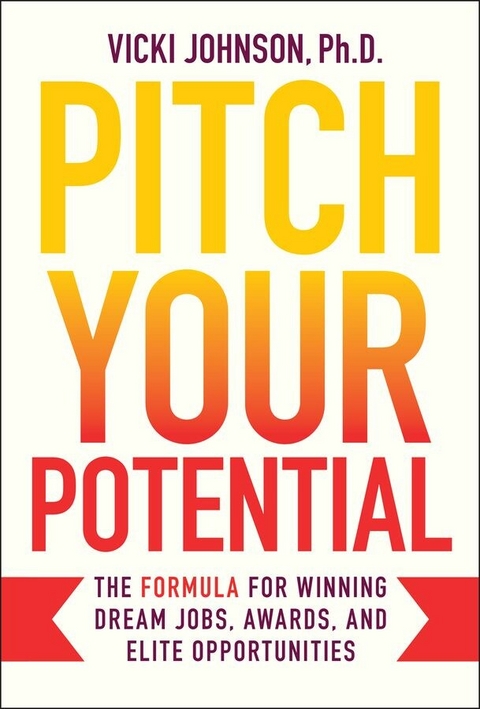
Pitch Your Potential (eBook)
256 Seiten
Wiley (Verlag)
978-1-394-32827-7 (ISBN)
Become the unexpected candidate who lands ultra-competitive career and academic opportunities.
We all want to compete at the highest level in our careers and land dream opportunities. But what do we do when the number and caliber of competitors are high, and others tell us we don't have any chance of getting selected?
In Pitch Your Potential: The Formula for Winning Dream Jobs, Awards, and Elite Opportunities, Dr. Vicki Johnson, admissions expert and nationally recognized founder of ProFellow, offers her breakthrough MATCH ME Formula, which has helped thousands of people go from rejected to selected. You'll learn how to overcome the discouragement of gatekeepers and apply proven strategies to create a winning personal pitch in writing and speaking to enter elite career tracks, get accepted to top universities, and win nationally competitive fellowships and awards.
You'll learn how to:
- Overcome mindset challenges that sabotage your effort
- Define your goals and identify opportunities that are a perfect fit
- Develop a memorable and compelling pitch, tailored to each opportunity
- Express your unique story on paper and in interviews
- Land the opportunities you have your heart set on!
Pitch Your Potential is the state-of-the-art book on the personal pitch that will help you develop your self-confidence and land dream roles in an increasingly competitive world. You don't have to listen to those who say your goals are out of reach. Become the leader you want to be.
VICKI JOHNSON, PHD, is a speaker, author, and four-time fellowship winner who helps ambitious professionals achieve elite opportunities. She is the founder of ProFellow, the leading U.S. platform for competitive fellowships, graduate programs, and leadership accelerators, read by more than nine million people globally. As a sought-after speaker and coach, Vicki teaches storytelling strategies that have helped ProFellow members secure more than $500 million in merit-based funding awards. Pitch Your Potential is her first book and serves as an in-depth guide to her breakthrough MATCH ME Formula®, representing the seven elements of a winning application. Vicki invites you to connect with her at www.DrVickiJohnson.com.
Introduction
Competition with our peers begins in childhood, but the real stakes begin in adolescence when we apply to college and prepare for our future careers, without any certainty of what adulthood has in store for us.
But there is one thing you can be certain of: you will be asked many times why you should be selected from among tens to thousands of other candidates—when applying to universities, to jobs, and for awards, and when pitching yourself for promotions and special opportunities.
The competitive process of applying and advocating for your selection will inevitably trigger your deepest fears that you are not good enough to be chosen for the opportunities you have your heart set on. But this fear is just the result of not having a framework to compellingly answer the question “Why you?” Because we are not taught an effective framework in grade school or college, we apply an idea of what might work and are left to wonder why it sometimes works but often fails.
We live in a society that feeds the narrative that only people with special connections, money, or a high IQ can achieve elite opportunities. Yet there are always examples of people without these things who were selected against the odds. This is because there are strategies for creating a winning application that anyone can apply, no matter your upbringing, financial status, or degree of success until now.
I learned this approach through experimentation. By leveraging the one thing that is truly unique to me—my lived experience—I turned the story of my future potential into my most powerful competitive advantage. Today, I love teaching this mastery to others.
My Story
I was born in Philadelphia in 1979 and from age four was raised in a rowhouse in Wilmington, Delaware, where my siblings and I attended city public schools. I had the privilege of being lovingly raised by two parents: my father, a Lutheran minister, and my mother, a nurse, who stayed at home when my siblings and I were young. In my adolescence, I learned important values and life skills from my parents, including the art of storytelling from my father, who is an experienced writer and speaker, and the power of attention to detail from my mother, who made our home beautiful despite having limited resources.
From a young age, I loved school and had a personal ambition to become a leader. Influenced by family and mentors who valued serving others, I also had a desire to work in public service. I discovered who I am and what my purpose is by setting high goals and pursuing them with the determination of an explorer. I’ve always operated with the optimism that even when I failed, I would gain skills in the process and get selected for the right opportunities that were meant for me.
I made the most of every educational opportunity I had available to me, and when I was a high school senior in 1997, I was college-bound. But I had some obstacles to achieving my dream of attending an Ivy League university. As you’ll learn later in this book, I successfully used the power of story and other human-centered strategies to get selected for the 2001 class of Cornell University with a substantial financial aid package. This early success of overcoming the odds of failure was a catalyst for my self-confidence. It was a signal that I had the potential to achieve much more, and I listened to this signal.
I was, however, challenged by one thing throughout my career: I constantly received advice from others to lower my goals and expectations because, from their perspective, my academic record and résumé were not good enough to rival my competitors. I regularly received the message from mentors that I should pursue less competitive opportunities where I had a higher probability of success. Even as I achieved success, the competition loomed bigger at every stage in my career, and the message that I should have a plan B never waned.
But I experimented with storytelling tactics and applied to many exciting opportunities anyway, because my goal was to have a career adventure. I wanted to make a social impact, travel the world, do exciting work, and become a leader in my field, whatever that field would be. I know many of you reading this book share these same goals.
From college, I had my eye on several prestigious professional fellowships in the United States and abroad that would help me enter and advance my early career in public health and emergency management. Each fellowship had a monthslong application process requiring a personal essay or project proposal, recommendation letters, and a finalist interview. When I first started applying for these my senior year in college, my senior advisor, a distinguished professor, commented that these nationally competitive awards “might be a waste of my time” because of my 3.2 GPA and lack of internships.
I took my advisor’s feedback with a grain of salt and focused on being the most prepared applicant. This commitment paid off over the next decade of my career, not just because I was ultimately successful winning several nationally competitive fellowships but also because I developed a specialized skill in persuasive communications: the personal pitch. The fellowships I achieved included the New York City Urban Fellows Program (2001); a German Chancellor Fellowship in Germany (2003); the Herbert Scoville Jr. Peace Fellowship in Washington, DC (2005); and the Ian Axford Fellowship in Public Policy (2011), a midcareer Fulbright award offered in New Zealand. In all of these fellowship competitions, there were competitors who had better résumés, more experience, and more credentials than I did, so winning these fellowships signaled to me I was doing something right in my applications.
Throughout my early career, I kept honing my personal pitch by using the story of my potential as my greatest competitive edge. At the age of 30, I landed a dream job within President Barack Obama’s administration. I was selected to become the policy director of the National Commission on Children and Disasters, an expert body instituted by Congress in response to the outcomes of Hurricane Katrina. The policy director job was a sought-after role, responsible for leading the incorporation and analysis of input from 10 expert commissioners, nationally selected from a range of disciplines, as well as input from hundreds of external experts and stakeholder organizations. It was an aspirational leadership role, and many people advised that I would not be qualified for it, but I applied anyway, getting my foot in the door through a referral from my network. Through intense preparation, which I talk about in Chapter 6, I ultimately edged out several impressive candidates with congressional experience, doctorates, and 10–20 years more work experience. Worried about how my age would be perceived once I entered the role, I worked hard to prove that I deserved the job, and my effort was acknowledged. After submitting our final report to Congress, I received a standing ovation for my orchestration of the final report from a room that included the commissioners and many federal leaders.
On the academic side, I had success getting accepted into top graduate schools and went on to earn my Master of Science in Public Health at the London School of Hygiene & Tropical Medicine, the leading public health school in Europe. In my mid-30s, I undertook my Ph.D. at Massey University in New Zealand at the encouragement of Kiwi professor Dr. David Johnston, whom I met during my Fulbright work. Although I didn’t need a doctorate for my career track, I enjoyed research and had a skill for it. I saw the unexpected opportunity as part of my career adventure because it was fully funded, and it allowed my husband, Ryan, and me to extend our time abroad.
Dr. Johnston served as my graduate advisor, and I took advantage of the positive support he offered. He was the first academic advisor I ever had who fully believed in what I could achieve, not just academically but also personally and professionally. With the vote of confidence that I had desired my whole life, I worked exceptionally hard and transformed from being a B-average student to a Ph.D. recipient who won the Dean’s Award for Exceptional Theses, placing me in the top 10% of all Ph.D. recipients at the university. I finally reached my full academic potential. Dr. Johnston’s positive support was a secret ingredient to my success that strongly influenced how I mentor others today.
In 2011, while I was a Ph.D. student in New Zealand, Ryan and I also co-founded ProFellow®, an information platform for people seeking fellowships and other merit-based funding awards. I am blessed to be married to my biggest fan, who saw my potential as an entrepreneur. Ryan came up with the idea for ProFellow after seeing me speak on fellowships and the excited reception I received from the young women professionals who attended. We entered many business plan and pitch competitions, which were experiences new to me, but they helped me further hone my skills in developing a winning application story. In several of the competitions, we received first place!
But, as a business, ProFellow was not an instant success. It was a passion project for the first five years. The reason ProFellow exists today is that we didn’t give up. Our commitment to our mission to make funding opportunities more accessible was the ultimate reason ProFellow lasted and gained ground during a period when many other similar companies started and failed.
From New Zealand, we moved to San Francisco, and two years after...
| Erscheint lt. Verlag | 22.12.2025 |
|---|---|
| Sprache | englisch |
| Themenwelt | Sachbuch/Ratgeber ► Beruf / Finanzen / Recht / Wirtschaft ► Bewerbung / Karriere |
| ISBN-10 | 1-394-32827-3 / 1394328273 |
| ISBN-13 | 978-1-394-32827-7 / 9781394328277 |
| Informationen gemäß Produktsicherheitsverordnung (GPSR) | |
| Haben Sie eine Frage zum Produkt? |
 EPUB (Adobe DRM)
Größe: 1,3 MB
Kopierschutz: Adobe-DRM
Adobe-DRM ist ein Kopierschutz, der das eBook vor Mißbrauch schützen soll. Dabei wird das eBook bereits beim Download auf Ihre persönliche Adobe-ID autorisiert. Lesen können Sie das eBook dann nur auf den Geräten, welche ebenfalls auf Ihre Adobe-ID registriert sind.
Details zum Adobe-DRM
Dateiformat: EPUB (Electronic Publication)
EPUB ist ein offener Standard für eBooks und eignet sich besonders zur Darstellung von Belletristik und Sachbüchern. Der Fließtext wird dynamisch an die Display- und Schriftgröße angepasst. Auch für mobile Lesegeräte ist EPUB daher gut geeignet.
Systemvoraussetzungen:
PC/Mac: Mit einem PC oder Mac können Sie dieses eBook lesen. Sie benötigen eine
eReader: Dieses eBook kann mit (fast) allen eBook-Readern gelesen werden. Mit dem amazon-Kindle ist es aber nicht kompatibel.
Smartphone/Tablet: Egal ob Apple oder Android, dieses eBook können Sie lesen. Sie benötigen eine
Geräteliste und zusätzliche Hinweise
Buying eBooks from abroad
For tax law reasons we can sell eBooks just within Germany and Switzerland. Regrettably we cannot fulfill eBook-orders from other countries.
aus dem Bereich