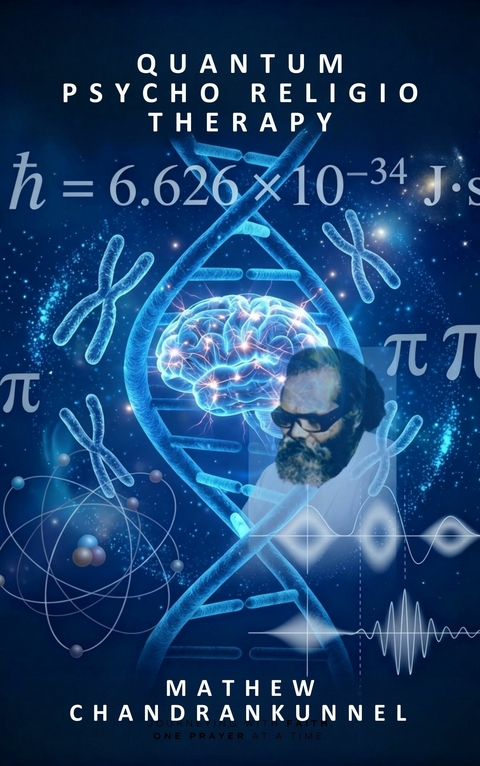
Quantum Psycho-Religio Therapy (eBook)
216 Seiten
Publishdrive (Verlag)
979-8-90243-016-2 (ISBN)
With the rich tapestry of knowledge, exactly the Ericksonian methodology, Jungian depth psychology, philosophical critique, and direct observation of psychic phenomena, Prof Dr Mathew Chandrankunnel CMI returned to the framework of Fr. Geo's Psycho-Religio Therapy - PRT, developed further on his beloved uncle's thousands of experiences on which he constructed the architecture of the Quantum Psycho Religio Therapy - QPRT. It was a potent, effective process, but it needed a contemporary lens, a way to speak to the modern mind steeped in the language of science and technology. His goal was not to discard the spiritual, the clinical and the philosophical, but to reframe the healing process in a way that acknowledged the extraordinary, non-linear reality he had discovered, while still maintaining intellectual rigour. This led to the essential synthesis and the creation of the architecture of the process of Quantum Psycho-Religio Therapy.
The term Quantum is not employed here as a literal assertion that the human body, psyche and pneuma - soul obeys the equations of quantum mechanics specifically, but a common, often misleading, simplification. Instead, it is adopted as a powerful, necessary metaphor, a profound philosophical and scientific construct used to describe a reality that transcends the limits of classical, deterministic thought.
Chapter 1 : Fr Geo Kappalumakal, Synthesiser of Psycho-Religio Therapy
In the fertile cultural and spiritual landscape of Kerala, India, where faith and tradition deeply intersect with daily life, the need for therapeutic models that acknowledge the whole person, namely the body, mind, and spirit, is paramount. It was against this backdrop that the late Rev. Fr. George Kappalumakal (1932–2009), a revered Catholic priest of the Eparchy of Pala, developed a groundbreaking integrative model known as Psycho-Religio Therapy (PRT). Born from decades of hands-on pastoral experience, intense study, and guidance from experts in both psychology and theology, Fr. Kappalumakal's approach was a deliberate effort to heal the fragmentation and alienation of the human person caught up in the dichotomies often seen in contemporary life.
Psycho-Religio Therapy is not merely an adaptation of existing psychotherapy with a religious veneer. It is a profound, custom-built therapeutic fabric utilizing sophisticated psychological analysis, the deep, transformative power of hypnotic suggestion to heal the unconscious, and a dedicated religious framework to reintegrate the person into a holistic continuum. The ultimate goal of PRT is the restoration of wholeness, wellness, and happiness, achieved by ensuring that the body, mind, and soul function in spiritual, psychological, and physical harmony. This article explores the life, context, theoretical architecture, and enduring legacy of this pioneering work, which cemented Fr. Kappalumakal’s status as a visionary in the field of spiritual mental health in the Indian subcontinent.
The Shepherd and the Seeker - The Life and Context
Fr. George Kappalumakal's journey was rooted deeply in the Catholic tradition of the Syro-Malabar Church, specifically within the Eparchy of Pala. His biographical markers trace a life dedicated to spiritual service and intellectual inquiry, namely born on March 10, 1932, ordained to the priesthood on March 10, 1960, and passing away on October 22, 2009. The longevity of his priesthood, nearly fifty years, provided him with an unparalleled window into the emotional and spiritual struggles of countless individuals and families.
The Kerala Context: Faith and Psychology
The state of Kerala, particularly the region served by the Pala diocese, is known for its high literacy rates, strong social structures, and a deep, historical adherence to Christian faith. However, this environment is not immune to modern pressures, mental health challenges, and emotional distress. Traditional Catholic ministry often focuses on pastoral care, confession, and spiritual direction, which address the moral and theological dimensions of suffering. Fr. Kappalumakal, observing the limitations of a purely spiritual or merely secular approach, recognized that many deep-seated issues such as anxiety, depression, behavioural patterns, and relationship conflicts which were fundamentally rooted in psychological trauma, unconscious wounds, and a lack of holistic integration.
He observed that offering spiritual solutions to a psychological problem was often ineffective, just as offering purely psychological analysis often failed to satisfy the client’s underlying need for meaning and spiritual anchor. This realization propelled him into a rigorous, self-driven study of psychology and human nature. His method, as described, emerged from a process of "trial and error," a phrase that speaks volumes about his commitment to empirical observation and practical effectiveness in his ministry. He was willing to step outside the traditional confines of his clerical role to seek truth and understanding from various scientific disciplines, integrating this knowledge with his profound theological and psychological foundation to discover a new therapeutic healing process.
The Seeds of Psycho-Religio Therapy
The intellectual and spiritual trajectory of Fr Geo was profoundly shaped during his years as a student at the St Joseph's Pontifical Institute known as Mangalappuzha Seminary, Aluva, Kerala. It was within this academic and sacred environment that he encountered Fr Zacharias OCD, a Spanish priest who served as both Professor and Rector, and whose influence proved pivotal. Fr Zacharias was not only an authority in theological studies but also a quiet pioneer in the nascent interactions between Psychology and Religion, a synthesis he actively fostered in his mentorship of the young student.
The relationship began on a practical, therapeutic footing. Suffering from debilitating and intense migraines, Fr Geo was introduced by Fr Zacharias to the principles of the subconscious mind and therapeutic intervention. Fr Zacharias personally taught him the techniques of self-hypnosis, providing Fr Geo with a potent tool for alleviating his acute pain. This instruction served as Fr Geo’s initial, firsthand immersion into the power of the human mind and its capacity for self-regulation and healing. The experience was transformative, laying the groundwork for an understanding of the mind not merely as a repository of knowledge but as a dynamic field capable of profound inner control.
However, it was a moment of inexplicable revelation that truly shifted the course of Fr Geo’s intellectual curiosity. During a class session, Fr Zacharias abruptly paused his lecture. After a startling moment of silent contemplation, he dismissed the students, announcing that his mother had just passed away and instructing them to engage in private study. The instantaneous, unmediated nature of this knowledge was deeply unsettling to Fr Geo, particularly in an era devoid of the internet or mobile communication facilities. The vast distance between Kerala and Spain, coupled with the immediacy of the news, presented an impenetrable mystery. After a month, when a letter sent from the family, wrote about the death of his mother, he could calculate that the information he received as the sudden passing away of his mother was so accurate which he shared with his students especially dismaying again the student who later to be called Fr Geo. The seeds of the mysteries and the hidden treasures of the human mind really empowered him to do an analysis mode of consciousness.
Fr Geo, already aware of the concepts of telepathy and clairvoyance, was startled by the demonstration of such potent, psychic connectivity. This incident raised profound questions about the nature of information processing between human minds and the hidden mechanisms that govern what seemed like instantaneous communication across continents. The mystery of the invisible network connecting human consciousness opened a deep well of inquiry within him. Fr Geo felt an undeniable vocational call to move beyond conventional studies, dedicating himself to understanding the inherent mysteries of the mind and the powerful psychic connections that transcend physical limitations. This lifelong quest for answers enabled and empowered him to delve deeper into these subjects, ultimately leading to the evolution and articulation of his own distinct therapeutic framework known as Psycho-Religio Therapy.
The Intellectual Foundation
Fr. Kappalumakal’s study of psychology likely spanned the major schools of thought prominent in the mid-to-late 20th century, including Freudian psychoanalysis for its understanding of the unconscious, Jungian analysis for its concepts of meaning, archetypes, and individuation, and Logotherapy, the meaning-cantered therapy developed by Viktor Frankl, a concept highly compatible with a religious worldview.
What set his work apart was the determination to not merely use psychological insights alongside religious practice, but to weave them into a single, cohesive, and theologically sound therapeutic methodology. He sought to demonstrate that the journey toward mental and emotional wellness is intrinsically linked to the journey toward spiritual transcendence and communion with the divine, which, in his Catholic tradition, is the ultimate definition of human wholeness integrated with the timeless spiritual wealth of the Indian subcontinent inextricably intertwined with the Hindu, Buddhist, Christian, Jewish and Islamic religious traditions.
The Theoretical Architecture of Psycho-Religio Therapy
The core of Psycho-Religio Therapy (PRT) is its commitment to the holistic continuum of the human person. It fundamentally rejects the dualistic notion that the soul and mind are separate entities to be treated by separate specialists. For Fr. Kappalumakal, human health existed only when the body (the physical vessel), the psyche (the cognitive and emotional landscape), and the pneuma - soul (the transcendent core that seeks meaning and God) were in seamless, mutual harmonic continuum.
Core Philosophy: The Integrated Self
The philosophy of PRT rests on several foundational theological and psychological premises:
- The Person is a Trinity: Echoing the tripartite view of humanity interpreted as Soma, Psyche, Pneuma in different traditions, PRT asserts that pathology arises from fragmentation and alienation. A healthy person is one whose emotional life, namely the mind is properly ordered by the spiritual life of the soul, and whose physical actions on the body reflect that inner harmony.
- The Unconscious as a Spiritual Battleground: Psychoanalysis highlights the unconscious as the repository of trauma, repressed desires, and conflicts. PRT accepts this, but overlays a religious dimension, viewing the deepest unconscious conflicts as often being rooted in a person's relationship with God, self-worth, and existential meaning. Healing the unconscious, therefore, requires tools that transcend mere conscious rationality.
- Meaning as the Ultimate Antidote: Consistent with Logotherapy,...
| Erscheint lt. Verlag | 19.12.2025 |
|---|---|
| Reihe/Serie | QPRT |
| Illustrationen | AI Gemini |
| Sprache | englisch |
| Themenwelt | Sachbuch/Ratgeber ► Gesundheit / Leben / Psychologie ► Esoterik / Spiritualität |
| Schlagworte | Contemplative psychotherapy • Integrative psycho-spiritual treatment • Mind-body-soul integration Quantum consciousness • Non-linear healing processes • Quantum metaphor in therapy • Quantum Psycho-Religio Therapy Quantum healing • Science meets spirituality healing |
| ISBN-13 | 979-8-90243-016-2 / 9798902430162 |
| Informationen gemäß Produktsicherheitsverordnung (GPSR) | |
| Haben Sie eine Frage zum Produkt? |
 EPUB (Ohne DRM)
Digital Rights Management: ohne DRM
Dieses eBook enthält kein DRM oder Kopierschutz. Eine Weitergabe an Dritte ist jedoch rechtlich nicht zulässig, weil Sie beim Kauf nur die Rechte an der persönlichen Nutzung erwerben.
Dateiformat: EPUB (Electronic Publication)
EPUB ist ein offener Standard für eBooks und eignet sich besonders zur Darstellung von Belletristik und Sachbüchern. Der Fließtext wird dynamisch an die Display- und Schriftgröße angepasst. Auch für mobile Lesegeräte ist EPUB daher gut geeignet.
Systemvoraussetzungen:
PC/Mac: Mit einem PC oder Mac können Sie dieses eBook lesen. Sie benötigen dafür die kostenlose Software Adobe Digital Editions.
eReader: Dieses eBook kann mit (fast) allen eBook-Readern gelesen werden. Mit dem amazon-Kindle ist es aber nicht kompatibel.
Smartphone/Tablet: Egal ob Apple oder Android, dieses eBook können Sie lesen. Sie benötigen dafür eine kostenlose App.
Geräteliste und zusätzliche Hinweise
Buying eBooks from abroad
For tax law reasons we can sell eBooks just within Germany and Switzerland. Regrettably we cannot fulfill eBook-orders from other countries.
aus dem Bereich