


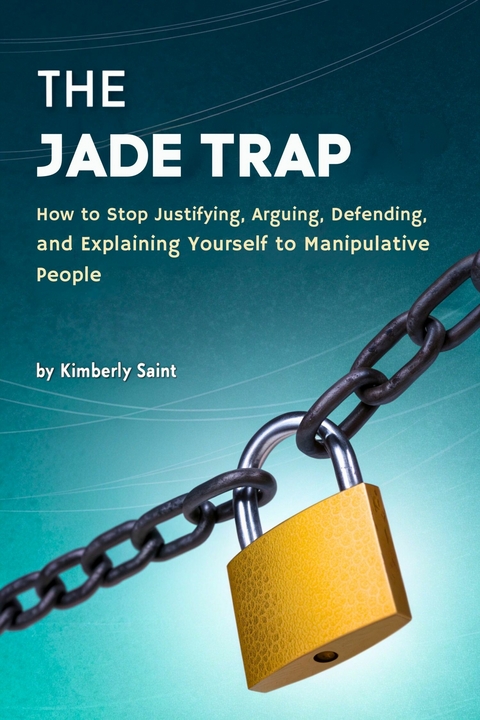
The JADE Trap (eBook)
155 Seiten
JNR Publishing (Verlag)
978-0-00-112170-6 (ISBN)
Are you tired of feeling drained, misunderstood, and constantly on the defensive in your relationships? Do you find yourself endlessly Justifying, Arguing, Defending, or Explaining (JADE) your actions and feelings, only to end up even more frustrated?
If you're stuck in cycles of unproductive conversations with manipulative people-whether it's a demanding boss, a critical family member, a difficult colleague, or a toxic partner-The JADE Trap by Kimberly Saint is your guide to breaking free and reclaiming your peace.
This book takes a deep dive into the JADE phenomenon, revealing how manipulators lure you into exhausting dynamics to maintain control and keep you off balance. No more walking on eggshells. No more fighting battles you can't win. It's time to understand why you JADE and learn how to stop for good.
This isn't just a book that points out the problem. It gives you a practical toolkit of strategies you can use to navigate emotional manipulation with confidence.
Inside The JADE Trap, you will discover:
The #1 reason you get pulled into JADE and how manipulators exploit your natural desire to be understood.
Proven ways to stop JADE-ing in the moment, including Gray Rocking, the Broken Record, Strategic Inaction, and Graceful Disengagement.
How to set rock-solid boundaries that manipulative people can't ignore, and what to do when they push back.
The art of assertive communication so you can express your needs clearly and respectfully without slipping into JADE.
Emotional regulation tools to help you manage triggers and stay calm when faced with gaslighting and guilt trips.
Practical confidence-building exercises like the Letter to Self and Accomplishment Inventory to rebuild self-esteem impacted by toxic relationships.
Targeted guidance for handling JADE and manipulation at work, within family dynamics, and in the digital world.
Long-term resilience tools to build a manipulation-resilient mindset, including the Values Compass, Gratitude Shield, and Emotional Weather Report.
A clear blueprint for knowing when to cut ties, how to exit toxic relationships safely, and how to recover afterward.
Ready to transform your interactions and protect your mental health? The JADE Trap goes beyond theory with practical exercises, real-life examples, and chapter takeaways that help you apply these skills in your daily life. You'll learn to recognize psychological manipulation and build lasting resilience.
1
Chapter 1: The JADE Phenomenon – And Why You’re Probably Doing It
Ever found yourself in a conversation that feels less like a discussion and more like quicksand? You’re trying to make your point, clarify your actions, or just get the other person to understand, but the more you talk, the deeper you sink. You’re exhausted, frustrated, and probably wondering if you’re losing your mind. If this sounds familiar, congratulations! You’ve likely stumbled into the JADE trap, and you’re not alone. It’s a common human response, especially when dealing with certain… challenging personalities.
What in the World is JADE and Why Should I Care?
JADE is a rather nifty acronym that stands for: Justify, Argue, Defend, Explain. Think of it as the four horsemen of conversational doom when you’re interacting with someone who isn’t interested in resolution, but rather in control or simply making you squirm. At its heart, JADE is that overwhelming compulsion to make sure the other person gets you, to validate your choices, or to correct their (often willful) misunderstanding of your character or actions.
Why should you care? Because JADE is a trap, pure and simple. It’s a cycle that rarely leads to a satisfying conclusion. Instead, it leaves you feeling drained, misunderstood, and like you’ve just run a marathon in fluffy slippers – a lot of effort for very little forward movement. Manipulative individuals, whether they’re doing it consciously or not, often thrive on JADE. It keeps you engaged, on their terms, pouring your precious energy into trying to convince them of something they likely have no intention of accepting. Understanding JADE is like getting a map to the quicksand; it’s the first step to learning how to navigate around it, or, if you’re already in it, how to stop sinking.
The Siren Song of Engagement: Why We JADE
Let’s be honest, the urge to JADE doesn’t come from nowhere. We’re social creatures. We have an innate desire to be understood, to be seen as reasonable, and to have our perspectives validated. When someone questions our motives, criticizes our choices, or attacks our character, our first instinct is often to jump into defense mode. We want to set the record straight, prove our integrity, or maybe even gain their approval (even if we don’t particularly like them). This is the allure, the siren song of engagement. It feels like the right thing to do.
However, when you’re dealing with someone who has a manipulative streak, this very natural desire becomes a vulnerability. They know just which buttons to push to get you to start justifying your every move or explaining your innermost thoughts. The danger here is that these interactions are rarely genuine attempts at mutual understanding. More often, they are subtle (or not-so-subtle) power plays designed to destabilize you, control the narrative, and leave you feeling exhausted and confused. They’re not looking for clarity; they’re often looking for ammunition, an emotional reaction, or simply the satisfaction of watching you tie yourself in knots.
Spotting JADE-Inducing Tactics: Common Phrases and Patterns
Recognizing when you’re being baited into JADE is a crucial skill. Manipulators often use specific phrases and patterns to trigger this response. Being aware of these red flags can help you sidestep the trap before you’re waist-deep.
Common JADE-Inducing Phrases:
- “Why did you do that?” (Especially with a tone of accusation or disbelief). This immediately puts you on the defensive, demanding justification. A neutral “Could you tell me more about your reasoning?” is one thing; a loaded “Why on earth would you do that?” is quite another.
- “You always…” or “You never…” These are generalizations that are almost impossible to defend against because they’re rarely 100% true. They invite you to argue by citing exceptions, thereby engaging in their frame. For example, “You never listen to me!” prompts you to list all the times you did listen.
- “If you really cared/loved me, you would…” This is a classic guilt-trip, designed to make you justify your actions (or inactions) by proving your affection or loyalty.
- “Don’t you think you’re overreacting?” or “You’re being too sensitive.” These phrases invalidate your feelings and pressure you to explain or defend your emotional state.
- “I’m just trying to help/understand.” Sometimes genuine, but often used as a cloak for intrusive questioning or criticism, making you feel obligated to explain yourself in detail.
- “It’s not my fault that X happened because Y…” followed by a subtle implication it’s yours. This is blame-shifting, often prompting you to defend yourself against an unspoken accusation.
- “You made me do it.” A direct attempt to avoid responsibility, often baiting you into an argument about who is truly at fault.
Common JADE-Inducing Patterns:
- Constant Questioning: Relentless, almost interrogative questioning designed to wear you down and force you to justify every detail of your decision or belief. It’s not about seeking information; it’s about creating pressure.
- Shifting the Blame: A consistent pattern of avoiding accountability by pointing fingers at others or external circumstances, often making you feel you need to defend those being blamed, or even yourself if the implication is turned towards you.
- Playing the Victim: Regularly portraying themselves as helpless, wronged, or misunderstood to gain sympathy and manipulate your behavior, making you feel compelled to explain how you aren’t harming them or to justify your actions in light of their “suffering”.
- Moving the Goalposts: You explain something to their satisfaction, only for them to change the criteria or bring up a new objection, keeping you in a perpetual cycle of explanation and defense.
- Ignoring or “Misunderstanding” Boundaries: Even if you’ve stated a boundary, they might feign ignorance or “forget,” prompting you to re-explain and re-justify your limits repeatedly.
- Circular Arguments: Conversations that go around and around, never reaching a resolution, with the manipulator bringing up old issues or twisting your words to keep you engaged and defending your position.
Real-Life (and Relatable) Examples of JADE in Action
Let’s paint a picture. Imagine these scenarios:
- The “Helpful” Relative: Aunt Mildred comments on your parenting choices: “Oh, you’re letting little Timmy watch that cartoon? In my day, we knew a screen was no substitute for fresh air. Why would you choose that for him?”Your JADE response: “Well, Aunt Mildred, it’s an educational cartoon, and he only watches for 30 minutes after he’s played outside. Studies show some screen time can be beneficial, and I’ve researched this specific program, and it helps with…” (You’re justifying and explaining). Aunt Mildred, of course, has another “helpful” comment ready.
- The Demanding Colleague: Your coworker, Bob, drops a pile of his work on your desk at 4:50 PM on a Friday. “Can you get this done? I’m swamped, and you’re so much better at this stuff anyway.” When you hesitate, he adds, “Wow, I thought we were a team. I covered for you that one time, remember? Why are you being like this?”Your JADE response: “Bob, I have my own deadlines, and I was planning to leave on time today. It’s not that I don’t want to help, but this is really your responsibility, and giving it to me now isn’t fair because…” (You’re justifying, explaining, and bordering on arguing). Bob just looks martyred.
- The “Concerned” Partner: You’re going out with friends. Your partner says, “Are you sure you want to wear that? And you’re going to that place again? You know how I worry. Why do you always have to pick places that make me uncomfortable?”Your JADE response: “It’s just a dress I like! And my friends chose the place. It’s perfectly safe. I don’t ‘always’ pick these places. Last time we went to the quiet bistro you liked, remember? I’m just trying to have a normal night out, and…” (You’re justifying your clothes, defending your choice of venue, arguing against their generalization, and explaining your motives).
In each of these scenarios, the person initiating the JADE-bait isn’t necessarily looking for a reasonable answer; they are often seeking to impose their views, create guilt, or control the situation. Your detailed explanations and justifications? They often fall on deliberately deaf ears, or worse, give the other person more to pick apart.
The Way Out: Setting Boundaries as the Foundation
If JADE is the quicksand, then setting boundaries is the solid ground. Boundaries are the limits we define for ourselves in relationships, clearly stating what we are and...
| Erscheint lt. Verlag | 12.12.2025 |
|---|---|
| Sprache | englisch |
| Themenwelt | Sachbuch/Ratgeber ► Beruf / Finanzen / Recht / Wirtschaft |
| ISBN-10 | 0-00-112170-7 / 0001121707 |
| ISBN-13 | 978-0-00-112170-6 / 9780001121706 |
| Informationen gemäß Produktsicherheitsverordnung (GPSR) | |
| Haben Sie eine Frage zum Produkt? |
 EPUB (Adobe DRM)
Größe: 2,2 MB
Kopierschutz: Adobe-DRM
Adobe-DRM ist ein Kopierschutz, der das eBook vor Mißbrauch schützen soll. Dabei wird das eBook bereits beim Download auf Ihre persönliche Adobe-ID autorisiert. Lesen können Sie das eBook dann nur auf den Geräten, welche ebenfalls auf Ihre Adobe-ID registriert sind.
Details zum Adobe-DRM
Dateiformat: EPUB (Electronic Publication)
EPUB ist ein offener Standard für eBooks und eignet sich besonders zur Darstellung von Belletristik und Sachbüchern. Der Fließtext wird dynamisch an die Display- und Schriftgröße angepasst. Auch für mobile Lesegeräte ist EPUB daher gut geeignet.
Systemvoraussetzungen:
PC/Mac: Mit einem PC oder Mac können Sie dieses eBook lesen. Sie benötigen eine
eReader: Dieses eBook kann mit (fast) allen eBook-Readern gelesen werden. Mit dem amazon-Kindle ist es aber nicht kompatibel.
Smartphone/Tablet: Egal ob Apple oder Android, dieses eBook können Sie lesen. Sie benötigen eine
Geräteliste und zusätzliche Hinweise
Buying eBooks from abroad
For tax law reasons we can sell eBooks just within Germany and Switzerland. Regrettably we cannot fulfill eBook-orders from other countries.
aus dem Bereich


