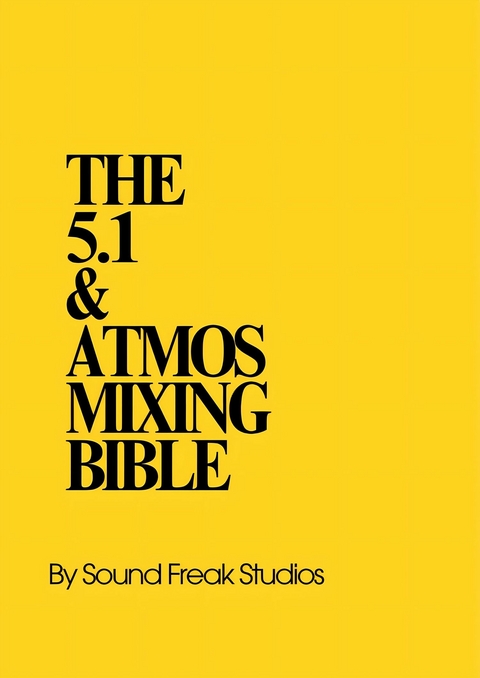
The 5.1 & Atmos Mixing Bible (eBook)
200 Seiten
Publishdrive (Verlag)
979-8-2748-9294-0 (ISBN)
Learn Film & OTT Audio Post-Production the Right Way - from a Working Sound Engineer with 20+ Years of Real Studio Experience.
If you've ever opened a Pro Tools session and felt overwhelmed by tracks, plugins, loudness rules, exports, and deadlines... this eBook will change the way you work.
Written by Sound Freak Studios, an award-winning sound designer and re-recording mixer, this guide distills years of film, OTT, advertising, podcast, and audiobook experience into one clear and practical handbook. No confusing theory. No outdated advice. Only real-world workflows used in actual productions.
⭐ What You'll Learn Inside
✔ How to properly organise your Pro Tools session
✔ Dialogue editing techniques used in films & web series
✔ SFX, foley, and background building made simple
✔ Music premix approaches for clean cinematic mixes
✔ 5.1 & OTT mixing fundamentals
✔ Loudness targets (LUFS) and delivery formats
✔ QC checklist to avoid rejection
✔ Exporting, rendering, and creating final deliverables
✔ Templates, shortcuts, and professional tips to speed up your workflow
⭐ Why This eBook Works
Because it focuses on practical, real-world industry methods, not textbook definitions.
Whether you're learning sound engineering, preparing for film/OTT work, or polishing your mixing skills, you'll find clear explanations, examples, and step-by-step breakdowns you can apply immediately.
⭐ Who This eBook Is For
Chapter 6
Backgrounds & Ambiences
Building the Sonic World Around the Story
If dialogue is the spine of a film, then backgrounds are the world it lives in. They are the invisible glue tying characters to their environment. Good backgrounds disappear. Great backgrounds define the emotional space of a scene.
In 5.1 and Atmos, backgrounds are not simply stereo loops pushed to surrounds; they are carefully layered environments that breathe, shift, evolve, and support the story without ever calling attention to themselves.
This chapter teaches you exactly how to design backgrounds that feel cinematic and immersive — without overwhelming dialogue or music.
6.1 — The Philosophy of Backgrounds
A common mistake among beginners is treating backgrounds as “fillers.” In reality:
Backgrounds are emotional context.
They tell the audience where they are and how they should feel.
Think of backgrounds as:
• time indicators
• location indicators
• emotional tone-setters
• rhythm creators
For example:
• A quiet forest with distant birds = safety
• The same forest with low wind rumble = tension
• A city hum that slowly grows = rising anxiety
• A silence turning into soft crickets = emotional stillness
Backgrounds manipulate mood more than any other element.
6.2 — Types of Background Layers Professional 5.1 backgrounds are never a single track. They are built from multiple layers, each serving a unique role:
1. Base Tone Layer
The continuous element that sets “air” or “bed”.
Examples: AC hum, distant traffic, soft wind.
2. Texture Layer
Adds character and realism.
Examples: birds, leaves, water, insects, room tone variation.
3. Movement or Dynamic Layer
Provides evolution so the scene doesn’t feel static.
Examples: passing cars, occasional gusts, distant dogs, shifts in crowd tone.
4. Perspective Layer
Reinforces the visuals.
Examples: interior echoes, exterior openness, tunnel reflections.
5. Emotional Accent Layer
Used sparingly to reinforce mood.
Examples: ominous drones, tension beds, soft musical textures blending into FX.
This modular approach creates depth and believability.
6.3 — Background Placement in 5.1
Professional background placement follows a simple principle:
Surrounds provide width, not distraction.
Front Channels (L/C/R):
• Light tonal presence
• Used to anchor backgrounds to screen
• Usually low-level, barely perceptible
Surround Channels (LS/RS):
• Main carriers of ambience
• Provide space and environmental truth
• Should feel enveloping, not localizable
LFE:
• Only for rare cases
• Thunder, earthquakes, trains, large rumbles
• Must be minimal
A clean 5.1 ambience should feel like stepping into the scene, not listening to separate speakers.
6.4 — Creating Depth Through EQ and Filtering
Distance and depth are created using:
• high-frequency roll-off
• low-mid attenuation
• gentle reverb
• lower levels
• reduced transients
Distant Backgrounds:
• roll off highs gently
• lower volume
• add subtle 5.0 reverb
• soften transients
Close Backgrounds:
• retain highs
• add mono/LCR reflections (if indoors)
• minimize reverb outdoors
This matches how sound behaves in real environments.
6.5 — Movement vs Static Ambience
Static loops make scenes feel dead.
Human spaces are never static.
Even a silent room has:
• air movement
• light reflections
• distant structural sounds
Great mixers introduce micro-movements:
• wind fluctuations
• subtle shifts in traffic
• variation in crickets
• occasional background details
But these must never compete with dialogue.
Key rule:
Backgrounds must evolve but never distract.
6.6 — Avoiding Ambience Masking
Masking occurs when ambience occupies the same frequency range as dialogue, music, or FX.
Common masking offenders:
• heavy midrange drones
• loud crickets
• harsh cicadas
• dense traffic beds
• broadband wind noise
Solutions:
• carve small EQ dips around 1–4 kHz
• automate ambience levels around key dialogue moments
• thin out low-mid buildup
• remove overly detailed layers during close-up shots
• use stereo width narrowing in front channels
Ambience should support, not fight.
6.7 — Reverb in Backgrounds (The Invisible Glue)
Reverb is essential for realistic ambience.
Indoors:
• subtle mono/LCR reverb
• early reflections
• room cues
• tail must be soft and natural
Outdoors:
• 5.0 reverb or open reflections
• very gentle
• mostly heightless unless large environment
Tunnels / Caves / Large Spaces:
• reverb becomes a character
• 5.0 or multi-tap
• long decay
• wide early reflections
The reverb must be believable, never dramatic.
6.8 — Backgrounds in the Surrounds: The Rule of Subtlety
Most of your background energy should live in the surrounds, but…
It must never feel like it’s “coming from behind the listener.”
Localizable surround sound:
• pulls attention
• breaks immersion
• feels like a mistake
Surrounds should provide:
• space
• width
• air
• environment
Not:
• sharp details
• sudden movements
• bright sounds
• attention-grabbing elements
6.9 — Backgrounds in Atmos
Atmos changes ambience mixing dramatically.
Heights should carry:
• air
• wind
• rain
• soft textures
• large indoor reflections
Heights should NOT carry:
• discrete FX
• bright birds
• sudden details
• dialogue-adjacent sounds
Heights amplify realism.
If misused, they amplify distraction.
We’ll explore this deeply in Atmos chapters.
6.10 — The Art of Connecting Cuts
Each shot has different:
• microphones
• lenses
• spaces
• angles
Ambiences must glue cuts together.
Professional mixers use:
• crossfades
• gentle automation
• bridging textures
• emotional consistency Between cuts, ambience must:
• shift slightly
• but not reset
• maintain tone
• maintain emotional atmosphere
Your mix should feel like one continuous moment, even if the camera jumps.
6.11 — Backgrounds QC Checklist
Before committing your backgrounds, verify:
✔ No sharp details pulling attention
✔ No masking of dialogue
✔ No phasing between front & surrounds ✔ No LFE abuse
✔ Smooth transitions between cuts
✔ Subtle dynamic movement
✔ Consistent tone across scenes
✔ Stereo fold-down clarity
✔ No bright elements in surrounds
✔ No “hole” in the front stage
A background that passes QC is a background that supports story.
Next Chapter Preview: Chapter 7 — Foley Art in 5.1
We’ll cover:
• perspective accuracy
• mic choice impact
• Foley-to-picture sync
• building believable movement
• balancing Foley against ambience
• mono vs stereo Foley choices
• footwear and surface detail
• ...
| Erscheint lt. Verlag | 18.11.2025 |
|---|---|
| Sprache | englisch |
| Themenwelt | Sachbuch/Ratgeber ► Freizeit / Hobby ► Sammeln / Sammlerkataloge |
| Naturwissenschaften ► Physik / Astronomie | |
| Schlagworte | dialogue editing workflow • film audio post production guide • learn 5.1 mixing and loudness • pro tools mixing for beginners • sound design and mixing handbook • sound engineering for film and ott |
| ISBN-13 | 979-8-2748-9294-0 / 9798274892940 |
| Informationen gemäß Produktsicherheitsverordnung (GPSR) | |
| Haben Sie eine Frage zum Produkt? |
 EPUB (Ohne DRM)
Digital Rights Management: ohne DRM
Dieses eBook enthält kein DRM oder Kopierschutz. Eine Weitergabe an Dritte ist jedoch rechtlich nicht zulässig, weil Sie beim Kauf nur die Rechte an der persönlichen Nutzung erwerben.
Dateiformat: EPUB (Electronic Publication)
EPUB ist ein offener Standard für eBooks und eignet sich besonders zur Darstellung von Belletristik und Sachbüchern. Der Fließtext wird dynamisch an die Display- und Schriftgröße angepasst. Auch für mobile Lesegeräte ist EPUB daher gut geeignet.
Systemvoraussetzungen:
PC/Mac: Mit einem PC oder Mac können Sie dieses eBook lesen. Sie benötigen dafür die kostenlose Software Adobe Digital Editions.
eReader: Dieses eBook kann mit (fast) allen eBook-Readern gelesen werden. Mit dem amazon-Kindle ist es aber nicht kompatibel.
Smartphone/Tablet: Egal ob Apple oder Android, dieses eBook können Sie lesen. Sie benötigen dafür eine kostenlose App.
Geräteliste und zusätzliche Hinweise
Buying eBooks from abroad
For tax law reasons we can sell eBooks just within Germany and Switzerland. Regrettably we cannot fulfill eBook-orders from other countries.
aus dem Bereich