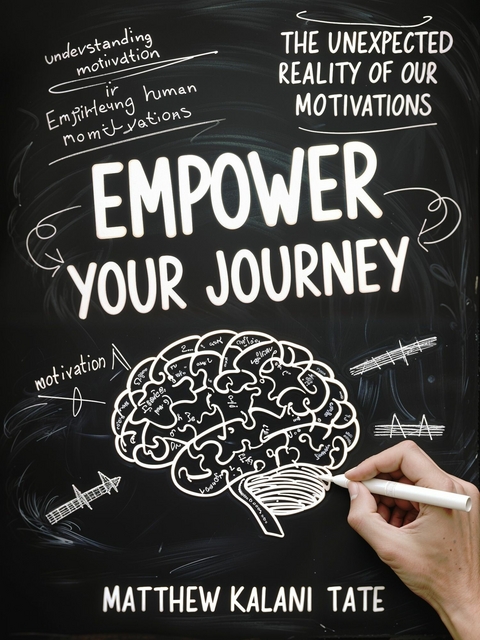
Empower your journey (eBook)
136 Seiten
Publishdrive (Verlag)
978-0-00-110578-2 (ISBN)
No matter what has happened to you, where you are from, or what you have done, you can still find total peace, unconditional love, complete fulfillment, and an abundance of joy in your life.
Everyone is subject to this. Light is necessary for the existence of darkness, hence even in our lowest hour, light must exist.
This book will fill you with wisdom that will last a lifetime and help you realize that no matter what happens in this world, you have the capacity to create your own reality via the power of your imagination.
The message of 'Don't Believe Everything You Think' is not to change your mindset, rewrite your history, or rewire your brains.
Using the same degree of awareness that caused our problems to arise will not allow us to fix them. Only tactics last. The effects of a raised state of awareness last a lifetime.
Introduction
In the mid-20th century, two young scientists undertook experiments that were supposed to revolutionize the world but did not. Harry F. Harlow taught psychology at the University.
In the 1940s, Wisconsin developed one of the earliest laboratories for studying primate behavior. In 1949, Harlow and two colleagues initiated a two-week learning experiment with eight rhesus monkeys. A simple mechanical puzzle was created by the researchers, as seen on the next page. Solving it required three steps: remove the vertical pin, unscrew the hook, and lift the hinged lid. Although easy for humans, it is far more difficult for a 13-pound lab monkey.Harlow's problem began (left) and solved (right).
The monkeys were given puzzles in their cages to observe their reaction and prepare for problem-solving exams after two weeks. Strange things happened fairly immediately.Monkeys played puzzles with focus, tenacity, and apparent delight without outside influence or prompting from experimenters. Within a short time, they discovered how the traps operated. Harlow assessed the monkeys on days 13 and 14 of the experiment, and they had become extremely adept. Puzzles were solved rapidly and frequently, with two-thirds of codes cracked in under 60 seconds.
I thought this was strange. The monkeys had never been instructed on how to open the cover, slide the hook, or remove the pin. When they were successful, no one had given them anything—not even a little bit of quiet applause or food. And that contradicted certain widely held beliefs about the behavior of primates, particularly the less hairy, larger-brained primates called humans.
At that time, researchers had identified two primary motivations for human action. The first one was the biological imperative. In the past, animals and humans both relied on food and drink to keep themselves hydrated and on mating to fulfill their libidinal needs. What wasn't occurring, though, was that. Food, water, or sex satisfaction were not outcomes of the solution, according to Harlow.
However, the odd conduct of the monkeys could not be explained by the sole other drive that is known to science. This second drive, in contrast to the intrinsic biological drives, emerged in response to environmental rewards and penalties. exhibiting specific behaviors. Indeed, this was the case for humans, as they reacted magnificently to these outside influences. We would put in more effort if you said we could get a raise. The possibility of an A would motivate us to study more for the exam. We would be punctual and careful to check every box if you threatened to penalize us for being late or for filling out a form improperly. However, that also failed to explain the monkeys' behavior. Because substantial learning and efficient performance were achieved without the use of special or extrinsic incentives, the results of this study raise some intriguing challenges for the field of motivation theory, as Harlow put it (and one can almost feel him rubbing his head in frustration).
Could it be anything else?
In response, Harlow proposed an innovative notion that functioned as a third drive: According to him, there was an inherent satisfaction in completing the work.
The monkeys solved the riddles for no other reason than the sheer joy of doing so. According to them, it was fun. Just enjoying doing it had its own reward.
What followed further muddied the waters whether this idea was radical. Maybe what Harlow dubbed "intrinsic motivation"—this newly-discovert drive—was actually there. Nevertheless, the other two motivations undoubtedly took precedence. The monkeys would definitely do better if they got raisins! for finishing the problems. However, in Harlow's experiment, the monkeys actually performed worse and made fewer correct guesses. Although not previously documented in the literature, Harlow noted that the introduction of food in this experiment had the effect of interfering with performance.
This was somewhat strange, you know. The scientific analogy would be to observe a steel ball float into the air instead of falling to the ground while trying to calculate its velocity on an inclined plane. It implied that there were many gaps in our knowledge of the effects of gravity on human conduct and that the rules we believed to be absolute were actually very malleable. Harlow highlighted the monkeys' dogged determination to solve the riddles. Following this, he made an observation:
This drive seems to be as basic and robust as the other drives. There is also some evidence to suggest that [it] can be as effective in promoting learning.
But at the time, the two main drivers had a strong hold on scientific thinking. So Harlow rang the alarm. He told scientists to shut down big parts of our theoretical junkyard and provide us better, more precise explanations of how people act. He said that our explanation of why we did what we did was not enough. He suggested that to really understand what it is to be human, we have to think about this third drive.
Then he basically gave up on the whole thing.
Instead of fighting the establishment and starting to present a more full understanding of motivation, Harlow gave up this controversial line of research and later became recognized for his work on the science of affection. His idea of this third drive was talked about a lot in psychology, but it never really caught on in behavioral science or in our knowledge of ourselves. It would take twenty years for another scientist to pick up the thread that Harlow had left so provocatively on that table in the Wisconsin lab.
Ema was a graduate student in psychology at a university and was looking for a topic for her dissertation. Ema, who already had an MBA, was interested in motivation but thought that academics and businesses had gotten it wrong. He then took a page from the Harlow playbook and used a puzzle to learn more about the subject.
The Soma puzzle cube was selected by Ema. The seven plastic parts that make up the puzzle, which is seen below, include six pieces that are each made up of four one-inch cubes, one of which is made up of three cubes measuring one inch each. Players have the ability to arrange the seven pieces into a number of different combinations, ranging from abstract shapes to objects that are easily recognizable.
The Soma puzzle, which consists of seven pieces, is shown on the left in its disassembled state. On the right, it is shown assembled into one of the millions of different configurations that are possible.
Ema split the participants in the study, which included both men and women who were students at the institution, into two groups: the experimental group (which I will refer to as Group A) and the control group (which I will refer to as Group B). Each of them took part in three sessions, each of which lasted for one hour, and the sessions were held on consecutive days.
The sessions were conducted in the following manner: Every participant went into a room and took a seat at a table, which was covered with copies of Time, The New Yorker, and Playboy, along with illustrations of three different puzzle configurations. In addition, the table had the seven Soma puzzle pieces on it.
Ema took a seat at the opposite end of the table to provide an explanation of the directions and to keep track of the amount of time it took to complete the task by using a stopwatch.
During the first session, participants of both groups were required to construct the Soma parts in order to mimic the configurations that were in front of them. They repeated the process in the second session, but this time they used a different set of drawings. This time, Hock informed Group A that their receive one dollar for each configuration that they successfully recreate (this is the equivalent of over six dollars today). Meanwhile, Group B received new drawings but did not receive any payment. Finally, in the third session, both groups were given new drawings, and they were required to recreate them without receiving any compensation, just as they had done in the first session. Consult the table that is provided below for more information.
The twist occurred halfway through each session that was held. Hock brought the proceedings to a halt once a participant had successfully completed two of the three drawings using the Soma puzzle pieces. In order to make the correct Hocksion, he stated that he would provide them with a fourth drawing, but that he would be required to input their completion times into a computer beforehand. And since this was the late 1960s, when mainframes that took up the entire room were the standard and personal computers were still ten years away, he was forced to leave for a short period of time.
He stated as he was leaving that it would only take him a few minutes to be gone and that, in the meanwhile, I could do whatever I wanted. Hock, on the other hand, was not actually entering numbers into an antiquated teletype machine. He instead made his way to an adjacent room that was connected to the experiment room by a window that only allowed people to see through it from one side. He then proceeded to observe the actions of individuals when they were left to their own devices for a period of precisely eight minutes. Was it possible that they were still trying to solve the problem, possibly in an effort to replicate the third drawing? Alternatively, did they do something else entirely? Were they flipping through the magazines, checking out the centerfold, staring into empty space, or taking a little nap?
It should not come as a surprise to anyone that there was not a significant...
| Erscheint lt. Verlag | 18.11.2025 |
|---|---|
| Übersetzer | A.I A.I |
| Sprache | englisch |
| Themenwelt | Sachbuch/Ratgeber ► Gesundheit / Leben / Psychologie ► Esoterik / Spiritualität |
| ISBN-10 | 0-00-110578-7 / 0001105787 |
| ISBN-13 | 978-0-00-110578-2 / 9780001105782 |
| Informationen gemäß Produktsicherheitsverordnung (GPSR) | |
| Haben Sie eine Frage zum Produkt? |
 EPUB (Adobe DRM)
Größe: 1,5 MB
Kopierschutz: Adobe-DRM
Adobe-DRM ist ein Kopierschutz, der das eBook vor Mißbrauch schützen soll. Dabei wird das eBook bereits beim Download auf Ihre persönliche Adobe-ID autorisiert. Lesen können Sie das eBook dann nur auf den Geräten, welche ebenfalls auf Ihre Adobe-ID registriert sind.
Details zum Adobe-DRM
Dateiformat: EPUB (Electronic Publication)
EPUB ist ein offener Standard für eBooks und eignet sich besonders zur Darstellung von Belletristik und Sachbüchern. Der Fließtext wird dynamisch an die Display- und Schriftgröße angepasst. Auch für mobile Lesegeräte ist EPUB daher gut geeignet.
Systemvoraussetzungen:
PC/Mac: Mit einem PC oder Mac können Sie dieses eBook lesen. Sie benötigen eine
eReader: Dieses eBook kann mit (fast) allen eBook-Readern gelesen werden. Mit dem amazon-Kindle ist es aber nicht kompatibel.
Smartphone/Tablet: Egal ob Apple oder Android, dieses eBook können Sie lesen. Sie benötigen eine
Geräteliste und zusätzliche Hinweise
Buying eBooks from abroad
For tax law reasons we can sell eBooks just within Germany and Switzerland. Regrettably we cannot fulfill eBook-orders from other countries.
aus dem Bereich