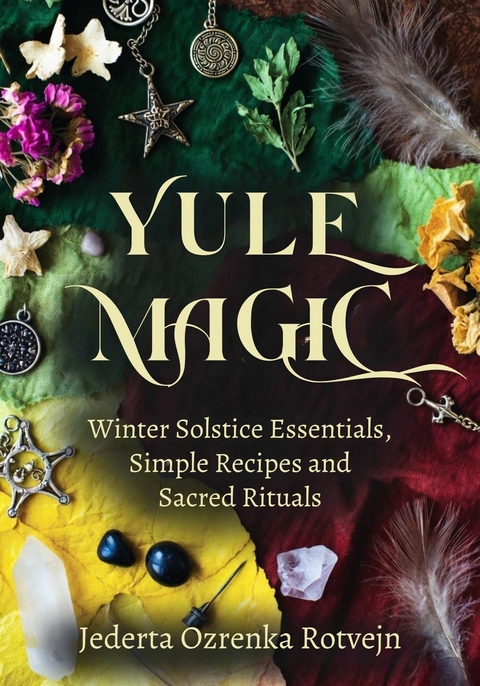
Yule Magic (eBook)
236 Seiten
Seahorse Pub (Verlag)
978-0-00-110164-7 (ISBN)
Discover the enchanting magic of the darkest night with Yule Winter Solstice Essentials, your ultimate guide to embracing ancient pagan traditions in a modern world. Drawing from five millennia of historical wisdom-from Neolithic stone alignments like Newgrange to Norse feasts and Roman Saturnalia-this captivating book unveils the profound symbolism of evergreens, holly, and mistletoe, while offering practical ways to honor the sun's rebirth.
Whether you're a seasoned witch or curious beginner, Rotvejn shares easy-to-follow spells for prosperity and protection, family-friendly ceremonies, and divination techniques to glimpse the year ahead. Infuse your home with seasonal energy through budget-friendly crafts, like enchanted wreaths and hearth blessings, and savor nourishing dishes infused with intention, from solar bread to spiced prosperity potions.
Adapt rituals for urban apartments, accessibility needs, or shared spaces, blending authentic folklore with contemporary innovation. Ignite your spirit, foster renewal, and connect deeply with nature's cycles. Perfect for solitary practitioners or covens, this empowering tome transforms midwinter into a time of hope, healing, and magical abundance. Welcome the returning light-your journey to a meaningful, sustainable practice starts here.
Chapter 1
History of Yule Celebrations
The December wind cuts through the valley as the sun dips below the horizon—earlier each day for weeks now. A small group gathers at the stone circle, their breath clouding in the frigid air. They've tracked the sun's journey across the sky all year, marking its path with carefully placed stones. Tonight, the shortest day, they'll watch where the light breaks through the monuments at dawn. Their survival depends on understanding these patterns—when to plant, when to harvest, when the dark will finally retreat.
Archaeological evidence reveals that humans have marked the winter solstice for at least 5,000 years, though the practices we can document differ significantly from modern Yule celebrations. The most concrete evidence comes from megalithic structures across Northern Europe and the British Isles. Newgrange in Ireland, dated to approximately 3200 BCE, features a passage precisely aligned to channel sunlight into its central chamber only during the winter solstice sunrise. This wasn't decorative—it required sophisticated astronomical knowledge and tremendous communal effort, suggesting the solstice held profound significance for Neolithic peoples.
Similar solar alignments appear at Maeshowe in Orkney (2800 BCE) and Stonehenge in England (construction phases 3000-1600 BCE). At Stonehenge, the Heel Stone frames the winter solstice sunset when viewed from the center, though scholars debate whether summer or winter solstice was the primary focus. The archaeological record shows these sites were gathering places—excavations reveal feasting debris, animal bones, and evidence of large assemblies. However, we cannot know what rituals occurred or what beliefs motivated their construction. Modern interpretations about "ancient pagan ceremonies" at these sites often project contemporary ideas onto prehistoric peoples whose worldviews remain fundamentally unknowable.
What we can document: these communities invested enormous resources in tracking solar movements. The winter solstice represented a critical astronomical event for agricultural societies. Whether they celebrated, feared, or simply marked the turning point remains speculative. Rock art from Scandinavia (1800-500 BCE) depicts solar symbols, ships, and what appear to be ritual processions, but interpreting prehistoric imagery is inherently uncertain.
The oldest written references to midwinter celebrations come from Roman observers describing Germanic and Celtic peoples. Pliny the Elder (23-79 CE) documented Druidic ceremonies involving oak and mistletoe, though his accounts reflect Roman biases and shouldn't be accepted uncritically. Tacitus (56-120 CE) described Germanic tribes holding festivals during dark months, complete with feasting and ritual observances, but provided few specific details about winter solstice practices.
The Archaeological Evidence Gap
Understanding prehistoric solstice observances faces inherent limitations. Stone alignments prove astronomical knowledge but not ritual practice. Feasting debris indicates gatherings but not their meaning. We can establish that certain structures tracked solar movements and that people assembled at these sites, but extrapolating specific ceremonies, deities, or beliefs exceeds available evidence.
Modern paganism often claims to "reconstruct" ancient practices, but honest scholarship acknowledges we're creating new traditions inspired by limited historical fragments, not recovering lost knowledge intact. Archaeological evidence shows what people built and where they gathered—not what they believed, sang, or ritualized. The responsible approach honors this uncertainty while finding meaning in what we can document: that humans have marked the year's darkest moment for millennia, finding hope in light's inevitable return.
Cultural Traditions
Snow blankets the longhouse roof as the Germanic family prepares for Yuletide. For twelve nights, the household will feast, no work will be done, and the boundaries between worlds grow thin. The father sacrifices a boar to Freyr, god of fertility and harvest, while children hang offerings on the evergreen tree inside their home. Outside, the Wild Hunt rides—Odin and his ghostly warriors sweeping across winter skies. The family bolts doors and windows, protection against spirits abroad during this threshold time.
Germanic traditions provide our richest documentation of Yule-specific practices. The Old Norse term "jól" (Yule) appears in numerous medieval sources, most notably in the Icelandic sagas and the Prose Edda compiled by Snorri Sturluson around 1220 CE. The Norse celebrated a midwinter festival involving sacrificial feasting (blót), where animals—particularly boars sacred to Freyr—were offered to ensure fertility and good harvests. The Ynglinga saga describes Swedish King Domalde sacrificed to end famine, illustrating the serious religious nature of these observances.
The twelve days of Yule originated in Germanic tradition, marked by cessation of work, feasting, and supernatural danger. The Wild Hunt, documented across Germanic regions, represented Odin leading dead warriors through winter skies. Household protection magic intensified during Yule when boundaries between worlds weakened. Evergreens brought indoors served protective and life-affirming functions—not decorative choices but magical acts against winter's death.
However, most written sources post-date Christianization, creating documentation challenges. Snorri Sturluson wrote as a Christian interpreting older traditions. The sagas, while preserving authentic cultural memory, were recorded centuries after conversion. We must carefully distinguish between documented pre-Christian practices and later Christian authors' interpretations.
Celtic midwinter traditions prove harder to document definitively. While Celtic peoples certainly marked the solstice astronomically, specific ritual practices remain obscure. Roman accounts describe Druidic ceremonies, but these reflect outsider perspectives and propaganda. Medieval Irish texts mention midwinter gatherings, but most sources post-date Christianization significantly.
The oak and mistletoe connection, popularized in modern Druidic revival, originates from Pliny's first-century account. He described Druids harvesting mistletoe from oak trees with golden sickles during ceremonial occasions—but didn't specify winter solstice, and his account serves Roman purposes of depicting barbarian others. Archaeological evidence of Celtic ritual practice comes primarily from votive deposits and temple sites, none clearly linked to specific solar festivals.
What we can establish: Celtic peoples possessed sophisticated astronomical knowledge, evidenced by monuments like Newgrange. They held midwinter assemblies involving feasting and ritual. Oak trees held sacred significance. But connecting these elements into specific "Yule" celebrations requires acknowledging we're making informed reconstructions, not documenting historical certainty.
Roman Saturnalia (December 17-23) influenced later European midwinter traditions significantly. This well-documented festival honoring Saturn involved gift-giving, feasting, social role reversal, and widespread celebration across the Empire. Households decorated with evergreens, candles illuminated darkness, and normal social hierarchies temporarily suspended. While not a solstice festival per se, Saturnalia's proximity and elements influenced how Christianized Europeans later celebrated Christmas—and how modern practitioners reconstruct Yule.
Slavic winter traditions centered on several interconnected celebrations. Koliada, celebrated around the winter solstice, involved caroling, divination, and welcoming the returning sun. Young people would dress in costumes, visit homes singing traditional songs, and receive gifts—practices surviving in modified forms into the present. The Slavic tradition emphasized ancestral connection during winter's darkness, with elaborate feast preparations honoring the dead.
Slavic peoples burned Yule logs (badnjak in South Slavic traditions) selected with specific rituals and kept burning throughout celebrations. The log's protective and life-giving properties were central to household wellbeing. After burning, ashes and remaining wood received special treatment—scattered on fields for fertility or kept as protective charms.
The Problem of Written Sources
Most documentation of pre-Christian European traditions comes from three problematic source types: Roman accounts (outsider perspectives often serving propaganda purposes), medieval Christian writers (recording suppressed practices from hostile viewpoints), and late-medieval/early-modern folklore collections (gathered centuries after Christianization).
This creates methodological challenges. When a thirteenth-century Christian monk describes "pagan" practices, he's interpreting traditions already transformed by centuries of Christian influence through his own theological lens. When nineteenth-century folklorists collected "ancient customs," they encountered syncretic practices blending Christian and older elements, often misinterpreting their findings through romantic nationalism.
Responsible historical work acknowledges these limitations. We can establish broad patterns—Germanic peoples held midwinter sacrificial feasts, Celtic cultures marked solar turning points, Slavic traditions emphasized ancestral connection—but specific ritual details often remain speculative. The honest approach presents what documentation supports while admitting uncertainty about elements beyond historical recovery.
Evolution Through Time
The medieval monastery bell rings for Matins as December's...
| Erscheint lt. Verlag | 13.11.2025 |
|---|---|
| Sprache | englisch |
| Themenwelt | Sachbuch/Ratgeber ► Gesundheit / Leben / Psychologie ► Esoterik / Spiritualität |
| ISBN-10 | 0-00-110164-1 / 0001101641 |
| ISBN-13 | 978-0-00-110164-7 / 9780001101647 |
| Informationen gemäß Produktsicherheitsverordnung (GPSR) | |
| Haben Sie eine Frage zum Produkt? |
 EPUB (Adobe DRM)
Größe: 2,8 MB
Kopierschutz: Adobe-DRM
Adobe-DRM ist ein Kopierschutz, der das eBook vor Mißbrauch schützen soll. Dabei wird das eBook bereits beim Download auf Ihre persönliche Adobe-ID autorisiert. Lesen können Sie das eBook dann nur auf den Geräten, welche ebenfalls auf Ihre Adobe-ID registriert sind.
Details zum Adobe-DRM
Dateiformat: EPUB (Electronic Publication)
EPUB ist ein offener Standard für eBooks und eignet sich besonders zur Darstellung von Belletristik und Sachbüchern. Der Fließtext wird dynamisch an die Display- und Schriftgröße angepasst. Auch für mobile Lesegeräte ist EPUB daher gut geeignet.
Systemvoraussetzungen:
PC/Mac: Mit einem PC oder Mac können Sie dieses eBook lesen. Sie benötigen eine
eReader: Dieses eBook kann mit (fast) allen eBook-Readern gelesen werden. Mit dem amazon-Kindle ist es aber nicht kompatibel.
Smartphone/Tablet: Egal ob Apple oder Android, dieses eBook können Sie lesen. Sie benötigen eine
Geräteliste und zusätzliche Hinweise
Buying eBooks from abroad
For tax law reasons we can sell eBooks just within Germany and Switzerland. Regrettably we cannot fulfill eBook-orders from other countries.
aus dem Bereich