


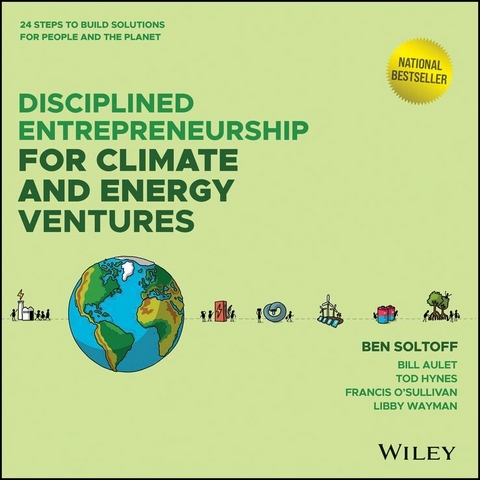
Disciplined Entrepreneurship for Climate and Energy Ventures (eBook)
461 Seiten
Wiley (Verlag)
978-1-394-28552-5 (ISBN)
Create exciting new products and build successful companies in the climate and energy sectors
In Disciplined Entrepreneurship for Climate and Energy Ventures: 24 Steps to Build Solutions for People and the Planet, veteran entrepreneur Bill Aulet, climate tech expert Ben Soltoff, and the faculty behind MIT's Climate & Energy Ventures course, Tod Hynes, Francis O'Sullivan, and Libby Wayman, deliver a comprehensive discussion of how to bring your climate or energy startup/venture to life.
You'll learn how to create a successful climate and energy venture using the authors' effective, 24-step framework that you can apply to your entrepreneurial idea, taking much of the guesswork and uncertainty out of your business journey. The book offers a precise, scientific approach to entrepreneurship and proves that effective entrepreneurship is more about the careful application of data and science than it is an exercise in blind intuition.
You'll find:
- A step-by-step guide to starting your new climate or energy venture offering a clear, systematic path to profitability
- Instructions on building and scaling your new firm and meeting your entrepreneurial ambitions
- Templates, tools, techniques, and strategies for climate and energy entrepreneurs at every stage of their business' growth, from initial idea to globally scaled solution
Perfect for aspiring and practicing entrepreneurs, founders, and managers in the climate, energy, and environment sectors, Disciplined Entrepreneurship for Climate and Energy Ventures is an expert guide for professionals ready to level-up their entrepreneurial skills and achieve a positive impact on people and the planet.
Ben Soltoff is an Entrepreneur in Residence and the Ecosystem-Builder in Residence at the Martin Trust Center for MIT Entrepreneurship. He has extensive experience in the area of climate technology and was previously the Environmental Innovation Manager at the Yale Center for Business and the Environment as well as an Innovation Fellow at the Tsai Center for Innovative Thinking at Yale.
Bill Aulet is the Ethernet Inventors Professor of the Practice of Entrepreneurship at MIT Sloan School of Management and the Managing Director of the Martin Trust Center for MIT Entrepreneurship. He has over 45 years' experience in entrepreneurship and business. He is a bestselling author and an award-winning educator.
Tod Hynes is a Senior Lecturer at MIT Sloan School of Management and a co-founder and long-time instructor in the MIT Climate and Energy Ventures course at MIT. He has been working, investing, volunteering, and advising in climate and clean energy since 2002. In 2008, he founded XL Hybrids and served as CEO for 11 years. The company went public in 2020 as XL Fleet and today is Spruce Power.
Francis O'Sullivan is a Senior Lecturer at MIT Sloan School of Management and long-time instructor in the MIT Climate and Energy Ventures course at MIT. He holds a PhD from MIT and was the Director of Research for the MIT Energy Initiative where he authored numerous seminal reports. His industry work experience includes senior positions at McKinsey, Ørsted and currently as Managing Director at S2G Investments.
Libby Wayman is a Senior Lecturer at MIT Sloan School of Management and long-time instructor in the MIT Climate and Energy Ventures course at MIT. She holds a Master's in Mechanical Engineering from MIT. Her industry and government work experience includes Sun Power, Alion, the U.S. Department of Energy, and General Electric (GE), and she is currently a Partner at Breakthrough Energy Ventures.
Create exciting new products and build successful companies in the climate and energy sectors In Disciplined Entrepreneurship for Climate and Energy Ventures: 24 Steps to Build Solutions for People and the Planet, veteran entrepreneur Bill Aulet, climate tech expert Ben Soltoff, and the faculty behind MIT's Climate & Energy Ventures course, Tod Hynes, Francis O'Sullivan, and Libby Wayman, deliver a comprehensive discussion of how to bring your climate or energy startup/venture to life. You'll learn how to create a successful climate and energy venture using the authors' effective, 24-step framework that you can apply to your entrepreneurial idea, taking much of the guesswork and uncertainty out of your business journey. The book offers a precise, scientific approach to entrepreneurship and proves that effective entrepreneurship is more about the careful application of data and science than it is an exercise in blind intuition. You'll find: A step-by-step guide to starting your new climate or energy venture offering a clear, systematic path to profitability Instructions on building and scaling your new firm and meeting your entrepreneurial ambitions Templates, tools, techniques, and strategies for climate and energy entrepreneurs at every stage of their business' growth, from initial idea to globally scaled solution Perfect for aspiring and practicing entrepreneurs, founders, and managers in the climate, energy, and environment sectors, Disciplined Entrepreneurship for Climate and Energy Ventures is an expert guide for professionals ready to level-up their entrepreneurial skills and achieve a positive impact on people and the planet.
INTRODUCTION
Tackling the Dual Challenge
Throughout history, energy has been interlinked with human progress. Coal, oil, and gas initially seemed like gifts from the gods. Their high-density energy-to-mass ratio allowed for rapid economic prosperity. If a scientist in a lab had invented any of them, they would have surely gotten a Nobel Prize. These energy sources fueled the Industrial Revolution and advanced society in unimaginable ways.
But like most things in life, this progress came at some costs. Many of our most prevalent energy sources emit greenhouse gases, which we now know cause warming and other changes to the climate. Since the Industrial Revolution, the average global temperature has gone up by more than a full degree Centigrade—closer to one and a half degrees if we look at the hottest recent years. That may not seem like a lot, but it is the fastest rate of temperature change on Earth in the last 10,000 years, and the world is now hotter than it has been in 100,000 years. We are facing a level and rate of warming that has not happened since the dawn of humanity.
The grand challenge of the 21st century will be to decouple energy use from emissions. We need to increase reliable and affordable access to energy while addressing detrimental effects on the climate, which includes removing the emissions and heat that we've added to the earth's system. This is what is known as the Dual Challenge.1
Solving the Dual Challenge is an urgent priority. When we started working on these issues, climate change was regarded as a future problem, but it is now clear that we are facing the impacts in the present. This is more apparent than ever in the United States, where we live. Just in the year we wrote this book (2024–2025), we saw floods that washed away entire communities in western North Carolina, as well as wildfires that burned huge swaths of Los Angeles, the second largest city in the country.
Much of the widely accepted social narrative on climate change focuses on grim prognostications about how these effects are getting worse. But we only get so far by fretting about what could happen, rather than rolling up our sleeves and doing something about it.
What Does This Mean for Entrepreneurs?
This is a book for entrepreneurs, and entrepreneurs don't see change as something scary; they see it as a source of great opportunity. The Dual Challenge is one of the greatest opportunities of our era. Does that mean we are advocating for entrepreneurs to exploit problems in the name of profit? Quite the opposite, actually. At its core, entrepreneurship is about solving problems, and it is about doing so in a manner that is not only financially sustainable but also financially successful, because that is a proven pathway to achieve both scale and impact.
The Dual Challenge poses a host of interesting and important problems to solve. For instance, there is the energy transition that entails moving away from an emissions-heavy energy system and toward one that is neutral or even beneficial for the climate. We need to provide a clean path for growth that works for countries across all levels of economic development.
We must also find ways to help people, institutions, and systems adjust to an altered environment. Our global economy was built on a stable climate that no longer exists. We need to adapt to the new changing climate and become more resilient at the local, national, and global level. This shift creates a tremendous opportunity for those who are willing to embrace and drive change.
Climate and energy problems create new markets, and entrepreneurs stand to gain immensely if they can figure out how to serve them and capitalize on transformative business models. They also get the added benefit of doing the right thing for current and future generations.
The Dual Challenge is often regarded, falsely, as a trade-off—we can either have better lives or we can have fewer emissions. Scalable climate and energy solutions must find a win-win. Entrepreneurs have many opportunities to create products that enhance user experience while solving pressing global problems.
We should note here that not all entrepreneurs are startup founders. Entrepreneurs can also operate in existing companies, organizations, and government institutions. Innovation in those places is essential for building solutions at scale where they can have meaningful impact in a short amount of time. We need companies with large balance sheets and capital-intensive infrastructure to be deeply involved, because they can handle scale and long timelines. We need entrepreneurs to thrive within large energy organizations … and even within government, nonprofits, and academic institutions.
If any of that sounds appealing, then you might just be a climate and energy entrepreneur, and this book is for you!
Yes, Climate and Energy Entrepreneurship Can Be Taught!
More than a decade ago, Bill Aulet began the first edition of Disciplined Entrepreneurship by posing the question of whether entrepreneurship could be taught. Over the course of that book, he answered that question with a clear and resounding yes. For over a decade, Disciplined Entrepreneurship has provided would-be entrepreneurs with a 24-step framework that is rigorous, accessible, and open source. Since the book was published, this framework has benefited hundreds of thousands of entrepreneurs and entrepreneurial thinkers, and it is now taught at hundreds of universities worldwide.
Disciplined Entrepreneurship (DE) also continues to be the backbone of much of MIT’s entrepreneurship curriculum, as well as hundreds of other schools too. MIT is home to what may be the oldest US entrepreneurship course,2 which is currently structured as a step-by-step run-through of the DE process, where students learn each step by actively working on a startup idea.
The DE framework is also a valuable resource for courses that focus on entrepreneurship within a certain industry or area. One of the most successful courses in that category is Climate & Energy Ventures (CEV), which Bill described in his Foreword to this book. The course solicits the most promising climate-related ideas or technologies from MIT and beyond, and students join interdisciplinary teams to explore the potential of these ideas and technologies as scalable climate ventures. You will find case studies from some of those companies throughout this book.
Over the years, we have observed and mentored hundreds of climate and energy startups. We have found not only that climate and energy entrepreneurship can be taught but also that it should be taught! We need as many bright minds and great ideas as possible addressing this challenge, and these concepts should be available to everyone. However, even with the best training and preparation, it is a hard road.
Why Is It So Tough to Be a Climate and Energy Entrepreneur?
Climate and energy ventures tend to be resource-intensive, tech-heavy, infrastructure-building businesses deeply intertwined with government and large corporations. They face excruciatingly long pathways to market and must build up a sophisticated capital stack, often to produce a commodity that's chemically or physically identical to incumbent products. On top of that, the founders bear the moral and emotional burden of dealing with the planet itself as a stakeholder—the weight of the world is on their shoulders.
Due to the long timelines and high capital needs, climate and energy ventures have what we call a high price of poker relative to other ventures. It costs more to play the game, which means that you need to make each move more thoughtfully and intentionally, including the decision of whether to play at all. The price of poker escalates over time. The longer you play, the pricier it gets, and if you cannot ante up for the next round, you fold.
The price of poker is much higher for climate and energy ventures than for other types of ventures.
Another way to think about the difficulty of climate and energy ventures is what's called the valley of death, which is the phenomenon where promising solutions fail to reach scale due to the challenges of funding, scaling, and deploying new technology. In practice, climate and energy ventures usually face multiple valleys of death, because each stage of technology development and commercialization requires a step change in the amount of time, money, and customer traction necessary to proceed. Each stage also involves different management skills and a different set of expectations from new funders and supporters.
Valleys of death are not unique to climate and energy. They exist across all deep tech, a term for ventures that aim to commercialize complex science or engineering innovations, usually requiring substantial research and development as well as large amounts of money.
Climate and energy ventures face multiple valleys of death.
As we said, it is a hard road, but if you are up to the challenge, you are in luck. This book will break down the journey of starting a climate and energy venture, letting you know what to expect and how to navigate it. Like the original Disciplined Entrepreneurship, our framework will not guarantee a positive result, but it will vastly increase your odds of success.
To DE or Not to DE?
As we were writing this book, a few people asked us why climate and energy ventures would require their own book when there are so many great...
| Erscheint lt. Verlag | 10.11.2025 |
|---|---|
| Reihe/Serie | Disciplined Entrepreneurship Series |
| Sprache | englisch |
| Themenwelt | Sachbuch/Ratgeber ► Beruf / Finanzen / Recht / Wirtschaft |
| Wirtschaft ► Betriebswirtschaft / Management | |
| Schlagworte | climate business • climate entrepreneurship • disciplined entrepreneurship framework • disciplined entrepreneurship guide • disciplined entrepreneurship handbook • Energy Entrepreneurship • Environmental business • environmental entrepreneurship |
| ISBN-10 | 1-394-28552-3 / 1394285523 |
| ISBN-13 | 978-1-394-28552-5 / 9781394285525 |
| Informationen gemäß Produktsicherheitsverordnung (GPSR) | |
| Haben Sie eine Frage zum Produkt? |
 EPUB (Adobe DRM)
Kopierschutz: Adobe-DRM
Adobe-DRM ist ein Kopierschutz, der das eBook vor Mißbrauch schützen soll. Dabei wird das eBook bereits beim Download auf Ihre persönliche Adobe-ID autorisiert. Lesen können Sie das eBook dann nur auf den Geräten, welche ebenfalls auf Ihre Adobe-ID registriert sind.
Details zum Adobe-DRM
Dateiformat: EPUB (Electronic Publication)
EPUB ist ein offener Standard für eBooks und eignet sich besonders zur Darstellung von Belletristik und Sachbüchern. Der Fließtext wird dynamisch an die Display- und Schriftgröße angepasst. Auch für mobile Lesegeräte ist EPUB daher gut geeignet.
Systemvoraussetzungen:
PC/Mac: Mit einem PC oder Mac können Sie dieses eBook lesen. Sie benötigen eine
eReader: Dieses eBook kann mit (fast) allen eBook-Readern gelesen werden. Mit dem amazon-Kindle ist es aber nicht kompatibel.
Smartphone/Tablet: Egal ob Apple oder Android, dieses eBook können Sie lesen. Sie benötigen eine
Geräteliste und zusätzliche Hinweise
Buying eBooks from abroad
For tax law reasons we can sell eBooks just within Germany and Switzerland. Regrettably we cannot fulfill eBook-orders from other countries.
aus dem Bereich


