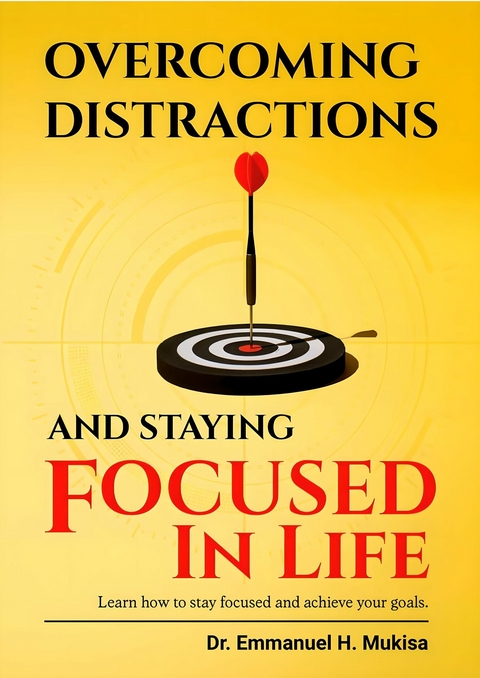
Overcoming Distractions And Staying Focused In Life (eBook)
160 Seiten
Publishdrive (Verlag)
978-0-00-109324-9 (ISBN)
Overcoming distractions & staying focused in life is your comprehensive guide to mastering focus in a world full of interruptions. Discover practical techniques to break free from multitasking, manage digital distractions, and prioritize tasks for greater productivity.
With strategies like deep work, mindfulness, and time management, this book helps you build self-discipline, overcome setbacks, and maintain momentum on your goals. Whether you're striving for personal growth or professional success, overcoming distractions & staying focused in life equips you to thrive with clarity and purpose.
Understanding Distractions: Why They Happen and How They Affect Your Productivity
With the fast world, one gets distracted by different things nowadays. These may include everything from the sound of a notification on your phone or somebody loudly talking to even your very own meandering thoughts. These will make focusing well on something a bit difficult. Understanding why distractions happen is key to managing them effectively. They occur mainly due to external causes, such as environmental noise or internal ones like stress and boredom. The brain is always in a process and that is what makes it susceptible to shifts of attention every time something catches its focus. Being able to identify the root causes will go a long way in helping your control them more effectively.
One major reason for distractions is the lack of attention control. The brains naturally and always will have attention deflected to whatever is immediately stimulating. This could be the case when one is working on a certain piece of work which may require many amounts of concentration or is very tedious or even intricate. To clarify this better, at times one just wants to get deep into some cumbersome report and disrupted by a very loud noise. The human brain loves novelty, and that is why it is susceptible to new stimuli. This need for novelty might turn out to be a stumbling block when you want to focus on something.
Another basis of distractions is multitasking. While this may appear to be very efficient-doing many things together-the results of research show that multitasking usually leads to lower productivity. The brain cannot seem to focus on more than one thing at a time, and there is mental exhaustion during task switches. Continuous errors and delays arise because of this fact. During multitasking, a person's attention gets divided between several activities and each job will take far more time than it naturally would have required. The one thing at a time will have better results in getting more or less sustainable productivity.
External factors are very responsible for distraction. The working environment nowadays consists of disturbances: from people coming up and asking something to flooding e-mails, buzz of social media outings. These external cues draw our attention away from the current task and make us lose focus. Even minor distractions lead to a big loss in productivity, since refocusing takes some time. There tend to be more distractions arising in open offices due to noise and visual disturbances. Many a time, the environment may be a major contributor to the loss of productivity.
Internal distractions are more personal, usually emanating from emotional or mental states: anxiety, hunger, or stress might turn out very disrupting to focus. As long as there is some kind of emotional or physical discomfort occupying the mind of a person, it is very hard for him to be focused on his work. For example, thinking about meeting a deadline or having some problems in personal life, one is unable to focus on what one is doing. Moreover, it easily shows attractions when one feels worn out or in pressure situations as they are seen to present immediate avenues of escaping those current pressures. Some of these inner factors might prove a little trickier to work your way around, yet they still rank among the greatest hurdles towards staying focused.
The other modern productivity distraction is digital ones. The internet is filled with loads of potential distractions in the form of social media applications and online videos. After all, people, even with the best of intentions, find themselves browsing the web when they really should be working. These are designed to be attention-seeking, with notifications, images, and updates motorized in their resistance. Digital platforms are designed in such a way that people ought not to get hooked. It is the addictive nature of such digital platforms that normally gets them to end up spending more time online than was initially intended.
While technology helped to increase productivity, it also causes disruption in many other, sometimes unexpected ways. Constant notifications from smartphones and computers make people check their devices even when they do not even intend to. It disrupts the workflow of a person and decreases time spent on complicated tasks. In some cases, it results in "task-switching," where people jump from one task to another without completing any of them fully. Such fragmentation of labor reduces quality while increasing the work time consumed. Ensuring that a lack of surplus access to such technology during hours of work thus helps to keep distracted minds together.
Other common kinds of self-imposed detourings are the forms of procrastination: when one thinks of delaying beginning an unpleasing or troublesome job, while in between doing less bothersome and irritating jobs or anything that one particularly enjoys doing. This may trigger a vicious circle of anxiety whereby, with time, the task becomes urgent. Because people get engrossed in the stress of the unfinished tasks, this only exacerbates the problem. In some cases, this is linked to the fear of failure or perfectionism in that people will prevent themselves from starting to attempt doing something perfectly. The first one is recognizing procrastination as being a distraction to work.
The other distractions involve those that are driven by boredom, especially in situations where a task is not challenging or requires repetition. Generally, the human brain seeks activity, and in the absence of it, there are going to be distractions to replace that feeling of void. Simpler tasks with lesser involvement of your brain will surely drift your attention out. An already drifted mind is going to wander off to easier, more accessible distractions, such as your phone. It is true that this condition does tend to majorly obstruct deep work. It's good that feelings of boredom can be caught for an early warning that it's time to do something to get re-engaged in what one is doing. To minimize feelings of boredom, one can introduce variety or else set specific goals about the task.
We also cannot negate the role of sleep in managing distractions. Sleep deprivation will lead to cognitive impairment, hence weak capability of focusing, and the chance to be easily distracted increases. The brain is getting weaker at processing information; therefore, decision making turns out to become more sluggish, hence means a person isn't focused will get distracted far more often. The brain operates the best in attempt to stay up. Without rest, it's way harder to stay on task-that's how simple the link between sleep and productivity is. Of all the important ways to cut distractions and boost general productivity, paying attention to sleep is significant.
Another strong internal distraction to productivity is stress. While under stress, the human body secretes a number of hormones, including cortisol, which interfere with cognitive functions. It easily results in a person losing the ability to concentrate, decide on things, or pay attention. High levels of stress create hyperarousal, but it can backfire and make it even harder to filter out irrelevant information. Prolonged chronic stress over time will deplete cognitive clarity and lower memory, making one even more distractible. Deal with your stress either through relaxation techniques or effective time management to stay productive.
Social media has been designed to be engaging and to hold one's attention; hence, it probably is a modern distraction. In the sea of updates, posts, and notifications, it is easy for one to lose track of time spent browsing their feeds. Social media platforms use algorithms to keep the feed in front of viewers interesting at all times, dynamic, and auto-refreshing due to users' behavior and preferences. That is such a spiral of activity that gets tough to break-even, not even for much more significant events/chores that seek your attention. This puts limits on time or the use of "productivity apps," highly advisable. Being consistently reminded of how social media disrupts your focus will minimize its ability to derail your productivity.
Physical environments can control distractions, too. The cluttered and disorganized settings create some form of mental noise that later on causes intrusion in the mind. A neat and organized workplace can allow a person to reduce such distractions and focus more on their work. Similarly, the degree of noisiness around can make a serious difference in someone's ability to focus. For some, there are never any problems with a buzzing atmosphere; for others, they just cannot work if it is too loud. Being aware of your workplace and arranging it in an appropriate manner will provide the right setting for work.
The human avoidance of discomfort might also serve as a source of distraction, in cases when the tasks are too boring or too hard. If for example a person is uncomfortable with certain work, he or she may switch to thoughts of other activities that would be more pleasing or less stressful for the brain. This avoidance generally happens unconsciously but nevertheless is a source of strong distraction. The need for immediate gratification can make it hard to stick with longer-term projects that require sustained effort. It is a forewarning signal, though, to build strategies to overcome this kind of tendency-such as breaking tasks down into smaller, more manageable ones. Confront the discomfort straightaway to enable productivity in the best possible way.
Studies have proved that the practice of mindfulness and meditation trains the brain to avoid distractions. In this way, one will be able to realize when his or her attention has wandered and bring it back into the present moment. It...
| Erscheint lt. Verlag | 30.10.2025 |
|---|---|
| Sprache | englisch |
| Themenwelt | Sachbuch/Ratgeber ► Gesundheit / Leben / Psychologie ► Esoterik / Spiritualität |
| ISBN-10 | 0-00-109324-X / 000109324X |
| ISBN-13 | 978-0-00-109324-9 / 9780001093249 |
| Informationen gemäß Produktsicherheitsverordnung (GPSR) | |
| Haben Sie eine Frage zum Produkt? |
 EPUB (Adobe DRM)
Größe: 1,3 MB
Kopierschutz: Adobe-DRM
Adobe-DRM ist ein Kopierschutz, der das eBook vor Mißbrauch schützen soll. Dabei wird das eBook bereits beim Download auf Ihre persönliche Adobe-ID autorisiert. Lesen können Sie das eBook dann nur auf den Geräten, welche ebenfalls auf Ihre Adobe-ID registriert sind.
Details zum Adobe-DRM
Dateiformat: EPUB (Electronic Publication)
EPUB ist ein offener Standard für eBooks und eignet sich besonders zur Darstellung von Belletristik und Sachbüchern. Der Fließtext wird dynamisch an die Display- und Schriftgröße angepasst. Auch für mobile Lesegeräte ist EPUB daher gut geeignet.
Systemvoraussetzungen:
PC/Mac: Mit einem PC oder Mac können Sie dieses eBook lesen. Sie benötigen eine
eReader: Dieses eBook kann mit (fast) allen eBook-Readern gelesen werden. Mit dem amazon-Kindle ist es aber nicht kompatibel.
Smartphone/Tablet: Egal ob Apple oder Android, dieses eBook können Sie lesen. Sie benötigen eine
Geräteliste und zusätzliche Hinweise
Buying eBooks from abroad
For tax law reasons we can sell eBooks just within Germany and Switzerland. Regrettably we cannot fulfill eBook-orders from other countries.
aus dem Bereich