


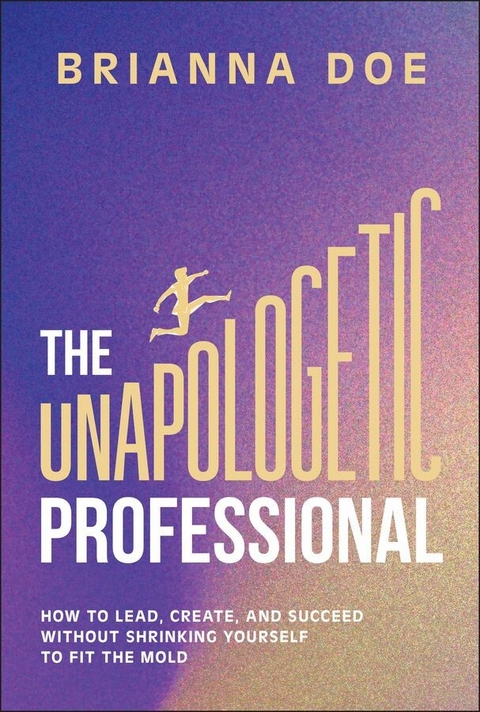
The Unapologetic Professional (eBook)
244 Seiten
Wiley (Verlag)
978-1-394-32945-8 (ISBN)
For every founder, creative, and multi-hyphenate professional rewriting the rules about work.
The world tells you to pick one path, follow the rules, and shrink yourself to succeed. The Unapologetic Professional: How to Lead, Create, and Succeed without Shrinking Yourself to Fit the Mold is your permission slip to do the opposite, and thrive.
Veteran marketer and entrepreneur, Brianna Doe, delivers the tools, tactics, and real talk you actually need to build a resilient, fulfilling career on your own terms. This book is a how-to guide for designing a path that reflects your values, your voice, and your vision for what work should be.
If you've ever thought, 'Is it just me, or is this whole system broken?' You're not imagining it. But there's another way.
Through strategic insights, personal stories, and actionable frameworks, Doe will show you how to:
- Build a flexible, future-proof career without burning out or selling out
- Navigate pivots, plot twists, and nonlinear paths with clarity and confidence
- Overcome imposter syndrome, systemic bias, and career uncertainty-and reclaim your voice
- Identify the work only you can do, and let go of what's holding you back
- Redefine success on your terms (not your manager's, your job title's, or social media's)
Whether you're a first-gen professional, creative multi-hyphenate, or an entrepreneur figuring it out as you go, this is more than a career guide. It's a blueprint for building something meaningful and sustainable, without waiting for anyone's permission.
The Unapologetic Professional is your toolkit for leading, creating, and succeeding in the modern working world-and doing it without losing yourself in the process.
BRIANNA DOE is an award-winning marketer, entrepreneur, and speaker redefining the future of work and leadership. A first-generation American who built her career challenging outdated definitions of 'professionalism,' she's committed to changing how we shape-and who gets to define-work, leadership, and success. She has been featured in Fast Company, Forbes, Marketing Brew, and CNBC.
Chapter 1
Understanding Imposter Syndrome
Have you ever walked into a room and instantly questioned if you belonged there? Maybe it was a meeting where every face turned toward you, expecting you to prove your worth. Or perhaps you walked into a room and thought, I’m not qualified to be here.
Let me be the first to tell you that you’re definitely not alone. That feeling (the tightening in your chest, the mental rehearsing of your credentials, the instinct to shrink or overcompensate) is a common experience for many of us who occupy identities that aren’t the default. Many of us have our own version of the “I don’t belong here” narrative.
It’s exhausting, isn’t it? But it doesn’t have to define you.
For years, I struggled with this too. I used to believe that I had to wait for someone to invite me in, give me a seat at the table, or grant me permission to belong. But I eventually realized that the table exists because of people like us: people who bring unique perspectives, lived experiences, and new, fresh ideas that challenge the status quo.
Imposter syndrome, at its core, is that nagging voice that makes us question our worth and whether we deserve our place in the room. But let me tell you, you do belong. And you don’t have to wait for someone else to validate that for you.
What Is Imposter Syndrome?
You’ve probably heard the term before, but what does imposter syndrome actually mean?
Simply put, the National Library of Medicine defines imposter syndrome as “self-doubt of intellect, skills, or accomplishments among high-achieving individuals.”1 It could sound like this:
- I don’t belong.
- I’m not qualified.
- Despite all the hard work I’ve put in and all of my wins, I’m just pretending to know what I’m doing. It doesn’t matter how many wins I rack up or how many people sing my praises. I’m a fraud.
And trust me, it’s not just a catchy phrase thrown around LinkedIn and Instagram posts. It’s very real.
That internal battle can show up anywhere, but it’s especially common in environments where you’re the “only one” in the room: the only Black woman, the only person of color, the only first-generation American, the only one who doesn’t come from a traditional background. And this self-doubt can feel amplified by systemic inequities.
According to The State of Black Women in Corporate America, a report released by Lean In in 2020, for every 100 men promoted to manager, only 58 Black women are promoted (despite the fact that Black women ask for promotions at the same rate as men). And for every 100 men hired into managerial roles, only 64 Black women are hired.2
Between racial bias, microaggressions, and the wage gap, the corporate world isn’t exactly a level playing field. And that reality can create an external pressure that manifests as (you guessed it) imposter syndrome. Maybe it’s not that we always feel unqualified. Perhaps, for some of us, our qualifications are questioned and minimized at every turn.
Reflections for You
Before we go deeper, I want to pause and give you a moment to reflect. Think about a time when you felt like an outsider in a personal or professional setting.
- What triggered that feeling? Was it something external or internal?
- How did you respond in the moment? Did you shrink, adapt, or stand firm?
- In hindsight, what would you have done differently?
These moments don’t define us, but they can teach us something about how we will show up in spaces where belonging feels elusive. Write your reflections down. They’ll serve as a map for navigating future challenges.
The Psychological Impact of Imposter Syndrome
According to research by Dr. Pauline Clancy and Dr. Suzanne Ames, who coined the term imposter phenomenon, imposter syndrome can be linked to higher levels of anxiety, depression, burnout, and self-sabotage. When you feel like you must fake it, that can lead to burnout. You keep pushing yourself harder than necessary, working to prove something (to yourself, to others) that doesn’t need proving. The damage isn’t just professional. It’s psychological.
And that’s where it can get even trickier. Raise your hand if you’ve ever caught yourself overcompensating because you’re experiencing imposter syndrome. Maybe you overwork, obsess over every minute detail, or simply refuse to delegate tasks and projects because you don’t trust anyone else’s judgment. When something doesn’t lead to the perfection that you expect, the cycle of self-doubt intensifies and resets. You become trapped in an exhausting, unproductive loop.
It’s not just about not being given opportunities you deserve. It’s about the constant feeling of being “on guard,” of never knowing if your success is actually being tolerated or seen as a threat. This level of scrutiny forces many of us into a position of feeling like imposters, even when we have more than earned our place. And it’s not always about fixing ourselves. It’s also about recognizing and challenging the systems that contribute to these feelings.
Systemic Roots of Imposter Syndrome (It’s Not Just in Your Head)
April Little, an executive career coach, says it best: “Imposter syndrome isn’t something inherent or innate. It’s more often imposed upon us by our environment and internalized over time.”
For marginalized communities, imposter syndrome often stems from workplaces that
- dismiss or overshadow our voices,
- fail to recognize diverse perspectives, or
- perpetuate systems of exclusion.
April refers to this as the planting of “seeds of discord” in these environments. “I don’t believe people enter the workplace inherently feeling like frauds. These feelings develop when their expertise is dismissed, their voices are overshadowed, or their approach is labeled as ‘wrong.’”3
We have to stop pretending that imposter syndrome is just a buzzword about personal insecurity. Can it manifest that way? Absolutely. But for marginalized communities, it’s often a direct response to an environment that constantly undermines our worth because the systems, spaces, and environments we navigate aren’t neutral.
A Personal Reckoning with Imposter Syndrome
Let me take you to a recent moment: a VIP networking dinner where I was the only Black woman at the table (actually, the only woman, period). Picture this: White male CEOs, CMOs, and CROs who’ve been at the top of their fields for decades. I was honored to be there, but in the back of my head, that voice started whispering:
- Maybe I’m not supposed to be here.
- Maybe they regret inviting me.
- What if I embarrass myself?
I could feel myself slipping into a smaller version of me. It didn’t matter that I’d spent more than 13 years building my career, that I was a keynote speaker, or that I was a published writer. In that moment, I felt like 21-year-old me: freshly graduated, unsure, and trying to prove I deserved a seat at the table.
It’s funny, right, how we can become so absorbed by our own insecurities and perceived shortcomings that we forget everything else? The fight against imposter syndrome is a personal one, but it’s also universal. It’s the quiet work we do to remind ourselves that we are more than the doubts in our head (and others’ preconceived notions about us).
Here’s what I wish I’d told myself that night, and what I’m telling you now: Your presence in these spaces isn’t an accident, a favor, or a fluke. You’ve earned it. You belong there. And when imposter syndrome rears its ugly head, there are ways to fight back.
Reframing Imposter Syndrome: Tools to Shift Your Mindset
This feeling about “belonging” is about more than just being in the room. It’s about feeling confident and grounded in your place there. But when imposter syndrome creeps in, it can be hard to hold onto that sense of belonging. The good news: you can actively reframe those feelings and shift your mindset with a few key tools. Let’s break them down.
Recognize and Name the Doubt
One of the first steps to reframing imposter syndrome is identifying the feeling when it arises. That inner voice whispering, You’re not good enough, thrives in ambiguity and in silence. The moment you name it, you begin to take away some of its power.
Here’s how it works:
- Every time you walk into a room where you feel out of place, remind yourself: I am here for a reason. Write it on a sticky note. Repeat it in your head like a mantra. That internal shift is the first step toward owning your space.
- When the thought I’m not qualified to be here pops up, pause and say to yourself (or even out loud), “This is imposter syndrome talking.”
- Give it a name. Maybe it’s “Self-Doubt Shayla” or “Negative Nancy.” It sounds silly, I know, but naming the thought creates distance between you and the feeling. It becomes something...
| Erscheint lt. Verlag | 28.10.2025 |
|---|---|
| Sprache | englisch |
| Themenwelt | Sachbuch/Ratgeber ► Beruf / Finanzen / Recht / Wirtschaft |
| Wirtschaft ► Betriebswirtschaft / Management | |
| Schlagworte | Career guide • entrepreneur guide • entrepreneurship case studies • entrepreneurship guide • entrepreneurship stories • Entrepreneurship Strategies • Income diversification • Portfolio career • portfolio career guide • resilient career guide |
| ISBN-10 | 1-394-32945-8 / 1394329458 |
| ISBN-13 | 978-1-394-32945-8 / 9781394329458 |
| Informationen gemäß Produktsicherheitsverordnung (GPSR) | |
| Haben Sie eine Frage zum Produkt? |
 EPUB (Adobe DRM)
Kopierschutz: Adobe-DRM
Adobe-DRM ist ein Kopierschutz, der das eBook vor Mißbrauch schützen soll. Dabei wird das eBook bereits beim Download auf Ihre persönliche Adobe-ID autorisiert. Lesen können Sie das eBook dann nur auf den Geräten, welche ebenfalls auf Ihre Adobe-ID registriert sind.
Details zum Adobe-DRM
Dateiformat: EPUB (Electronic Publication)
EPUB ist ein offener Standard für eBooks und eignet sich besonders zur Darstellung von Belletristik und Sachbüchern. Der Fließtext wird dynamisch an die Display- und Schriftgröße angepasst. Auch für mobile Lesegeräte ist EPUB daher gut geeignet.
Systemvoraussetzungen:
PC/Mac: Mit einem PC oder Mac können Sie dieses eBook lesen. Sie benötigen eine
eReader: Dieses eBook kann mit (fast) allen eBook-Readern gelesen werden. Mit dem amazon-Kindle ist es aber nicht kompatibel.
Smartphone/Tablet: Egal ob Apple oder Android, dieses eBook können Sie lesen. Sie benötigen eine
Geräteliste und zusätzliche Hinweise
Buying eBooks from abroad
For tax law reasons we can sell eBooks just within Germany and Switzerland. Regrettably we cannot fulfill eBook-orders from other countries.
aus dem Bereich


