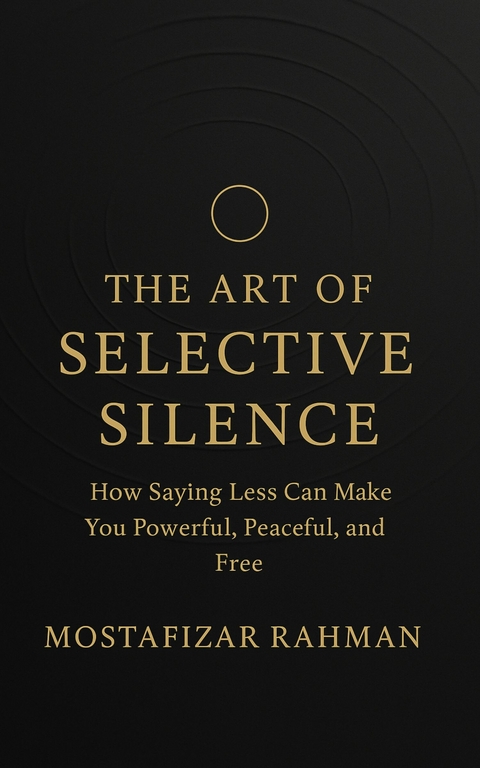
The Art of Selective Silence (eBook)
267 Seiten
Publishdrive (Verlag)
978-0-00-108781-1 (ISBN)
In a world obsessed with noise, The Art of Selective Silence teaches the hidden power of saying less. Through simple yet profound lessons, this book reveals how silence can become your strongest form of expression - a tool for confidence, clarity, and calm.
Discover how to speak only when it adds value, how to build inner peace in a loud world, and how silence can transform your relationships, career, and self-control.
Combining psychology, mindfulness, and communication strategies, this book guides readers to master the art of restraint and speak with intention.
Learn to:
Communicate powerfully through fewer words
Stay peaceful in conflict and chaos
Build presence without shouting for attention
Turn silence into a source of strength and wisdom
Quiet is not weakness - it's a superpower.
Preface — Why I Chose Silence
On a gray Tuesday that looked like every other Tuesday, I decided not to answer the world on its schedule. My calendar was a parade of tiny red dots; my mind, a crowded station. I made coffee, put the phone facedown, and promised myself one modest experiment: for the next day, I would do everything I normally do—work, care, commute, decide—while saying less than I usually say, and listening more than I usually listen. Not monastic less. Not performance art less. Just selectively less.
Nothing in the room changed, yet everything felt different. The hum of the refrigerator sounded like weather; the street sounded like a river. In that slight shift, I noticed how much of my life I had been narrating out loud or in my head. I heard the reflex that leaps to fill a pause; I saw the sentence ready to escape my mouth simply because a gap appeared. I watched my fingers itch toward a reply that—if I waited five breaths—no longer needed to exist.
Silence has a reputation problem. We confuse it with passivity, with sulking, with lack. We treat quiet as an absence to be repaired. But the silence I discovered that day was thick with presence. It did not make me smaller. It made me precise. The more I practiced it, the more I recognized a pattern: in the absence of noise, the essential introduced itself. The right next step became ordinary and obvious—so ordinary that I almost missed it while looking for something more dramatic.
I did not write this book to recruit you into a monastery, nor to shame you for participating in modern life. I wrote it so that you could remain modern without becoming reactive by default. You are allowed to live in a loud world without letting the world live loudly inside you. Selective silence is the method. It is a practical art: saying less so that you can notice more; pausing long enough to let your best self arrive; responding on purpose instead of reacting on cue.
You don’t need special robes or long weekends. You need three things:
A few simple tools that make pausing easier than pressing send.
A repeatable set of practices you can do in minutes, not hours.
A kinder story about what silence is and what it can do.
This book offers those three. It is research-literate without being research dependent, story-driven without being sentimental, and ruthlessly practical. I will not ask you to become a different person. I will invite you to become a clearer version of the one you already are. If you have ever left a conversation thinking, Why did I say all that?—or posted something you had to walk back later—you already understand the cost of constant reaction. What you may not yet have is a system for living differently. That is what these pages give you.
A few promises before we begin:
No mystique. We will keep the language plain and the ideas portable. You should be able to carry every chapter into your afternoon.
No overclaiming. Where science is clear, I’ll say so. Where it is suggestive, I’ll say so. Where experience is the better teacher, I’ll provide a practice you can try this week.
No moralizing. You are not bad for speaking, posting, reacting, or caring. We will not pretend you can live outside the culture you inhabit. We will learn how to inhabit it with more choice.
What qualifies me to write about silence? Not perfection. Practice. I have learned to pause in rooms where speed was celebrated. I have learned to wait the extra beat that makes a meeting smarter. I have learned that love sometimes asks for words, and sometimes only for presence. I have learned that there is a difference between withholding and choosing—and that the latter grows trust rather than fear. These lessons did not arrive as revelations. They accreted, like a shoreline, one patient tide at a time.
The structure of the book reflects that slow, useful accretion. Part I names the problem: the age of noise and the myth of constant reaction. Part II reframes silence as strength and explains—in ordinary language—what quiet does for a tired brain. Part III builds the habit: when to be silent in anger, debate, competition, grief, and accusation. Part IV follows silence into relationships, conflict, and work. Part V explores the inner shift from reflex to response. An Epilogue looks at what a quieter future might require of us. At the end, you’ll find a 21Day Practice Plan designed to make the habits automatic.
Along the way, I’ll give you short tools you can keep: a Response Ladder for hot moments, a Sound Map to audit your inputs, a Decision Denoise protocol for big choices, and a PACE Card to make five seconds of pause feel natural. None of these require a perfect life. They require only that you notice when a moment would be better served by less sound and more attention.
Two cautions as you start:
You will be misunderstood. When you practice selective silence, some people will project meaning onto your quiet that does not belong to you. They may read your pause as disapproval or distance. That’s part of the learning. We will practice phrases to hold the pause without closing the heart: “I’m listening,” “Give me a moment to think,” “Let me sit with this and return tomorrow.”
You will meet yourself. Noise is an excellent distraction from the parts of us that want care. In the quiet, emotions you’ve postponed may arrive. That is not failure. That is the work. Chapter 13 offers ways to process feeling without flooding yourself or anyone else.
I believe something simple: clarity loves a quiet room. You can build such a room anywhere—in a meeting, on a bus, in the kitchen at 6:30 a.m. The room is not defined by the absence of sound. It is defined by the presence of intention. Step into that room, and your best questions get braver. Your listening gets kinder. Your choices get cleaner. You stop spending sentences to buy approval you don’t need.
If you’re ready, begin with the smallest possible promise: before you answer the next thing that asks for you, take one slow breath and ask, What outcome would I love to cause here? If that question earns you even two seconds of silence, the book has already started working.
Let’s begin.
How to Use This Book
This is a field guide, not a textbook. Read it with a pen nearby and your calendar open. The aim is not to admire ideas about silence; the aim is to install silence as a life skill—the way you install budgeting or strength training. Here’s how to get the most from the pages ahead.
Read with a Rhythm
First pass — Understand (Parts I–II): Move quickly. Don’t stop to perfect anything. Circle the tools that feel promising.
Second pass — Install (Parts III–V): Slow down. Pick two tools per week and run them in real life. Tie each tool to a daily anchor (coffee, commute, meetings, bedtime) so you don’t rely on memory.
Third pass — Integrate (21Day Plan): Use the structured program as your operating system for three weeks. Then repeat your favorite week.
Work in Small, Honest Doses
Silence is a capacity that compounds. Ten honest minutes beats an hour you resent. If you only have two minutes before a call, use Mindful Pause (MP120) and a one-line intention: “In this meeting I will listen for what matters most.” If you miss a day, you don’t start over—you start again.
Customize the Tools
Time poor? Choose micro practices: Three Breaths Before Send, Five Minute Sit, Premeeting 30 seconds.
Stimulus rich environment? Start with Sound Map and Notification Diet. Your attention is a commons; protect it like you would a park.
High stakes decisions? Use Decision Denoise—limit sources, set a decision window, schedule a silent walk.
Relationship work? Try the Listening Date Challenge and the Three Nod, One Line reflection.
Keep It Humble and Observable
When you run a practice, write down what you actually did and what actually happened. Replace vague goals with specific behaviors: “No phone in bed,” “Two email windows,” “Ask one clarifying question before stating an opinion.” Track outcomes weekly: mood, clarity, conflict quality, output. Adjust like a scientist, not a judge.
About Stories and Science
You’ll meet personal stories and plain language neuroscience. Where evidence is solid, I’ll say so. Where it is emerging, I’ll treat it as suggestive. Silence improves different people in different ways; the surest research is your own notes. If a practice helps you be kinder, clearer, and more effective, keep it.
If You Lead a Team or Family
Invite others into small experiments: a 5-minute silent start to meetings for reading briefs; a weekly Listening Date; one hour on Sundays when the home is intentionally quiet. Share what works, not why you’re superior for trying.
When You Hit Resistance
Expect fidgets, boredom, and the itch to check. This is not proof that silence is failing; it’s proof that you are practicing. Use the scripts in Chapters 10–12 to hold boundaries kindly: “I want to think about this and reply after lunch,” “Let’s take two minutes to read, then discuss.”
Symbols You’ll See
To keep the book actionable, you’ll encounter small badges. Use them as road signs:
| Erscheint lt. Verlag | 26.10.2025 |
|---|---|
| Sprache | englisch |
| Themenwelt | Sachbuch/Ratgeber ► Beruf / Finanzen / Recht / Wirtschaft |
| ISBN-10 | 0-00-108781-9 / 0001087819 |
| ISBN-13 | 978-0-00-108781-1 / 9780001087811 |
| Informationen gemäß Produktsicherheitsverordnung (GPSR) | |
| Haben Sie eine Frage zum Produkt? |
 EPUB (Adobe DRM)
Größe: 4,4 MB
Kopierschutz: Adobe-DRM
Adobe-DRM ist ein Kopierschutz, der das eBook vor Mißbrauch schützen soll. Dabei wird das eBook bereits beim Download auf Ihre persönliche Adobe-ID autorisiert. Lesen können Sie das eBook dann nur auf den Geräten, welche ebenfalls auf Ihre Adobe-ID registriert sind.
Details zum Adobe-DRM
Dateiformat: EPUB (Electronic Publication)
EPUB ist ein offener Standard für eBooks und eignet sich besonders zur Darstellung von Belletristik und Sachbüchern. Der Fließtext wird dynamisch an die Display- und Schriftgröße angepasst. Auch für mobile Lesegeräte ist EPUB daher gut geeignet.
Systemvoraussetzungen:
PC/Mac: Mit einem PC oder Mac können Sie dieses eBook lesen. Sie benötigen eine
eReader: Dieses eBook kann mit (fast) allen eBook-Readern gelesen werden. Mit dem amazon-Kindle ist es aber nicht kompatibel.
Smartphone/Tablet: Egal ob Apple oder Android, dieses eBook können Sie lesen. Sie benötigen eine
Geräteliste und zusätzliche Hinweise
Buying eBooks from abroad
For tax law reasons we can sell eBooks just within Germany and Switzerland. Regrettably we cannot fulfill eBook-orders from other countries.
aus dem Bereich