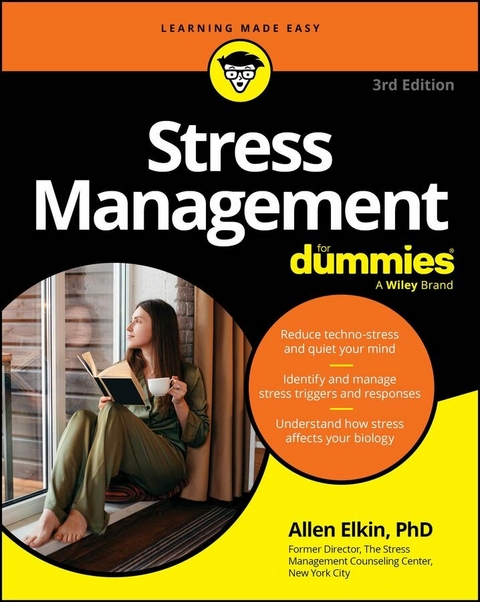
Stress Management For Dummies (eBook)
483 Seiten
For Dummies (Verlag)
978-1-394-35023-0 (ISBN)
Lower stress and anxiety with accessible tips you can use today
Whether related to love, work, family, or other parts of everyday life, Stress Management For Dummies, 3rd Edition is dedicated to helping you stock up your wellness toolbox. This new edition will help you identify your stress triggers and ways to manage them, practice mindfulness and meditation, understand the mind-body connection and how this applies to you and your experience, apply quieting rumination, and more.
With straightforward advice incorporating scientific research on the relationship between stress and health, Stress Management For Dummies, 3rd Edition provides practical tips on how to use key techniques, including the power of gratitude and perspective, to transform your mindset and improve your resilience toward stress.
Inside:
- Explore the impacts that stress has on your biology-including sleep
- Find step-by-step guidance that demonstrates how to manage worry and feel less anxious
- Discover your mental health needs and ways to implement them in your everyday life
- Understand the effects of smartphones, social media, and world events on your mental health and ways to cope
Stress Management For Dummies, 3rd Edition is a trustable, calming handbook that helps you reduce stress and build the life you want.
Allen Elkin, PhD, is a clinical psychologist, certified sex therapist, and the former director of the Stress Management & Counseling Center in New York City. He appears frequently on Today, Good Morning America, and Good Day New York, as well as on programs of PBS, CNN, FNN, Fox 5, and National Public Radio.
Lower stress and anxiety with accessible tips you can use today Whether related to love, work, family, or other parts of everyday life, Stress Management For Dummies, 3rd Edition is dedicated to helping you stock up your wellness toolbox. This new edition will help you identify your stress triggers and ways to manage them, practice mindfulness and meditation, understand the mind-body connection and how this applies to you and your experience, apply quieting rumination, and more. With straightforward advice incorporating scientific research on the relationship between stress and health, Stress Management For Dummies, 3rd Edition provides practical tips on how to use key techniques, including the power of gratitude and perspective, to transform your mindset and improve your resilience toward stress. Inside: Explore the impacts that stress has on your biology including sleep Find step-by-step guidance that demonstrates how to manage worry and feel less anxious Discover your mental health needs and ways to implement them in your everyday life Understand the effects of smartphones, social media, and world events on your mental health and ways to cope Stress Management For Dummies, 3rd Edition is a trustable, calming handbook that helps you reduce stress and build the life you want.
Chapter 1
Stressed Out? Welcome to the Club!
IN THIS CHAPTER
Figuring out why you feel more stressed
Determining where your stress comes from
Understanding how stress affects you
Looking at the good kinds of stress
Are you feeling more tired lately than you used to? Is your fuse a little shorter than normal? Are you worrying more? Enjoying life less? If you feel more stress in your life these days, you aren’t alone. Count yourself among the ranks of the overstressed. Most people feel that their lives have too much stress. Your stress may come from your job or lack thereof, your money worries, your personal life, or simply not having enough time to do everything you have to do — or want to do. You can use some help. Thankfully, you can eliminate or at least minimize much of the stress in your life and better manage the stress that remains. This chapter helps you get started.
Experiencing a Stress Epidemic?
You probably can’t make it through a single day without seeing or hearing the word stress someplace. Just glance at any magazine stand and you’ll find numerous cover stories all about stress. In most larger bookstores, an entire section is devoted to books on stress. TV, radio talk shows, websites, social media apps, and newspapers regularly feature stories reporting the negative effects of stress. Why all the fuss? Hasn’t stress been around forever? Is all of this just media hype, or are people really experiencing more stress today?
One good way of finding out how much stress people are experiencing is to ask them about the stress in their lives. Here are some findings from recent polls and surveys that did just that:
- A Harris 2024 poll conducted by the American Psychiatric Association found that more adults are now feeling increasingly stressed. In that poll, 43 percent of adults said they feel more anxious now than they did the previous year, up from 37 percent in 2023 and 32 percent in 2022. The poll found that adults are particularly anxious about current events (70 percent — especially the economy (77 percent), the 2024 U.S. election (73 percent), and gun violence (69 percent).
- A second 2024 survey conducted for the American Psychological Association — called Stress in America 2024 — found that more than seven in ten adults said the future of the nation (77 percent) is a significant source of stress in their lives, with the economy (73 percent) and the 2024 presidential election (69 percent) following closely behind.
- When asked about a list of lifestyle factors potentially impacting mental health, adults most commonly say stress (53 percent) and sleep (40 percent) have the biggest impact on their mental health. Younger adults (18–34 years old) are more likely than older adults (50+) to say social connection has the biggest impact on their mental health.
- Despite the increasing anxiety, most adults have not sought professional mental health support. In the Harris 2024 poll, just one in four (24 percent) adults say that they talked with a mental healthcare professional in the past year. Notably, younger adults (18–34) are more than twice as likely as older adults (50+) to have done so.
- The survey data also showed that when it comes to stress management, many are struggling to cope and bear the burden alone. Around three in five adults (62 percent) said they don’t talk about their stress because they don’t want to burden others.
Our lives, it seems, have indeed become far more stressful. But why? The next section provides some answers.
Individual or personal stressors
It’s useful to make a distinction between personal/individual stressors and shared/collective stressors.
Personal/individual stressors are most often associated with personal stress triggers. These are the situations, feelings, and events that routinely punctuate your daily life. You know what’s on the list: health issues, a difficult boss, not enough time, not enough money, relationship issues, loss of a loved one, job insecurity, or the being Wi-Fi down (did I mention not enough money?). And that’s for starters.
These stressors are more subjective, more tied to the person’s life situation as well as their resilience and personality.
Shared or collective stressors
These stressors affect groups of people, often at the same time and in similar ways. They have a larger impact. They can affect a community, an entire city, and even entire countries. Consider, for example, our shared response to COVID-19. Here are some other examples of shared/collective stressors:
- Floods and hurricanes
- Earthquakes
- Wildfires
- Recessions
- Inflation
- Foreign wars
- Political instability
- Climate change
- Discrimination
- School shootings
- Healthcare
- Pandemics
- Famine
- Crime
These two categories of stressors often require different coping behaviors. For example, trying, without any luck, to find a parking spot can be frustrating and somewhat stressful. Having a conflict with the spouse of a good friend can be even more stressful. The level of stress you might experience depends on your personality, the situation, your mood, and many other factors. Other people facing similar stressors might feel less stress, or even no stress.
STRESS CAN BE TAXING
A number of studies have shown that when you’re under stress, your cholesterol level goes up. In one now-classic study, researchers looked at the stress levels of accountants before and after the month of April, a notoriously busy time for tax accountants. They also looked at cholesterol levels in corporate accountants, who had stressful deadlines in April and January. The researchers found that for both groups, cholesterol levels rose significantly before the April deadline and fell after the deadline. They observed a second rise in cholesterol levels for the corporate accountants as their January deadline approached. Again, after the deadline passed, blood lipid levels fell back to normal.
Shared or collective stressors generally affect many others, who, for the most part, share in the emotional reactions. They, too, are stressed. Addressing these collective stressors most often requires outside intervention, mainly utilizing external coping resources (the community, the police, the government, and so on). These larger social and political bodies become important resources that can be part of the stress-reduction process.
Understanding Where All This Stress Is Coming From
In his prophetic book Future Shock, Alvin Toffler observed that people experience more stress whenever they are subjected to a lot of change in a short span of time. If anything characterizes people's lives these days, it’s an excess of change. They’re in a continual state of flux. They have less control over their lives, live with more uncertainty, often feel threatened and, at times, overwhelmed. People's stress levels are higher than they have ever been. The following sections explain in greater detail some of the more common sources of stress in people's lives.
The lingering pandemic
That latest APA “Stress in America” survey (2024) reported that although the number of COVID-19 cases has declined significantly, many people regarded the improved statistics as a “return to normal.” However, the findings from the APA survey paint a rather different picture. The data suggests that the pandemic has had a significant psychological effect on people’s emotional health and the levels of stress they experience, and that for many, the effects still linger. For many, COVID-19 has created a general confusion about public health, economic uncertainty, and personal resilience:
- Many people feel that there still is a very high probability of contracting COVID-19 or a newer variant of COVID.
- Some continue to cope with the symptoms of long COVID.
- The pandemic has resulted in changes to the ways people conduct work life. This has added to the stress.
- Many still restrict their social life, becoming increasingly isolated.
- Confusing health guidelines about how to prevent contracting COVID — vaccines, masks, gloves — add to the stress. COVID has become a political issue.
A nation under stress
That 2024 survey conducted for the American Psychological Association, Stress in America 2024, found that more than seven in ten adults said the future of the nation (77 percent) is a significant source of stress in their lives, with the economy (73 percent) and the 2024 presidential election (69 percent) following closely behind.
When asked about a list of lifestyle factors potentially impacting mental health, adults most commonly say stress (53 percent) and sleep (40 percent) have the biggest impact on their mental health. Younger adults (18-34 years old) are more likely than older adults (50+) to say social connection has the biggest impact on their mental health.
Despite the increasing stress, most adults have not sought professional mental health support. In 2024, just one in four (24 percent) adults say they talked with a mental healthcare professional in the past year. Notably, younger adults (18–34) are more than twice as likely as older adults (50+) to have done...
| Erscheint lt. Verlag | 22.10.2025 |
|---|---|
| Sprache | englisch |
| Themenwelt | Sachbuch/Ratgeber ► Gesundheit / Leben / Psychologie ► Lebenshilfe / Lebensführung |
| Schlagworte | anxiety book • anxiety guide • Anxiety management • Anxiety Strategies • anxiety tips • anxiety treatment • eliminate stress • manage your anxiety • Manage your stress • reduce stress • stress strategies • stress tips • stress treatment |
| ISBN-10 | 1-394-35023-6 / 1394350236 |
| ISBN-13 | 978-1-394-35023-0 / 9781394350230 |
| Informationen gemäß Produktsicherheitsverordnung (GPSR) | |
| Haben Sie eine Frage zum Produkt? |
 EPUB (Adobe DRM)
Kopierschutz: Adobe-DRM
Adobe-DRM ist ein Kopierschutz, der das eBook vor Mißbrauch schützen soll. Dabei wird das eBook bereits beim Download auf Ihre persönliche Adobe-ID autorisiert. Lesen können Sie das eBook dann nur auf den Geräten, welche ebenfalls auf Ihre Adobe-ID registriert sind.
Details zum Adobe-DRM
Dateiformat: EPUB (Electronic Publication)
EPUB ist ein offener Standard für eBooks und eignet sich besonders zur Darstellung von Belletristik und Sachbüchern. Der Fließtext wird dynamisch an die Display- und Schriftgröße angepasst. Auch für mobile Lesegeräte ist EPUB daher gut geeignet.
Systemvoraussetzungen:
PC/Mac: Mit einem PC oder Mac können Sie dieses eBook lesen. Sie benötigen eine
eReader: Dieses eBook kann mit (fast) allen eBook-Readern gelesen werden. Mit dem amazon-Kindle ist es aber nicht kompatibel.
Smartphone/Tablet: Egal ob Apple oder Android, dieses eBook können Sie lesen. Sie benötigen eine
Geräteliste und zusätzliche Hinweise
Buying eBooks from abroad
For tax law reasons we can sell eBooks just within Germany and Switzerland. Regrettably we cannot fulfill eBook-orders from other countries.
aus dem Bereich