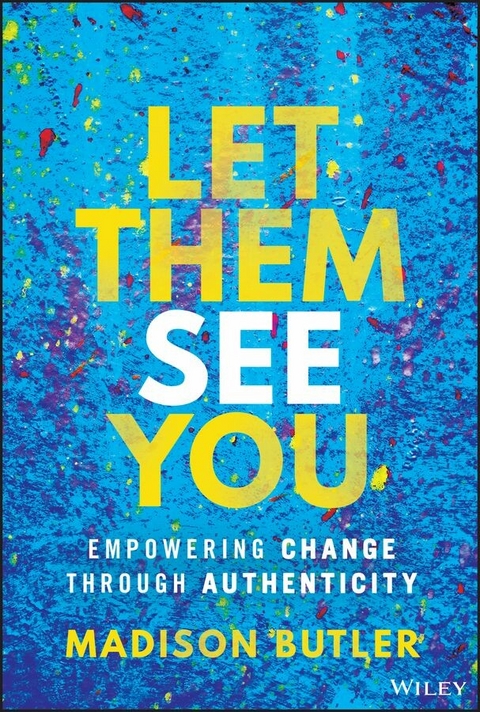
Let Them See You (eBook)
217 Seiten
Wiley (Verlag)
978-1-394-29432-9 (ISBN)
A deeply insightful and hands-on treatment of authenticity in the workplace and in the community
In Let Them See You: Empowering Change Through Authenticity, mental health advocate and People Operations expert Madison Butler delivers an eye-opening and practical playbook for what it means to create safe spaces not just for others, but for yourself. You'll learn what authenticity really looks like as you discover how to be authentic with yourself and with the world around you. The author will help you uncover who you are, and what you need in order to be safe space first to yourself and then to others.
The book walks you through the micro- and macro-traumas that impact how you show up at home, at work, in your community, and everywhere else, every day. It unpacks the heartbreak, fear, and trauma experienced by members of every community, and gives you strategies for understanding people as they really are, bruises and all.
Inside the book:
- A realistic and empathetic look at authenticity that takes into account the complexity of the human experience
- Strategies for acknowledging the myriad experiences, viewpoints, and perspectives of all people
- A focus on reality over unwarranted what it means to acknowledge your reality, while still speaking kindly to yourself.
Perfect for managers, business leaders, and people in general, Let Them See You is a can't-miss book for human resources practitioners, managers, business owners, and anyone else with an interest in enriching their understanding of what it means to demonstrate-and appreciate-authenticity.
MADISON BUTLER is the founder of the Black Speakers Collection and the creative force behind The Employee Journey Blueprint (formerly known as Blue Haired Unicorn). She???s a loud-and-proud champion for building workplaces where equity isn???t an afterthought, it???s the foundation. Madison designs organizations that people actually want to work in, blending scalable strategy with psychological safety so cultures aren???t just productive, they???re human. She???s also an unapologetic mental health advocate, making sure hard conversations have the space to happen.
A deeply insightful and hands-on treatment of authenticity in the workplace and in the community In Let Them See You: Empowering Change Through Authenticity, mental health advocate and People Operations expert Madison Butler delivers an eye-opening and practical playbook for what it means to create safe spaces not just for others, but for yourself. You ll learn what authenticity really looks like as you discover how to be authentic with yourself and with the world around you. The author will help you uncover who you are, and what you need in order to be safe space first to yourself and then to others. The book walks you through the micro- and macro-traumas that impact how you show up at home, at work, in your community, and everywhere else, every day. It unpacks the heartbreak, fear, and trauma experienced by members of every community, and gives you strategies for understanding people as they really are, bruises and all. Inside the book: A realistic and empathetic look at authenticity that takes into account the complexity of the human experience Strategies for acknowledging the myriad experiences, viewpoints, and perspectives of all people A focus on reality over unwarranted what it means to acknowledge your reality, while still speaking kindly to yourself. Perfect for managers, business leaders, and people in general, Let Them See You is a can t-miss book for human resources practitioners, managers, business owners, and anyone else with an interest in enriching their understanding of what it means to demonstrate and appreciate authenticity.
1
Let Them
Let Them
It took me more than 30 years to understand the phrase “let them.” Growing up you spend so much of your time, energy, and life trying to be likeable, to be palatable, to be tolerated.
You don’t want people to think you’re too much, too loud, too Black, too present. So, you shrink yourself into bite-size pieces instead of letting them see you whole.
You stay quiet instead of letting them see you angry.
You smile instead of letting them see you heartbroken.
You assimilate instead of letting them see that you are different.
The world swears it wants authenticity until you show up in full human form.
Authenticity isn’t about the warm fuzzy feelings; it is about the raw unbridled human experience, and the human experience is messy, uncomfortable, and nonlinear.
Growing up in the 1990s involved a lot of bad fashion trends, low-rise denim, multitoned windbreakers, and rose-colored glasses. We were conditioned to believe that being colorblind was the future, and that education would solve all our problems. Gen-Xers spent the decade convincing my generation that ignoring race, being great at algebra, and staying quiet would solve racism. I bought into the lie and let my imagination run wild.
PBS, Sesame Street, and every show we watched taught unconditional acceptance, but they didn’t teach us what to do when society fought against our individual identities. I walked through life confident that I was the same as those around me. I was sure that love and acceptance would allow people to see past the color of my skin. I convinced myself that people who experienced harrowing situations were to blame because they weren’t behaving in the “right” way.
The 1990s media gaslit an entire generation to believe that our lack of access was due to our shortcomings rather than the barriers created by a society that never intended for us to succeed. We were taught to believe that kindness would heal the world, and as long as we were educated, we would be fine.
I Realized I Was Black at 25
Don’t worry; the irony isn’t lost on me either. This statement always feels weird for me to write, say, or even acknowledge, but it’s true. Sometimes, trauma breaks us, but sometimes it makes us. I fall into the latter group. At 25, I realized I was Black and the magnitude of what that meant, and boy, was that a wake-up call.
Being biracial is weird. I felt like I was trapped in a body that didn’t belong to me, suspended in the air, watching my flaws unfold. I grew up being told I wasn’t Black enough, but I was also very obviously not white enough. I spent hours pulling at my curls in the mirror, wishing them to be straight like the white girls who tossed their hair effervescently over their shoulders. I dreamed of a life where I was as skinny as the white girls in gym class. A life where I was anything but Black. My Blackness made me feel like I was ugly because those white girls who the boys smiled at looked nothing like me. My Blackness made me feel dirty. I felt inferior, born into the wrong body. Every day, I wished I could be anyone but this person. I wanted acceptance so badly, I was willing to crawl out of my skin for it, betray my history for it, and ignore my reality for it.
I aspired to whiteness while being hyper-aware of my Black skin. I remember my parents telling me that the world was colorblind, and everyone was the same. The world no longer saw color. False. The world saw color but only chose to acknowledge “white.” The only thing I saw was my Blackness, mirrored by the caricatures of Blackness seen on TV. I saw my skin as a blemish, a curse, something to be ashamed of. I searched for every way to crawl out of my own skin away from the darkness that I believed encapsulated me.
The desire to be like everyone else crept into the cracks of my deepest desires. I wanted the white picket fence, the golden retriever, the love: I wanted the life that I saw emulated in every Nick at Nite show. I felt the desire twist around my insides, convincing me that my Blackness made me undeserving of these things.
I said to myself defiantly, “I will be like them, watch me.” So, I folded myself into a box that was never intended for me to fit in. I flat-ironed my hair until it broke, wore a waist trainer to look skinny, starved myself until I saw my hips wither away, denied myself love, listened to their music, and laughed at the jokes they made about me.
I am a biracial woman who grew up in the suburbs and went to boarding school followed by business school. My mom is white, and my biological dad is Black. I grew up with my mom and my stepdad, who is really my dad. They are wonderful people who always tried to do the right thing even if the “right thing” to them was actually rooted in unconscious bias and classism. I never stepped foot in a public school because my parents wanted me to have the best education that money could buy. However, they didn’t know that meant keeping me from people who resembled me. They didn’t realize that their idea of “best education” looked like white schools. They didn’t realize they were letting them win, and they got exactly what society wanted: a whitewashed version of their child.
I never wanted for anything. I grew up privileged and will never deny my own privilege in this world. I never felt lucky, but I should have. I had traveled the world by the age of 10, played any sport I wanted, and always had food to eat and clean clothes to wear. My parents did what they thought they needed to do for me to be successful.
They wanted me to fit in, but their idea of fitting in meant society’s idea of fitting in. My parents believed that the right education would protect their kids from racism and hate. However, education is one of the world’s greatest barriers. Education is great, it’s a start, but it won’t solve any problems if we continue to teach watered-down versions of American history. We continue to peddle the idea of powerful white men who led a nation, when in reality they were just regular men who colonized a country that never belonged to them. This trend has continued for hundreds of years. Mediocre white men after mediocre white men have been praised in books and by the media until we believe with absolute certainty that they are better. We idolize whiteness and glorify colonization while never speaking about who actually built this country. Spoiler: It was not the founding fathers. Yet history teaches us to aspire to whiteness.
When my parents realized that I had internalized the whiteness around me, they began to panic, begging me to see my own Blackness. I looked away. I felt betrayed by them. Isn’t this what they wanted for me? My whole life, people told me, “You sound white.” I never knew that was an insult. I vividly remember being excited the first time I heard those words. My subconscious was screaming, “It’s working! I tricked them!” Whiteness had always been the goal in my 13-year-old mind.
How was I supposed to think anything different? I was immersed in whiteness; I was immersed in heteronormativity. All my friends were white and straight, all my professors were white and straight, everyone on TV was white and straight, and my own mother was white and straight. Success had always been painted in those brushstrokes. Business school brought more of the same. I was the girl who was often referred to as “not really Black.” I used to smile so widely at that compliment. I felt important. I saw dollar signs and wedding bells every time those words were uttered by some jock who smelled like WD-40 and Natty Ice. I would toss my head back and laugh loudly at this unfunny joke, flipping my pin-straight hair behind my shoulder like those girls in elementary school, confident that was what life should feel like.
I cringe just thinking about that now. I went about life in my J.Crew loafers and Abercrombie polos, unaware there was magic hidden inside my melanin, ignoring that my true power meant experiencing the world around me as me and not the me I had conjured up from an episode of The Hills. I thought that I was just “the white Black girl.” I didn’t know what powerful felt like because I was taught I should feel weak, I should feel small, and I should step aside for whiteness to take center stage. I believed I was less than because that is exactly what the world wanted me to believe. This realization still breaks my heart because I know I am not alone in these feelings. I thought that was who I had to be. I really believed that skin color had nothing to do with who I was or how people treated me. I even voted Republican because I was so convinced that I was “socially liberal and fiscally conservative” (ironically that doesn’t exist; it’s called classism). I believed racism didn’t exist, and that Black people were just playing the victim. I believed that people who looked like me deserved the fates dealt to them by society. I believed we were at fault for our own marginalization.
Fast-forward 10 years, and it turns out the world sees me as Black. When I walk into a room, no matter how I sound or what I’m wearing, I’m Black, I’m queer, I am neurodivergent, I am polyamorous. I am the antithesis of what white America sees as a success. It turns out, I am powerful.
No one cares about my goddamn loafers? Huge shock.
I’m sure you’re...
| Erscheint lt. Verlag | 6.10.2025 |
|---|---|
| Sprache | englisch |
| Themenwelt | Sachbuch/Ratgeber ► Beruf / Finanzen / Recht / Wirtschaft ► Bewerbung / Karriere |
| Wirtschaft ► Betriebswirtschaft / Management | |
| Schlagworte | authenticity • authentic work culture • authentic workplace • dei • dei book • diverse workplaces • diversity book • diversity equity and inclusion • equitable workplaces • life experience • macro-trauma • micro-trauma • work culture • workplace culture |
| ISBN-10 | 1-394-29432-8 / 1394294328 |
| ISBN-13 | 978-1-394-29432-9 / 9781394294329 |
| Informationen gemäß Produktsicherheitsverordnung (GPSR) | |
| Haben Sie eine Frage zum Produkt? |
 EPUB (Adobe DRM)
Kopierschutz: Adobe-DRM
Adobe-DRM ist ein Kopierschutz, der das eBook vor Mißbrauch schützen soll. Dabei wird das eBook bereits beim Download auf Ihre persönliche Adobe-ID autorisiert. Lesen können Sie das eBook dann nur auf den Geräten, welche ebenfalls auf Ihre Adobe-ID registriert sind.
Details zum Adobe-DRM
Dateiformat: EPUB (Electronic Publication)
EPUB ist ein offener Standard für eBooks und eignet sich besonders zur Darstellung von Belletristik und Sachbüchern. Der Fließtext wird dynamisch an die Display- und Schriftgröße angepasst. Auch für mobile Lesegeräte ist EPUB daher gut geeignet.
Systemvoraussetzungen:
PC/Mac: Mit einem PC oder Mac können Sie dieses eBook lesen. Sie benötigen eine
eReader: Dieses eBook kann mit (fast) allen eBook-Readern gelesen werden. Mit dem amazon-Kindle ist es aber nicht kompatibel.
Smartphone/Tablet: Egal ob Apple oder Android, dieses eBook können Sie lesen. Sie benötigen eine
Geräteliste und zusätzliche Hinweise
Buying eBooks from abroad
For tax law reasons we can sell eBooks just within Germany and Switzerland. Regrettably we cannot fulfill eBook-orders from other countries.
aus dem Bereich