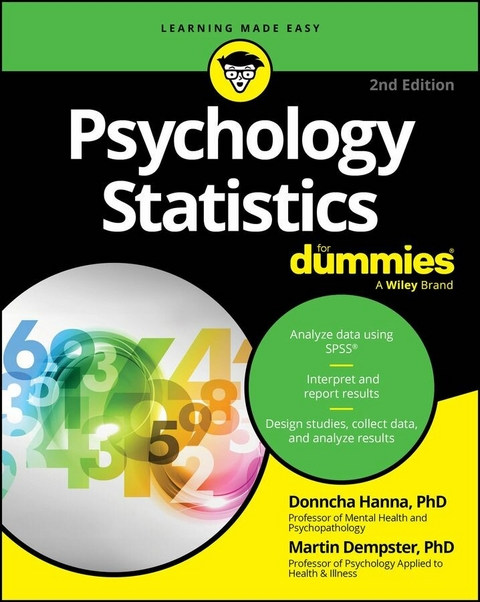
Psychology Statistics For Dummies (eBook)
509 Seiten
For Dummies (Verlag)
978-1-394-29532-6 (ISBN)
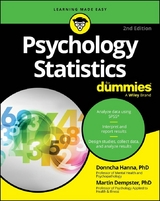
Untangle statistics and make correct, dependable conclusions
Psychology Statistics For Dummies, 2nd Edition makes statistics accessible to psychology students, covering all the content in a typical undergraduate psychology statistics class. Built on a foundation of jargon-free explanations and real-life examples, this book focuses on information and techniques that psychology students need to know (and nothing more). You'll learn to use the popular SPSS statistics software to calculate statistics and look for patterns in psychological data. And, this helpful guide offers a brief introduction to using the R programming language for statistical analysis-an increasingly important skill for the digital age. You'll also find hands-on practice exercises and examples using recent, real datasets.
- Explore the use of statistical analysis in research for the psychology field
- Master basic statistics concepts such as means, standard deviations, and correlations
- Conduct data analysis using the SPSS software package
- Get clear explanations of everything in your psychology statistics course, so you can pass with flying colors
This guide is perfect to use as a readable supplement to psychology textbooks and overall coursework. Students in other social and behavioral sciences can also benefit from this stellar primer on statistics.
Donncha Hanna, PhD, is Professor of Mental Health and Psychopathology at Queen's University, Belfast. He is a co-author of Research Methods in Psychology For Dummies.
Martin Dempster, PhD, is a health psychologist and statistician at Queen's University, Belfast. He's a co-author of Research Methods in Psychology For Dummies.
Chapter 1
Statistics? I Thought This Was Psychology!
IN THIS CHAPTER
Understanding variables
Introducing SPSS
Outlining descriptive and inferential statistics
Differentiating between parametric and non-parametric statistics
Explaining research designs
When we tell our initially fresh-faced and enthusiastic first-year students that statistics is a substantial component of their course, approximately half of them are genuinely shocked. “We came to study psychology, not statistics,” they shout. Presumably they thought they would be spending the next three or four years ordering troubled individuals to “lie down on the couch and tell me about your mother.” We tell them there is no point running for the exits because statistics is part of all undergraduate psychology courses and, if they plan to undertake post-graduate studies or work in this area, they'll be using these techniques for a long time to come. (Besides, we were expecting this reaction and have locked the exits.)
Then we hear the cry, “But I’m not a mathematician. I'm interested in people and behavior.” We don’t expect students to be mathematicians. If you have a quick scan through this book, you won’t be confronted with pages of scary looking equations. Software packages such as SPSS do all the complex calculations for us.
We tell them that psychology is a scientific discipline. If they want to learn about people, they have to objectively collect information, summarize it, and analyze it. Summarizing and analyzing allow you to interpret the information and give it meaning in terms of theories and real-world problems. Summarizing and analyzing information is statistics; it is a fundamental and integrated component of psychology.
The aim of this chapter is to give you a roadmap of the main statistical concepts you'll encounter during your undergraduate psychology studies and sign posts to relevant chapters on topics where you can learn how to become a statistics superhero (or at least scrape by).
Knowing Your Variables
All quantitative research in psychology involves collecting information (called data) that can be represented by numbers. For example, levels of depression can be represented by depression scores obtained from a questionnaire, and a person’s country of birth can be represented by a number (say, 1 for Afghan and 2 for Zambian). The characteristics you're measuring are known as variables because they vary! They can vary over time in the same person (depression scores can vary over a person’s lifetime) or vary between different individuals.
Variables can be continuous or discrete, have different levels of measurement, and can be independent or dependent. Variables can be classified as discrete, where you specify discrete categories (for example, 1 for Afghan and 2 for Zambian), or continuous, where scores can lie anywhere along a continuum (for example, depression scores may lie anywhere between 0 and 63 if measured by the Beck Depression Inventory).
Variables also differ in their measurement properties. Four levels of measurement exist:
- In a nominal level of measurement, a numerical value is applied arbitrarily. This measurement level contains the least amount of information. Country of birth is an example of a nominal variable because it makes no sense to say one is greater or less than the other.
- In an ordinal level of measurement, values are ranked. Rankings on a class test are an example of an ordinal level of measurement because we can order participants from the highest to the lowest score but don’t how much better the first person did compared to the second person. (The difference between actual scores could be 1 mark or 20 marks.)
- In an interval level of measurement, the difference between each point is equal. IQ scores are measured at the interval level, which means we can order the scores and difference between 95 and 100 is the same as the difference between 115 and 120.
- In a ratio level of measurement, the scores can be ordered, the difference between each point on the scale is equal, and the scale also has a true absolute zero. Weight, for example, is measured at the ratio level. Having a true absolute zero means a weight of zero signifies an absence of any weight and also allows you to make proportional statements, such as “10 kg is half the weight of 20 kg.”
You also need to classify the variables in your data as independent or dependent, and that classification will depend on the research question you're asking. For example, if you're investigating the difference in depression scores between Afghans and Zambians, country of birth is the independent variable (the variable you think is predicting a change) and depression scores is the dependent variable (the outcome variable where the scores depend on the independent variable).
These terms, which we cover in more detail in the next chapter, may seem bewildering. But having a good understanding of them is important because they dictate the statistical analyses that are available and appropriate for your data.
What Is SPSS?
SPSS, or Statistical Package for the Social Sciences, is a program for storing, manipulating, and analyzing your data. In this book, we assume that you will be using SPSS to analyze your data. SPSS is probably the most commonly used statistics package in the social sciences, but of course other similar packages exist as well as those designed to conduct more specialized analysis.
The normal format for entering data is that each column represents a variable (for example, country of birth or depression) and each row represents one person. Therefore, if you collected and entered information on the country of birth and depression scores of 10 people, you would have 2 columns and 10 rows in SPSS data view. SPSS allows you to enter numeric data and string data (which is non-numeric data, such as names) and also assign codes (for example, 1 for Afghan and 2 for Zambian).
Once you enter your data, you can run a variety of analyses by using drop-down menus. Hundreds of analyses and options are available, but in this book we explain only the statistical procedures necessary for your course. After you select the analyses you want to conduct, your results appear in the output window; your job then is to read and interpret the relevant information.
In addition to using the pull-down menus, you can also program SPSS by using a simple syntax language. This approach can be useful if you need to repeat the same analyses on many different data sets, but explaining how to do it is beyond the scope of this introductory text.
SPSS was released in 1968 and has been through many versions and upgrades. At the time of writing this chapter, the most recent version was SPSS 30.0, which was released in 2024. In 2010 it was purchased by IBM and now appears in your computer’s menu under the name IBM SPSS statistics. (And no, we don’t know why the last statistics is necessary either!)
Descriptive Statistics
When you collect your data, you need to communicate your findings to other people (tutor, boss, or supervisor). Let’s imagine you collect data from 100 people on their levels of coulrophobia (fear of clowns). Simply producing a list of 100 scores in SPSS won’t be useful or easy to comprehend for your audience. Instead, you need a way to describe your data set in a concise and repeatable format. The standard way to do this is through descriptive statistics. In this section, we introduce the following types of descriptive statistics: central tendency, dispersion, graphs, and standardized scores.
Central tendency
There are several types of central tendency, but they all attempt to give a single number that represents your variable. The most common measure is sometimes known as average but is more correctly called the arithmetic mean, and you're probably already familiar with it. The common measures of central tendency are covered in Chapter 4.
Dispersion
Several measures of dispersion exist, and each aims to give a single number that represents the spread or variability of your variable. Chapter 5 describes important measures of dispersion, including standard deviation, variance, range, and interquartile range.
Graphs
Another way of displaying your data is to provide a visual representation in the form of a graph. Graphs are important for another reason; the type of statistical analysis you can conduct with variables will depend on the distribution of your variables, which you will need to assess by using graphs. Chapter 6 outlines the common types of graphs used in psychology and how to generate each of them in SPSS.
Standardized scores
Imagine you measured a friend’s extraversion level with the Revised NEO Personality Inventory and told them they obtained a score of 164. It's likely they will want to know how this score compares to other people’s scores. Is it high or low? They also might want to know how it compares to the psychoticism score of 34 they received last week from the Eysenck Personality Questionnaire. Simply reporting raw scores often isn’t informative. You need to be able to compare scores to other people’s...
| Erscheint lt. Verlag | 22.9.2025 |
|---|---|
| Sprache | englisch |
| Themenwelt | Sachbuch/Ratgeber ► Gesundheit / Leben / Psychologie ► Esoterik / Spiritualität |
| Schlagworte | Basic Statistics • Behavioral science statistics • introduction to statistics • Psychology Research • psych statistics • Psych stats • quantitative research • R programming language • Social science research • SPSS software • Statistical Analysis • statistics basics • Statistics for Social Science |
| ISBN-10 | 1-394-29532-4 / 1394295324 |
| ISBN-13 | 978-1-394-29532-6 / 9781394295326 |
| Informationen gemäß Produktsicherheitsverordnung (GPSR) | |
| Haben Sie eine Frage zum Produkt? |
 EPUB (Adobe DRM)
Kopierschutz: Adobe-DRM
Adobe-DRM ist ein Kopierschutz, der das eBook vor Mißbrauch schützen soll. Dabei wird das eBook bereits beim Download auf Ihre persönliche Adobe-ID autorisiert. Lesen können Sie das eBook dann nur auf den Geräten, welche ebenfalls auf Ihre Adobe-ID registriert sind.
Details zum Adobe-DRM
Dateiformat: EPUB (Electronic Publication)
EPUB ist ein offener Standard für eBooks und eignet sich besonders zur Darstellung von Belletristik und Sachbüchern. Der Fließtext wird dynamisch an die Display- und Schriftgröße angepasst. Auch für mobile Lesegeräte ist EPUB daher gut geeignet.
Systemvoraussetzungen:
PC/Mac: Mit einem PC oder Mac können Sie dieses eBook lesen. Sie benötigen eine
eReader: Dieses eBook kann mit (fast) allen eBook-Readern gelesen werden. Mit dem amazon-Kindle ist es aber nicht kompatibel.
Smartphone/Tablet: Egal ob Apple oder Android, dieses eBook können Sie lesen. Sie benötigen eine
Geräteliste und zusätzliche Hinweise
Buying eBooks from abroad
For tax law reasons we can sell eBooks just within Germany and Switzerland. Regrettably we cannot fulfill eBook-orders from other countries.
aus dem Bereich