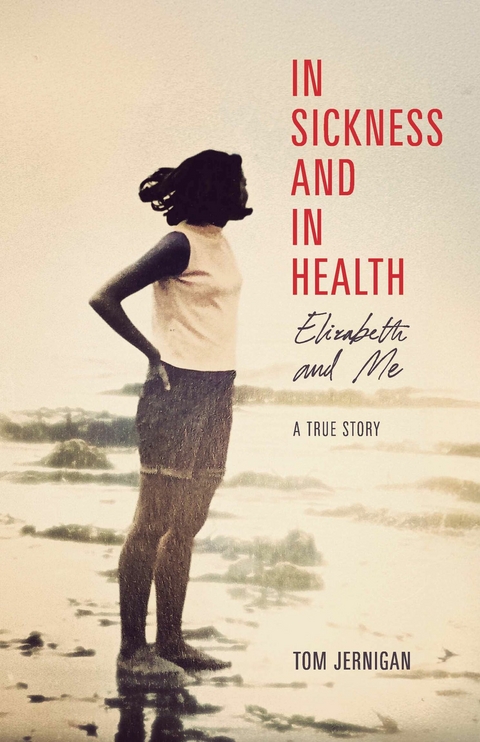
In Sickness and in Healtth (eBook)
120 Seiten
Bookbaby (Verlag)
9798317814502 (ISBN)
Husband of Elizabeth Jernigan.
Love story of a husband and wife and the wife's struggle to survive three devasting strokes.
- At The Hospital After The Third Stroke
- The local emergency room and the trip to Phoenix
The last thing she said to me before they loaded her on the helicopter was “I love you.” With tears in my eyes, I told her how much I loved her.
At six am that morning, Saturday, March 22, 2025, she called to me from across our bed “Tom, I think I’m having a stroke.” I was half asleep and didn’t do everything right. I stumbled around the bed to her side. She lay sprawled on the bed just a foot or so from the portable toilet at the end of the bed. Her pajamas were wet.
Still sleepy, I worked fast but not with a clear head. “I should call 911,” I said.
“No, just take me in the car.” I worked to get her pajamas and underwear off and put on clean ones. Probably wasted a few minutes doing that. Then I tried picking her up. I couldn’t.
“I’m going to call 911.”
“Don’t panic,” she said.
I rushed around clearing room for the paramedics. I opened the garage door, turned on the outside light, and waited. It took them about ten minutes. I followed them to the hospital in my car. In the emergency room they took her right away to do a CAT scan. I sat on the edge of a chair, scared. Suddenly, on a TV screen that I hadn’t noticed, mounted on the wall, a man appeared, speaking. I don’t remember his name but he was a neurologist, and he said, “your wife has a brain bleed in a very critical part of the brain. It appears to be stable, but she needs to go to---” I interrupted.
“Phoenix.”
“Correct. We don’t have the ability here to do neuro surgery if it should be needed.”
I knew that she would be loaded onto a helicopter for the approximate one-hour flight to a neurological center in Phoenix. It had happened to her twice before, only those two times the brain bleed was not in the critical part of the brainstem called the pons. The flight crew arrived in about thirty minutes. They wanted her to be intubated-- A tube inserted through the mouth down the throat in the event she aspirated on the flight down. Just before the procedure, my wife turned her head toward me and said, “I love you.” I held her hand and told her tearfully how much I loved her. Then I signed the release not knowing or even thinking of the ramifications of that procedure.
I watched outside in the early morning light as they loaded her in the helicopter. The machine warmed up, then slowly rose, turning toward Phoenix. I felt lonely and scared, more so than the two times she had been helicoptered down there before. Almost trembling, I said a prayer then hurried home to grab a few things before driving to Phoenix. How long we would be there--I did not know.
It’s a four-hour drive to the neurological center in Phoenix from where we live. My mind raced around as if trying to keep up with the speed I was driving. The neurologist said that the stroke was in a dangerous part of the brain. And then he said “good luck.” Both comments scared me. This seemed to be different from the first two times she was taken to Phoenix; now I was afraid that I might lose her. I thought of the future. I thought of the past. She is my love, my life, my reason for living.
- Remembering when we first met
I remembered the bonfire from forty-two years ago when we first met. I had been miserable and depressed since my divorce three months prior. Being shy and living in a small rural community the chances of meeting someone else seemed remote. But, by chance, I saw a small blurb about it in the newspaper. A newspaper that I seldom purchased. It was a get together for the local singles group which, I found out later, had only existed for a short time and subsequently ceased to exist not long after. I am still incredulous how it all came about as if stars suddenly fell into alignment. My world changed in those few moments like the flip of a switch.
About twenty people were already there at the bonfire. I was scared, but I forced myself to keep going. I nervously approached the fire with my hands sticking out as if they were cold. She was seated on the other side of the fire. Though the flames sometimes blocked my view, I could see that she seemed different from the others. I could also see that she was glancing at me. After a while, she came and sat beside me before I could work up the courage to go to her. The conversation was easy, comfortable, like with an old friend.
She had also been divorced for a few months after a number of years of marriage and neither of us had a clue about how to conduct ourselves as single persons. After the group did a few activities that I don’t remember, and after what seemed like a short time, the other people around the fire whom we had become unaware of in favor of talking to one another, had started to leave. We stood up to go, blandly telling each other that, it was very nice talking to you. As she turned to go, she mentioned that there was another picnic scheduled the next Saturday at Lyman Lake. Maybe we’ll see each other there, she said.
Walking away toward my car on the bare ground I felt as though l were gliding on carpet. The singles group would be meeting again the next week at Lyman Lake and I determined to be there, expecting that I would see her there also. The following mornings for me were bright blue and I heard birds singing.
- The first days at the neurological hospital in Phoenix
And the breathing tube
I arrive at the hospital in Phoenix at three pm, about four hours after she did. I remember where to park and how to get into the huge complex from the last time she was here six months ago. The man at the security station says she is in ICU, fourth floor, room four.
There she lies, wires and hoses connected to her, breathing tube in her mouth, eyes closed. I put my hand on her forehead and whisper how much I love her. Her lips move but with the tube in her mouth she can’t speak. Her soft brown eyes look up at me. I stand close and put my hand in her hand where there aren’t any attachments. A nurse comes in and tells me they are waiting to do an MRI to see if the bleed has stabilized. We wait and wait but no one comes. Elizabeth sleeps most of the time. I ask about the long wait. “On weekends the MRI machine is fully occupied with emergency cases such as gun shots, auto accidents, etc. We just have to wait for an opening.” Isn’t my wife an emergency? I thought.
As the minutes then hours tick by, I become more and more anxious. I feel like the loneliest person in the world. She is my life, my love, my reason for living. Won’t someone come and do something. I feel like I am sinking in quicksand, and people are walking by and not reaching out to help me.
I hold her hand often. I have always loved the feel of her hands. Our first date, so many years ago, was my idea. It was a camping trip, and we had our young children with us. We did a lot of hand-holding, and I remember how sensual her hands were.
The nurse asks me if I would like a blanket and a pillow. I glance at the clock and nod yes. It is getting late. There is a combination couch and bed at the side of the room near her bed where I can sleep. I pull my wife’s blanket up around her shoulders and tell her I will be just a few feet away and would not leave her. I ask the nurses to pull the blanket up around her shoulders each time after they examine her, but about half the time they forget, so I get up after they leave and do it myself.
There is a lot of noise in the ICU, nurses talking, carry carts rattling down the hallway, and occasional laughter. And then the nurses come in every so often to rotate her body and do a cognitive assessment-- move this hand, that foot, eyes follow my finger, what year were you born, etc. But, in spite of the noise and activity, if you are tired enough, you sleep some.
All the patients are hooked up to monitors that measure vital signs, and these machines have a certain rhythm of sounds that you get used to. They also buzz, ring, or beep if something is wrong or if they run out of fluid. When one or another of the alarms goes off, I wake up and worry. These ICU nurses watch over and are responsible for two rooms. If the nurse is in the other room and can’t hear my wife’s monitor, I get up and pace the floor, then hang my head out the door into the hallway, hoping someone will see me and come check to see what’s wrong. If no one sees me, I walk down the hall to attract attention. Unauthorized people are not supposed to be roaming the hall, so they notice me. At the risk of being asked to leave, I get someone to come and check her condition.
At seven in the morning I wonder, are they ever going to do the MRI? I hustle down to the cafeteria to get a bowl of oatmeal, bringing it back to the room and eating it out of Elizabeth’s sight. I feel guilty eating when she can’t.
Around eight-thirty this morning, a team of doctors comes in. They are talking among themselves and looking at notes or charts. I hear one of them say to the others, “We don’t need the MRI. The CAT scan shows all we need to know.” I see some heads nod. One of them seems to be a leader or spokesperson. They turn their...
| Erscheint lt. Verlag | 9.9.2025 |
|---|---|
| Sprache | englisch |
| Themenwelt | Sachbuch/Ratgeber ► Gesundheit / Leben / Psychologie ► Esoterik / Spiritualität |
| ISBN-13 | 9798317814502 / 9798317814502 |
| Informationen gemäß Produktsicherheitsverordnung (GPSR) | |
| Haben Sie eine Frage zum Produkt? |
 EPUB (Ohne DRM)
Größe: 521 KB
Digital Rights Management: ohne DRM
Dieses eBook enthält kein DRM oder Kopierschutz. Eine Weitergabe an Dritte ist jedoch rechtlich nicht zulässig, weil Sie beim Kauf nur die Rechte an der persönlichen Nutzung erwerben.
Dateiformat: EPUB (Electronic Publication)
EPUB ist ein offener Standard für eBooks und eignet sich besonders zur Darstellung von Belletristik und Sachbüchern. Der Fließtext wird dynamisch an die Display- und Schriftgröße angepasst. Auch für mobile Lesegeräte ist EPUB daher gut geeignet.
Systemvoraussetzungen:
PC/Mac: Mit einem PC oder Mac können Sie dieses eBook lesen. Sie benötigen dafür die kostenlose Software Adobe Digital Editions.
eReader: Dieses eBook kann mit (fast) allen eBook-Readern gelesen werden. Mit dem amazon-Kindle ist es aber nicht kompatibel.
Smartphone/Tablet: Egal ob Apple oder Android, dieses eBook können Sie lesen. Sie benötigen dafür eine kostenlose App.
Geräteliste und zusätzliche Hinweise
Buying eBooks from abroad
For tax law reasons we can sell eBooks just within Germany and Switzerland. Regrettably we cannot fulfill eBook-orders from other countries.
aus dem Bereich