


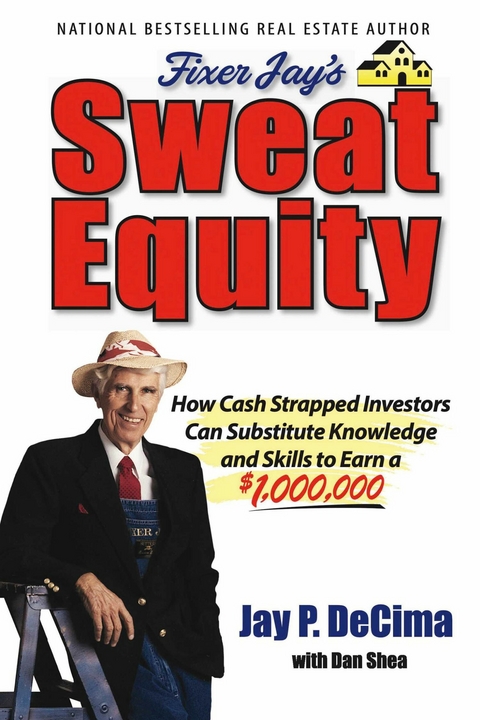
Sweat Equity (eBook)
288 Seiten
Bookbaby (Verlag)
979-8-3178-0706-1 (ISBN)
Jay P. DeCima; 'FIXER JAY' is a seasoned teal estate investor, teacher/trainer and best-selling author of six (6) real estate books. Three are self-published (KJAY Publishing) and three were published by McGraw Hill Publishers in New York. Total sales are approximately 260,000 books which include bookstores, seminars and nationwide speaking events at investment clubs. After 50 plus years in the trenches, Jay is both semi-retired and semi-still active with only 20 duplex units left from his high-water mark of over 250 multiple-unit properties and houses. Jay has taught investment seminars for over 30 years, including Fixer Camps in his hometown, 3-day investment seminars around the country and aboard cruise ships. For 32 years Jay wrote and published his popular 'How To' newsletter, TRADE SECRETS. Fixer Jay has long been acknowledged as the undisputed king of fixer-uppers on the national teaching circuit. In 2018, Fixer Jay was the winner of the prestigious ROHNY AWARD presented by the Norris Realty Group at the Nixon Presidential Library in Yorba Linda, California. Over 400 real estate professionals in attendance helped celebrate this lifetime achievement award with Jay. The Rhony Award is given to individuals who have elevated the profession by providing outstanding leadership and a willingness to share their knowledge and wisdom to help others. Today, Jay continues to have a large group of real estate followers from his books, seminars and past speaking events at investment clubs around the country. His Telephone Mentoring Service and One-On-One Counseling remain popular with past students as well as newbies attracted to his educational website, FIXERJAY.COM. When asked about his plans for full retirement and what he might do next - there's always a long pause before the answer! Jay claims he's already fully retired - and what he's doing right now - he calls 'doing next'! According to Jay, 'As long as investors and wanta-bes seek my help, full retirement doesn't sound nearly so attractive in my mind'. You can take investing away from the investor, but it's nearly impossible to take the investor away from teaching about investing. Can ya dig it?
CHECKLIST OF THINGS YOU WILL LEARN How to become a real estate investor with the least amount of money, sometimes none, when you purchase the right kind of property. How to use sellers for financing properties, as opposed to bank mortgages. This means your personal credit score won't be a financing issue. You'll learn which income properties will produce the most cash flow in the shortest amount of time. You'll discover how to substitute your personal skills, in lieu of down payment cash. When you purchase the right kind of income properties, you will build equity quickly regardless of the economy. You'll discover why earning your income as a capitalist (real estate investor) is far more efficient than an employee (wage earner). You'll learn to purchase rundown properties with all the right things wrong. Discover how to set yourself up to enjoy the best retirement plan when it's time to smell the roses providing seller carryback mortgages. How to maximize depreciation (tax benefits) to improve cash flow. Learn how to acquire cash flow properties by purchasing the private mortgage first. Learn money stretcher techniques to save down payment cash. How to maximize profits with grants from Uncle Same (HUD). A partnership with the best chance of survival.
CHAPTER 1
Blazing Your Own Trail
Let’s begin with a clear understanding of what SWEAT EQUITY is and why it offers such an incredible opportunity for blue collar workers—the folks I often refer to as the “Johnny Lunch Bucket” crowd. These hard-working wage earners basically struggle from payday to payday, with very little hope of ever saving any money to invest. SWEAT EQUITY levels the playing field and eliminates the financial barriers for thousands of eager wanta-bees willing to learn new strategies to help themselves.
Most beginners and career-changers are totally blown away when they learn that almost 90% of fix-up and adding value to rundown investment properties is nothing more than plain ol’ grunt work. I’m talking about the kind of stuff that nearly everyone can do with hardly any experience and very little instruction. I call it the CHP formula (cleaning, hauling, and painting). If you’re willing to pitch in and help yourself as a substitute for down payment money and creative financing, you’ll be taking the first important step on the road to financial independence and lifetime security. Sound good? Keep reading.
EARNING WHILE YOU LEARN
Sweat equity is about “on-the-job” training. It’s about learning while you invest, and it allows you to start right now. If you’ll follow in my footsteps, I’ll show you how to begin immediately and compete with experienced investors who have a lot more money than you. You’ll quickly learn why seasoned investors with more money are seldom interested in the properties I’m recommending for you. I will tell you that at least 95% of them are searching for cleaner and sweeter-smelling properties. Most are looking for decent-looking single-family houses. Looks and first impressions pretty much control their thinking and most will either pass or write “low-ball” offers that often insult the seller. This is the essence of the sweat equity advantage—and it can make you the next millionaire in your town.
Sweat equity is how I started. Sweat equity allowed me to invest with little more than fumes in my bank account. Even more important, it allowed me to begin investing immediately and compete with investors who had lots more money, plus more experience. That’s powerful! Just think about that for a moment! Where else could you expect to have a tinker’s chance against such odds? This is why I told you in the very first paragraph: sweat equity offers an incredible opportunity if you can muster up the courage and take that first step.
YOU CAN START IMMEDIATELY
Starting out like I did is not about waiting. It’s not seasonal. It works just as well in the winter as it does in the summertime. If you’re smart enough to work inside when it rains, you’re more than qualified. Sweat equity investing is profitable regardless of what the economy is doing, and you needn’t sit around waiting for bankers to say yes. As you shall learn in the following pages, sweat equity is never dependent on banks to begin with. Most real estate authors claim investing takes a village—or a team of professionals. I disagree; you don’t need a team of anyone to start with. Allow me to explain.
Sweat equity is about building your real estate portfolio from scratch using everything you already have—basically that’s you! Most beginners can’t even spell portfolio on the day they start. If you were opening your own restaurant, you’d be the cook, the server and the dishwasher all rolled into one. In other words—you are the team. For just a second, stop and think. Now ask yourself: Which professionals can you think of who’d be willing to sign on with a broke, inexperienced investor who drives on bald tires with holes in his underwear? This was not intended to be an exceptionally hard question to answer. You certainly have my blessings for a team of professionals in the future, but right now my friend, you’re gonna see your entire team every time you look in the mirror.
STARTING WITH THE RIGHT PROPERTY
The kind of property you purchase to begin with will have a whole lot to do with your success. It’s the same kind that provides the fastest cash flow. Lucky for you it’s most likely the kind of property you can afford. It’s also the kind of property your competition will drive past and turn their nose up at. The reason is because of how the property looks. It’s rundown, it’s shabby, and it stinks. For the dollars invested, however, rundown, shabby-lookin’ multiple-unit properties or colonies, as I call them, will produce the quickest cash flow. That’s exactly what cash strapped investors need most.
Buying the kind of properties I recommend and using the adding value techniques I suggest can result in the first and only down payment you’ll ever pay from your personal funds. Allow me to explain. If you can hustle up the down payment to purchase your first property—the kind I suggest—then follow through with my fix-up plan, mostly cleaning, hauling and painting, you’ll quickly add value to the property. My goal is to increase the rents by 50% and sometimes double the value of a property. I allow myself roughly two years to accomplish this task. If I come anywhere close to my goal, my fixed-up property will have more than enough equity (forced equity) to pay all my down payments from here on out! Later on in this chapter, I’ll explain my two favorite methods to accomplish this.
CONTROL CASH FLOW AND EQUITY BUILD-UP
Allow me to reiterate the awesome power of being able to create additional cash flow and equity, especially for new investors just starting out. Creating both can make the difference between the brightest days of sunshine and a dismal winter that never ends. I want you to underline this next sentence and never forget it. Sellers with sweet-smelling properties that look nice with rents near market rates can demand top prices and big down payments. Even if an inexperienced wanta-bee investor had the down payment required, he’d end up with questionable cash flow and no way to increase equity except waiting for natural appreciation. This is like being two feet tall in a three-foot trench. You can’t see out, and you have no feel for which direction you’re headed. Simply put—you have no control.
Before I leave the subject of down payments and who pays them, I need to explain that down payments paid from your fixed-up property account are the cheapest kind to pay and a whole lot easier on your pocketbook! Right now, you’re probably thinkin’, this Fixer Jay guy must be smokin’ that weird smelling “wackie tobaccie” again! Okay, but be a little patient here, and I’ll attempt to explain.
When you write a personal check for the down payment—say $20,000, the true cost, I’m guessing, is a whole lot more. The $20,000 in your checking account is money you earned and was likely deposited in your account after state and federal taxes have been deducted. In other words, the $20,000 is a net amount after taxes were paid on some larger amount. For a taxpayer with combined state and federal taxes near the 30% bracket or so—he or she would have had to earn a lot more money in order to write a $20,000 down payment check. In other words, the true down payment cost might have easily been $6000 more than the check you wrote. If you keep paying down payments with after tax earnings—keep reading, there are much cheaper methods.
USING FIXED-UP PROPERTY FOR DOWN PAYMENTS
Unique to fix-up investors, who by their own actions can quickly add value—and create add-on equity—a whole new range of financial opportunities present themselves. One such opportunity is being able to harness the newly created equity and use it for the down payment on your next purchase. This can be repeated with each new acquisition so that you needn’t ever pay future down payments from your current bank account. Each property you fix up will in turn pay the down payment for your next acquisition. Following are my two favorite methods of accomplishing this task.
Creating paper, a promissory note and deed of trust, otherwise a mortgage in non-trust deed states is as simple as falling off a log. If you can light up your computer screen and type several words a minute—you’re qualified. My first attempt at typing up these documents was on an old army surplus typewriter with a worn-out ribbon and half the keys stuck—still it worked!
The idea here is to create a note or mortgage for the amount of money needed for your next down payment. The plan is to offer the seller an income-producing note rather than a cash down payment. Before you ask me—what seller would accept this kind of down payment? Just think about the type of property I’m suggesting you purchase. It’s a fix-up property, rundown, poorly maintained, and it’s ugly. I’m looking for a seller who would rather take my down payment note than keep his ugly-lookin’ property. Always remember, sellers who own trashy-looking properties are severely limited when it comes to finding legitimate buyers who want dirty-looking properties. Think about yourself for a moment—if you owned a rundown, troubled property, would you consider taking a well secured note or mortgage with regular monthly payments for a down payment?
HERE’S AN EXAMPLE OF HOW THIS CAN WORK—
LET’S...
| Erscheint lt. Verlag | 5.9.2025 |
|---|---|
| Sprache | englisch |
| Themenwelt | Sachbuch/Ratgeber ► Beruf / Finanzen / Recht / Wirtschaft |
| ISBN-13 | 979-8-3178-0706-1 / 9798317807061 |
| Informationen gemäß Produktsicherheitsverordnung (GPSR) | |
| Haben Sie eine Frage zum Produkt? |
 EPUB (Ohne DRM)
Größe: 7,3 MB
Digital Rights Management: ohne DRM
Dieses eBook enthält kein DRM oder Kopierschutz. Eine Weitergabe an Dritte ist jedoch rechtlich nicht zulässig, weil Sie beim Kauf nur die Rechte an der persönlichen Nutzung erwerben.
Dateiformat: EPUB (Electronic Publication)
EPUB ist ein offener Standard für eBooks und eignet sich besonders zur Darstellung von Belletristik und Sachbüchern. Der Fließtext wird dynamisch an die Display- und Schriftgröße angepasst. Auch für mobile Lesegeräte ist EPUB daher gut geeignet.
Systemvoraussetzungen:
PC/Mac: Mit einem PC oder Mac können Sie dieses eBook lesen. Sie benötigen dafür die kostenlose Software Adobe Digital Editions.
eReader: Dieses eBook kann mit (fast) allen eBook-Readern gelesen werden. Mit dem amazon-Kindle ist es aber nicht kompatibel.
Smartphone/Tablet: Egal ob Apple oder Android, dieses eBook können Sie lesen. Sie benötigen dafür eine kostenlose App.
Geräteliste und zusätzliche Hinweise
Buying eBooks from abroad
For tax law reasons we can sell eBooks just within Germany and Switzerland. Regrettably we cannot fulfill eBook-orders from other countries.
aus dem Bereich


