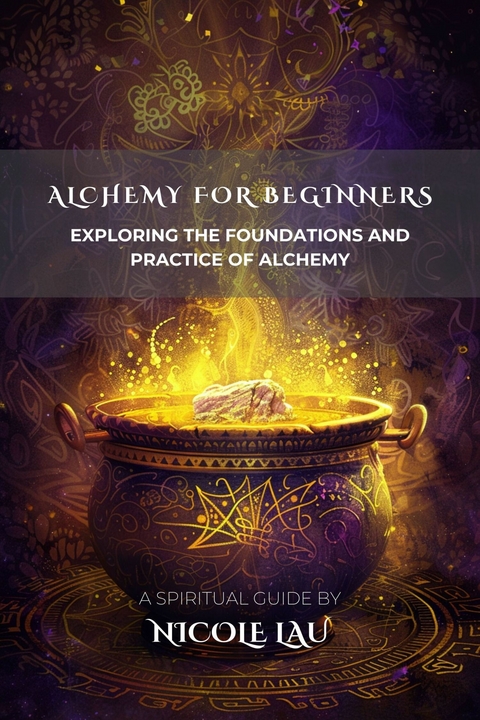
Alchemy for Beginners (eBook)
380 Seiten
Publishdrive (Verlag)
978-0-00-104035-9 (ISBN)
Alchemy is more than gold. It is transformation.
Alchemy for Beginners: Exploring the Foundations and Practice of Alchemy introduces you to the ancient art of change - not only of metals, but of mind, spirit, and soul. Nicole Lau guides you through the myths and realities of alchemy, bridging its symbolic language with modern perspectives so you can experience its wisdom in your own practice.
This book provides a gentle yet powerful entry point into the world of alchemy, where laboratory, symbol, and soul meet.
Inside this book, you will discover:
⚗️ The historical roots of alchemy in Egypt, Greece, China, and the Islamic world
Chapter 2: Core Notation and Terminology
2.1 Main Alchemical Symbols
- Planets and Metal Symbols
In classical alchemy, the seven planets were not only central to astronomy and astrology but also considered the cosmic source of the seven primary earthly metals. Alchemists believed that each metal carried the "celestial energy" of a specific planet. Therefore, planetary symbols were not only marked on astrological charts but also became an essential symbolic language in alchemical formulas, experimental records, and meditation sigils. These symbols carry the codes of ancient wisdom and serve as a bridge between the material and spiritual worlds. They not only reveal the mysteries of the universe but also guide alchemists in their pursuit of spiritual sublimation and material perfection through the transformation of matter.
The Seven Planets Correspond to Metals
- Sun (☉) = Gold
- Symbolic meaning: perfection, purity, authority, vitality
- Alchemical Interpretation: Gold is considered a "mature metal," impervious to corrosion, and symbolizes spiritual perfection and immortality. In alchemy, it represents the ultimate transformation, a symbol of the philosopher's stone, and the highest achievement of both material and spiritual attainment. Its radiance echoes the sun's rays, representing the ultimate goal pursued by alchemists and a symbol of eternity and immutability.
- In experimentation: It represents the final goal or the manifestation stage of the Philosopher's Stone. The radiance of gold echoes the light of the sun, representing the ultimate goal pursued by alchemists and symbolizing eternity and immutability.
- Moon (☽) = Silver
- Symbolic meaning: intuition, subconsciousness, emotion, cycle
- Alchemical Interpretation: Silver's luster, similar to moonlight, is seen as a symbol of receptivity and reflection. In the alchemical process, it represents physical purification and spiritual elevation. Silver's gentle glow, like moonlight, can illuminate the dark corners of the soul, guiding the alchemist toward deeper self-awareness.
- In experiments, silver was often combined with gold to symbolize the fusion of the conscious and subconscious. In alchemy, silver was also associated with the cyclical changes of the moon, representing change and transformation. Through the purifying power of silver, alchemists believed that both material and spiritual purification could be achieved.
- Mercury (☿) = Mercury
- Symbolic meaning: communication, transformation, balancing yin and yang
- Alchemical Interpretation: Mercury, fluid at room temperature and capable of combining with a variety of metals, symbolizes plasticity and intermediacy. In alchemy, it symbolizes change, representing the transformation of matter and spirit. Mercury's fluidity and unpredictable nature make it an essential element in alchemy, symbolizing constant change and adaptation.
- In experiments: Mercury was considered a catalyst for the transmutation of metals. Its fluidity and capricious nature made it an essential element in alchemy, symbolizing constant change and adaptation. Through its transmutative properties, alchemists believed they could achieve a complete transformation of matter.
- Venus ( ♀ ) = Copper
- Symbolism: love, beauty, harmony, creativity
- Alchemical Interpretation: Copper's soft luster and ease of processing symbolize artistry and the flow of vitality. In alchemy, it represents emotional richness and spiritual harmony. Copper's warm hue, like the radiance of Venus, can inspire inner feelings of love and beauty, promoting harmony and balance of the mind.
- In experimentation, copper is often associated with aesthetics and energetic harmony. In alchemy, copper aligns with Venus, the planet of love and beauty, representing creation and harmony. Through copper, alchemists believed they could achieve a harmonious unity between matter and spirit.
- Mars ( ♂ ) = Iron
- Symbolism: Strength, courage, conflict, action
- Alchemical Interpretation: Iron is hard and powerful, symbolizing willpower and execution, and is associated with war and protection. In alchemy, it represents concentrated strength and decisive action. Iron's sturdiness, like the fighting spirit of Mars, can inspire inner strength and courage, propelling the alchemist forward.
- In experimentation, iron represents both driving and defensive energies. In alchemy, iron is also associated with the fighting spirit of Mars, a symbol of strength and courage. Through the strengthening effects of iron, alchemists believed they could achieve inner strength and spiritual steadiness.
- Jupiter (♃) = Tin
- Symbolism: Expansion, wisdom, protection, abundance
- Alchemical Interpretation: Tin, with its lightness and malleability, symbolizes the power of openness and tolerance. In alchemy, it represents the growth of wisdom and the expansion of the spirit. Tin's malleability, like Jupiter's expansive power, fosters the expansion of wisdom and spiritual growth, guiding alchemists toward a broader perspective.
- In experimentation: Tin is often used in formulas symbolizing the expansion of influence or intellectual growth. In alchemy, tin is also associated with Jupiter, the planet of expansion and fertility, and a symbol of growth and development. Through tin's expansive properties, alchemists believed they could achieve a dual expansion of wisdom and spirit.
- Saturn (♄) = Lead
- Symbolic meaning: limitation, precipitation, maturity, time
- Alchemical Interpretation: Lead, heavy and dark, symbolizes a raw, rough starting point and one of the starting materials for alchemical transformation. In alchemy, it represents the settling of matter and the maturation of spirit. Like Saturn's restraining and settling qualities, lead's heaviness promotes both material and spiritual maturation, aiding the alchemist in achieving inner transformation and sublimation.
- In experiments, it represents an initial state that must be purified and sublimated. In alchemy, lead is also associated with Saturn's time and limitations, representing the starting point for the transformation of the material and spiritual worlds. Through the precipitation of lead, alchemists believed they could achieve a complete purification and sublimation of both matter and spirit.
Uses of Symbols in Alchemy
- Experimental Records: Alchemists often used planetary symbols instead of specific metal names during their experiments to facilitate recording and maintain confidentiality. These symbols not only served a symbolic purpose but also effectively concealed key information about the alchemical process, preventing outsiders from easily deciphering it. For example, gold was often represented by the sun symbol (☉), while silver was represented by the moon symbol (☽).
- Meditation and Ritual: In the practice of inner alchemy, practitioners engage in specific meditations and rituals, in which visualizing corresponding symbols and metals is a crucial component. By mentally picturing these symbols, practitioners can channel and stimulate their inner psychic energies, while also drawing upon the influence of celestial bodies to achieve spiritual purification and elevation. For example, visualizing the metal sun symbol (☉) can enhance one's willpower and leadership.
- Symbolic Synthesis: In alchemy, the combination of symbols is a crucial way to express the fusion of different forces or elements. By combining two planetary symbols, one can symbolically represent the birth of a new force or element. For example, the union of the Sun (☉) and the Moon (☽) not only represents the union of yin and yang, but also symbolizes the harmonious unity of light and dark, masculine and feminine, and rational and emotional. This combination of symbols is widely used in alchemy to express the process of material transformation and spiritual sublimation.
- The inheritance and evolution of symbols: Alchemical symbols have a long history, having been passed down and evolved across cultures and eras. Some symbols may have originated in ancient astrology, acquiring new meanings and uses over time. For example, the mercury symbol (☿) in alchemy not only represents the substance itself but also symbolizes change and fluidity, embodying the core alchemical concept of material transformation and spiritual sublimation.
- Symbols in Modern Alchemy: Although modern science has revealed many of the secrets of the material world, alchemical symbols still hold a place in certain modern practices and philosophical reflections. They are used to symbolically represent processes of personal growth, psychotherapy, and spiritual exploration. For example, the sulfur symbol ( ♂ ) may represent personal passion and creativity in modern alchemy, while the lead symbol ( ♀ ) may symbolize stability and foundation.
- Symbols for Phases of Matter (Ternary Structure of Salt, Sulfur, and Mercury)
In alchemy, salt, sulfur, and mercury are known as the "Tria Prima," proposed by the Renaissance alchemist Paracelsus as the core...
| Erscheint lt. Verlag | 29.8.2025 |
|---|---|
| Sprache | englisch |
| Themenwelt | Sachbuch/Ratgeber ► Gesundheit / Leben / Psychologie ► Esoterik / Spiritualität |
| ISBN-10 | 0-00-104035-9 / 0001040359 |
| ISBN-13 | 978-0-00-104035-9 / 9780001040359 |
| Informationen gemäß Produktsicherheitsverordnung (GPSR) | |
| Haben Sie eine Frage zum Produkt? |
 EPUB (Adobe DRM)
Größe: 1,2 MB
Kopierschutz: Adobe-DRM
Adobe-DRM ist ein Kopierschutz, der das eBook vor Mißbrauch schützen soll. Dabei wird das eBook bereits beim Download auf Ihre persönliche Adobe-ID autorisiert. Lesen können Sie das eBook dann nur auf den Geräten, welche ebenfalls auf Ihre Adobe-ID registriert sind.
Details zum Adobe-DRM
Dateiformat: EPUB (Electronic Publication)
EPUB ist ein offener Standard für eBooks und eignet sich besonders zur Darstellung von Belletristik und Sachbüchern. Der Fließtext wird dynamisch an die Display- und Schriftgröße angepasst. Auch für mobile Lesegeräte ist EPUB daher gut geeignet.
Systemvoraussetzungen:
PC/Mac: Mit einem PC oder Mac können Sie dieses eBook lesen. Sie benötigen eine
eReader: Dieses eBook kann mit (fast) allen eBook-Readern gelesen werden. Mit dem amazon-Kindle ist es aber nicht kompatibel.
Smartphone/Tablet: Egal ob Apple oder Android, dieses eBook können Sie lesen. Sie benötigen eine
Geräteliste und zusätzliche Hinweise
Buying eBooks from abroad
For tax law reasons we can sell eBooks just within Germany and Switzerland. Regrettably we cannot fulfill eBook-orders from other countries.
aus dem Bereich