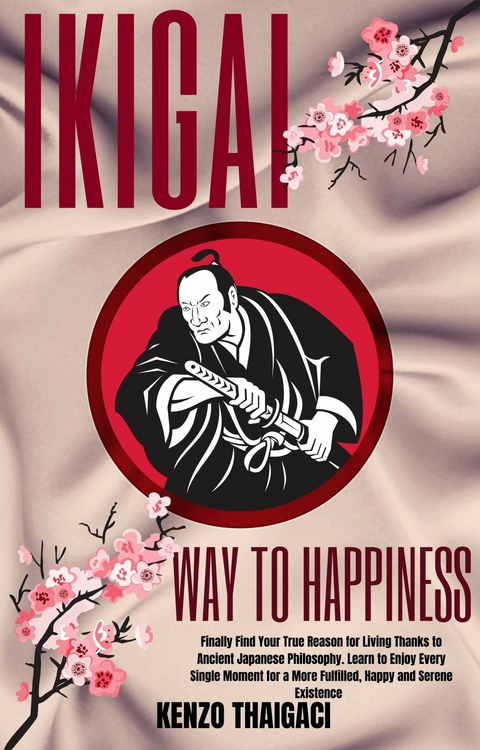
Ikigai Way to Happpines (eBook)
141 Seiten
Publishdrive (Verlag)
978-0-00-101944-7 (ISBN)
Why don't we find our own way?
What would you say if from today you were paid to do what you most enjoy?
Each of us dreams of a life that flows in a continuous and harmonious flow....
We dream of being surrounded by beautiful things, inspiring people, and doing work that is as rewarding to ourselves as it is useful to others, but paradoxically, no matter how strong the desire to achieve this state of well-being and harmony, it feels almost impossible to achieve.
Seeing things from this point of view, we remove ourselves from the responsibility of looking for a better way of living, accepting as excuses the typical phrases we repeat to ourselves in order not to listen to our true selves: 'where do I find the time to change?!' or 'go figure, unlucky as I am sure nothing changes!'
When we speak to ourselves in a negative way, it is as if we are doing self-sabotage to our self, thus moving us away from one of the most effective practices for achieving our goals and realizing our desires, which is visualization.
There is, however, a way of life, Ikigai, that can make our goals concrete and thus give us a valid reason to get up in the morning, as well as the responsibility to decide what tone we want to live in every single day.
In this book you will find out exactly what it is, why it is so important to know it, and how to start looking for your own personal ikigai:
The Meaning of Life in Psychology, Philosophy and Religion
The 5 Pillars of Ikigai
How to find and protect ikigai
The obstacles of modern life: how they affect ikigai
....and much more
IKIGAI: the North Star that will help you navigate the path of life
If you feel attracted to this philosophy of life and also want to find your Ikigai, please add the book to your cart and fill in the circles related to the four areas of your life so that you are clear on how to converge them to the center, identifying your Ikigai!
CHAPTER 1
What is ikigai?
When President Barack Obama paid his official visit to Japan in the spring of 2014, Japanese government officials chose the location for the prime minister's reception. The private event, prior to the state visit that would officially begin the following day, included a dinner at the Imperial Palace presided over by the emperor and empress.
Imagine how delicate the choice of restaurant was. When it was finally announced that it would be Sukiyabashi Jiro, arguably one of the most famous and respected sushi restaurants in the world, the decision met with general approval. In fact, you could tell how much President Obama enjoyed the dining experience there by how smiling he came out. Obama reportedly said it was the best sushi he had ever tasted. It was high praise, coming from someone raised in Hawaii and under a strong Japanese influence, sushi included, and for whom this was certainly not his first experience of fine dining.
The proud man behind Sukiyabashi Jiro is Jiro Ono, at ninety-one years old one of the oldest chefs with three Michelin stars. Sukiyabashi Jiro was already famous among Japanese connoisseurs before the first Tokyo Michelin Guide came out in 2012, but its publication definitely put the restaurant on the gourmet map of the world.
Although Ono's sushi is shrouded in an almost mystical aura, her cooking is based on practical and ingenious techniques. For example, she has developed a special method of serving fresh salmon roe (ikura) all year round. This defies the wise professional tradition respected in the best sushi restaurants: only serve ikura in the fall, the best season, when salmon come up the rivers to spawn.
He has also created a particular method of smoking certain fish by burning dry rice stalks to give them a special flavor.
The time to serve sushi dishes to demanding customers, as well as the temperature of the fish, must be precisely calculated so that its flavor is optimal. (It is understood that the client will take it to his mouth without delay). Indeed, dining at Sukiyabashi Jiro is like enjoying an exquisite ballet, choreographed behind the counter by a respected and solemn-looking master with an austere appearance (although his face, if one is lucky, lights up with a smile from time to time).
Rest assured, Ono's incredible success is due to her exceptional talent, determination and steadfast perseverance over years of hard work, as well as her relentless pursuit of the highest quality culinary methods and presentations. Ono has achieved both.
However, on top of that or maybe even above that, Ono has ikigai. It is no exaggeration to say that he owes his fabulous success both professionally and personally to the refinement of this value system that is so characteristic of his country.
Ikigai is a Japanese term to refer to the pleasures and meaning of life. The word is made up of iki (to live) and gai (reason).
In Japanese, ikigai is used in various contexts and is applicable to the details of everyday life as well as big goals and achievements. It is such a common term that people usually use it quite lightly, without being aware of its special meaning. The most important thing is that in order to have ikigai, professional success is not necessary. In this aspect it is a very democratic concept, it celebrates the diversity of life. It is true that having ikigai can lead to success, but this is not an essential condition for that. Ikigai is available to everyone.
For a successful sushi restaurant owner like Jiro Ono, a eulogy from the President of the United States is a source of ikigai. Recognition of him as the world's oldest three-Michelin-starred chef has surely strengthened his ikigai. However, this is not exhausted in obtaining the recognition and acclaim of all. Ono is able to find ikigai simply by serving the best tuna to a smiling customer or noticing the fresh air in the early morning when he gets up and prepares to go to the Tsukiji fish market. He is even able to find ikigai in the cup of coffee he drinks before starting the day or in a ray of sunlight that breaks through the leaves of a tree as he walks to his restaurant in downtown Tokyo.
Ono once said that she wishes to die preparing sushi. Evidently, preparing him gives him a deep sense of ikigai, even though he requires many small, inherently monotonous and time-consuming steps. For example, for octopus meat to be soft and tasty, he has to "massage" the cephalopod for an hour. The preparation of kohada, a small fish considered the king of sushi, also requires a lot of attention, because you have to remove the scales and guts, as well as preserve it in a perfectly balanced marinade of salt and vinegar. "Perhaps my last sushi creation will be kohada," he has said.
The realm of ikigai is in the details. The morning air, the cup of coffee, the sunbeam, the octopus massage and the congratulations from the American president are on an equal footing. Only those who know how to recognize the richness of its entire spectrum truly appreciate and enjoy it.
This is an important ikigai lesson. In a world where our value as individuals and our self-worth is largely determined by success, many people find themselves unnecessarily under pressure. It may seem to us that our value system, whatever it may be, is only valid and justified if it translates into concrete achievements: for example, a promotion or a lucrative investment.
Well, calm down! You don't have to test yourself like this to have ikigai, a reason to live. I'm not saying it will be easy. Sometimes I have to remind myself of this truth, even though I was born and raised in a country where ikigai is more or less assumed knowledge.
In a TED talk entitled "How to live beyond a hundred years", the American writer Dan Buettner discussed ikigai as a value system for good health and longevity. At the time of this writing, Buettner's talk has been viewed more than three million times. Buettner explains the lifestyles of five places in the world, whose population is longest. Each "blue zone," as Buettner calls it, has its own culture and traditions that contribute to longevity. They are: Okinawa (Japan), Sardinia (Italy), Nicoya (Costa Rica), Icaria (Greece), and the Loma Linda Seventh-day Adventist community (California). Of all of them, the one in Okinawa has the highest life expectancy.
Okinawa is a chain of islands in the southernmost part of the Japanese archipelago. There they boast of having a lot of centenarians. To explain what ikigai consists of, Buettner cites its inhabitants: a one hundred and two year old karate master told him that his ikigai was his love for martial arts; a centenarian fisherman explained that his was to continue fishing for his family three times a week; a 102-year-old woman replied that hers was to hug her great-great-granddaughter (she commented that it was like jumping into heaven). Taken together, these simple lifestyle choices hint at what constitutes the very essence of ikigai: a sense of community, a balanced diet, and an awareness of spirituality.
Although perhaps more evident in Okinawa, the entire Japanese population shares these principles. Not surprisingly, the longevity rate in Japan is extremely high, throughout the country. According to a survey by the Ministry of Health, Labor and Welfare in 2016, compared to other countries and regions in the world, the longevity of Japanese men ranks fourth (with an average life expectancy of 80.79 years) after Hong Kong , Iceland and Switzerland. That of Japanese women ranks second in the world (with an average life expectancy of 87.05 years) after Hong Kong and followed by Spain.
It is fascinating to see how much ikigai is ingrained in many Japanese. A pivotal study on the health benefits of ikigai conducted by researchers at Tohoku University School of Medicine[one], in northern Japan, with a large number of subjects, allowed the researchers to establish statistically significant correlations between ikigai and these benefits.
This study analyzed data from another, the Ōsaki National Health Insurance Cohort Study, conducted over seven years. A questionnaire was distributed to 54,996 beneficiaries of the Ōsaki Public Health Center (which provides health coverage to residents of fourteen townships) between the ages of forty and seventy-nine.
The survey consisted of a 93-item questionnaire in which subjects were asked about their medical and family history, health status, alcohol and tobacco use habits, job, marital status, education, and other factors related to health, including ikigai. The crucial question related to the latter was very direct: "Is there ikigai in your life?" Subjects were asked to choose one of three answers: “yes”, “not sure” or “no”.
Analyzing data from more than 50,000 people, Ōsaki's study concluded that "compared with those who had found their ikigai, those who had not were more likely to be single and unemployed, have a lower educational level , perceive their health as poor, be very stressed, suffer from severe or moderate pain, physical limitations and less motor capacity».
Based on this study alone, it is not possible to say whether having ikigai has improved the subjects' marriage, work and education, or whether, on the contrary, it has been the sum of the small successes in life that has led to his heightened sense of ikigai. However, it seems reasonable to say that having ikigai indicates a certain state of mind: subjects feel capable of leading a happy and active life. In a way, ikigai is a barometer that reflects a person's vision of life in an integrated and representative way.
Furthermore, the mortality rate of people who answered "yes" to the ikigai question was...
| Erscheint lt. Verlag | 10.8.2025 |
|---|---|
| Sprache | englisch |
| Themenwelt | Sachbuch/Ratgeber ► Gesundheit / Leben / Psychologie ► Esoterik / Spiritualität |
| ISBN-10 | 0-00-101944-9 / 0001019449 |
| ISBN-13 | 978-0-00-101944-7 / 9780001019447 |
| Informationen gemäß Produktsicherheitsverordnung (GPSR) | |
| Haben Sie eine Frage zum Produkt? |
 EPUB (Adobe DRM)
Größe: 1,0 MB
Kopierschutz: Adobe-DRM
Adobe-DRM ist ein Kopierschutz, der das eBook vor Mißbrauch schützen soll. Dabei wird das eBook bereits beim Download auf Ihre persönliche Adobe-ID autorisiert. Lesen können Sie das eBook dann nur auf den Geräten, welche ebenfalls auf Ihre Adobe-ID registriert sind.
Details zum Adobe-DRM
Dateiformat: EPUB (Electronic Publication)
EPUB ist ein offener Standard für eBooks und eignet sich besonders zur Darstellung von Belletristik und Sachbüchern. Der Fließtext wird dynamisch an die Display- und Schriftgröße angepasst. Auch für mobile Lesegeräte ist EPUB daher gut geeignet.
Systemvoraussetzungen:
PC/Mac: Mit einem PC oder Mac können Sie dieses eBook lesen. Sie benötigen eine
eReader: Dieses eBook kann mit (fast) allen eBook-Readern gelesen werden. Mit dem amazon-Kindle ist es aber nicht kompatibel.
Smartphone/Tablet: Egal ob Apple oder Android, dieses eBook können Sie lesen. Sie benötigen eine
Geräteliste und zusätzliche Hinweise
Buying eBooks from abroad
For tax law reasons we can sell eBooks just within Germany and Switzerland. Regrettably we cannot fulfill eBook-orders from other countries.
aus dem Bereich