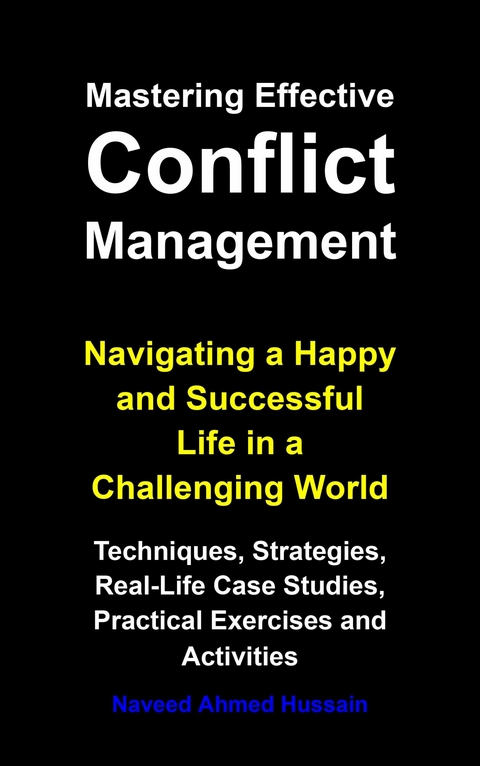
Mastering Effective Conflict Management (eBook)
167 Seiten
Publishdrive (Verlag)
978-0-00-066120-3 (ISBN)
Mastering Effective Conflict Management :
Conflict is a part of life, but it doesn't have to be a source of stress or anxiety. 'Mastering Effective Conflict Management' is your essential guide to transforming conflicts into opportunities for growth, understanding, and stronger relationships. Whether you're dealing with challenges in your personal life, workplace, or community, this book equips you with the tools and strategies to navigate conflicts with confidence and ease.
What You'll Discover in This Book
This book is packed with practical insights, real-life examples, and actionable strategies you can use immediately. Here's a glimpse of what you'll find inside:
Understanding Conflict: Discover the root causes of conflicts and learn how to approach them with a clear mind. By understanding the underlying dynamics, you'll be better prepared to address issues before they escalate.
Enhancing Emotional Intelligence: Emotional intelligence is key to successful conflict resolution. This book offers practical tips to improve your self-awareness, empathy, and emotional regulation, enabling you to handle conflicts with greater sensitivity and insight.
Effective Communication: Communication is the cornerstone of conflict resolution. Learn how to express your needs and feelings clearly, listen actively, and use techniques that foster understanding and reduce tension.
Practical Conflict Resolution Techniques: From negotiation to mediation, this book provides a variety of proven strategies to resolve conflicts effectively. Whether you're managing a minor disagreement or a significant dispute, you'll find actionable advice to guide you toward a resolution.
Building Resilience and Balance: Conflict can be challenging, but with resilience and a balanced approach, you can handle anything life throws your way. This book helps you develop a resilient mindset, manage stress, and maintain a healthy balance in your life.
Real-Life Examples and Exercises: 'Mastering Conflict Management' isn't just about theory-it's about practice. The book includes real-life case studies and practical exercises that allow you to apply what you've learned and refine your conflict management skills.
Why This Book Matters:
Whether you're looking to improve your personal relationships, enhance your professional interactions, or contribute to a more harmonious community, 'Mastering Conflict Management' provides the insights and tools you need. By mastering conflict, you're not just solving problems-you're building stronger, more positive connections with those around you.
Don't Wait Another Day to Start Changing Your Life
Take the first step towards a more peaceful and fulfilling life. With 'Mastering Effective Conflict Management,' you'll be ready to turn any conflict into an opportunity for growth and success.
Get your copy today
Chapter Introduction
Welcome to the second chapter of our journey through effective conflict management. Now that we have a foundational understanding of conflict, it's time to delve deeper into how we respond to it. Each of us has a preferred way of dealing with disputes, often influenced by our personality, experiences, and the specific context of the conflict. Understanding your conflict resolution style can provide valuable insights into your approach to disagreements and help you navigate them more effectively.
Why Understanding Your Conflict Style Matters
Knowing your conflict style is crucial because it influences how you interact with others during a disagreement. It affects not only the outcome of the conflict but also the quality of your relationships and your overall well-being. By identifying and understanding your style, you can make more informed choices about how to handle conflicts, improving both your personal and professional interactions.
The Five Conflict Styles
Researchers Kenneth Thomas and Ralph Kilmann developed a widely recognized model that categorizes conflict resolution styles into five distinct types: Avoiding, Accommodating, Competing, Compromising, and Collaborating. Each style has its strengths and weaknesses, and the effectiveness of a style can vary depending on the situation.
1. Avoiding
The Avoiding style involves dodging the conflict entirely. Individuals who use this style may withdraw from the situation, hoping that the issue will resolve itself over time. While this can be effective in situations where the conflict is trivial or where the cost of confrontation outweighs the benefits, it often leads to unresolved issues that can resurface later.
Strengths:
● Can prevent unnecessary confrontation.
● Allows time for tempers to cool and perspectives to shift.
Weaknesses:
● Issues remain unresolved.
● Can lead to resentment or frustration over time.
When to Use:
● When the issue is minor.
● When the conflict is highly emotional, and a cooling-off period is needed.
2. Accommodating
The Accommodating style is characterized by giving in to the other party's demands, often at the expense of your own interests. This style can be useful when maintaining harmony is more important than winning the argument, or when the issue is more important to the other party.
Strengths:
● Preserves relationships and reduces tension.
● Can be seen as an act of goodwill or generosity.
Weaknesses:
● Can lead to unaddressed personal needs.
● May create a pattern of imbalance in relationships.
When to Use:
● When the issue is more important to the other person.
● When maintaining peace and harmony is the priority.
3. Competing
The Competing style involves asserting your own position aggressively, often at the expense of others. Individuals who use this style prioritize winning the argument over maintaining relationships. This can be effective in situations where a quick, decisive action is needed or when protecting your own interests is critical.
Strengths:
● Can lead to quick, decisive outcomes.
● Useful in emergencies or when standing up for important principles.
Weaknesses:
● Can damage relationships and create hostility.
● May lead to a win-lose situation where one party feels defeated.
When to Use:
● In emergencies requiring quick action.
● When you need to stand firm on important issues or principles.
4. Compromising
The Compromising style seeks a middle ground where both parties make concessions. This style aims to find a solution that is acceptable to all parties, though it may not fully satisfy anyone. Compromising can be effective in resolving conflicts quickly and fairly.
Strengths:
● Can provide a quick resolution.
● Ensures that all parties get something they want.
Weaknesses:
● May lead to a solution that partially satisfies everyone but fully satisfies no one.
● Can result in suboptimal outcomes if overused.
When to Use:
● When time is a factor and a quick resolution is needed.
● When the goals are moderately important but not worth the potential disruption of a more assertive approach.
5. Collaborating
The Collaborating style involves working together to find a mutually beneficial solution. This style emphasizes cooperation, open communication, and creative problem-solving. It is often the most effective approach for resolving complex conflicts where the interests of all parties are important.
Strengths:
● Leads to win-win solutions.
● Can strengthen relationships through cooperation and mutual respect.
Weaknesses:
● Can be time-consuming.
● Requires a high level of trust and communication between parties.
When to Use:
● When the conflict is complex and all parties' interests are important.
● When there is a need to build or maintain strong relationships.
Assessing Your Style
To effectively manage conflicts, it's important to assess your default conflict resolution style. Reflecting on past conflicts can provide valuable insights into your natural tendencies and help you understand the impact of your approach.
Exercise: Conflict Style Assessment
1. Think about a recent conflict you were involved in.
○ Describe the situation and the parties involved.
○ Outline the key issues and points of disagreement.
2. Write down how you handled the situation.
○ Detail your actions, responses, and strategies.
○ Note any thoughts or feelings that influenced your approach.
3. Identify which conflict style you used.
○ Compare your approach to the descriptions of the five conflict styles.
○ Determine which style best matches your behavior in the situation.
4. Reflect on the outcome and consider if a different style might have been more effective.
○ Assess the results of the conflict and its impact on your relationships and objectives.
○ Think about how using a different style might have changed the outcome.
Example: Conflict Style Assessment
1. Situation: A disagreement with a coworker about the best approach to a project.
○ Key Issues: Differing opinions on project methodology and resource allocation.
2. Handling the Situation: I insisted on my approach, emphasizing its benefits and dismissing my coworker's suggestions.
○ Actions: Dominated the discussion, presented data to support my position, and did not acknowledge my coworker's perspective.
3. Conflict Style: Competing.
○ Match: Assertive and focused on winning the argument rather than finding a common ground.
4. Outcome and Reflection: The project moved forward with my approach, but my relationship with the coworker became strained.
○ Alternative Style: Collaborating could have led to a more inclusive solution and preserved the working relationship.
Techniques for Balancing Your Conflict Style
While everyone has a default conflict style, it's important to be flexible and adapt your approach based on the situation. Here are some techniques to help you balance your conflict style:
- Self-Awareness: Regularly assess your conflict style and its impact on your relationships and goals. Be mindful of your natural tendencies and strive to understand how they influence your interactions.
- Contextual Adaptation: Consider the specific context and stakes of the conflict. Different situations may require different approaches. For example, while competing might be necessary in high-stakes scenarios, collaborating or compromising might be more effective in maintaining long-term relationships.
- Developing New Skills: Practice and develop skills associated with different conflict styles. For instance, if you tend to avoid conflicts, work on assertiveness and communication skills. If you often compete, practice empathy and active listening.
- Seeking Feedback: Ask trusted colleagues, friends, or mentors for feedback on your conflict management approach. This can provide valuable insights and help you identify areas for improvement.
Practical Exercises and Activities
To help you further develop your conflict resolution skills, here are some practical exercises and activities:
- Role-Playing Scenarios: Engage in role-playing exercises with a friend or colleague to practice different conflict resolution styles. Choose various scenarios and...
| Erscheint lt. Verlag | 17.10.2024 |
|---|---|
| Sprache | englisch |
| Themenwelt | Sachbuch/Ratgeber ► Beruf / Finanzen / Recht / Wirtschaft |
| ISBN-10 | 0-00-066120-1 / 0000661201 |
| ISBN-13 | 978-0-00-066120-3 / 9780000661203 |
| Informationen gemäß Produktsicherheitsverordnung (GPSR) | |
| Haben Sie eine Frage zum Produkt? |
 EPUB (Adobe DRM)
Größe: 161 KB
Kopierschutz: Adobe-DRM
Adobe-DRM ist ein Kopierschutz, der das eBook vor Mißbrauch schützen soll. Dabei wird das eBook bereits beim Download auf Ihre persönliche Adobe-ID autorisiert. Lesen können Sie das eBook dann nur auf den Geräten, welche ebenfalls auf Ihre Adobe-ID registriert sind.
Details zum Adobe-DRM
Dateiformat: EPUB (Electronic Publication)
EPUB ist ein offener Standard für eBooks und eignet sich besonders zur Darstellung von Belletristik und Sachbüchern. Der Fließtext wird dynamisch an die Display- und Schriftgröße angepasst. Auch für mobile Lesegeräte ist EPUB daher gut geeignet.
Systemvoraussetzungen:
PC/Mac: Mit einem PC oder Mac können Sie dieses eBook lesen. Sie benötigen eine
eReader: Dieses eBook kann mit (fast) allen eBook-Readern gelesen werden. Mit dem amazon-Kindle ist es aber nicht kompatibel.
Smartphone/Tablet: Egal ob Apple oder Android, dieses eBook können Sie lesen. Sie benötigen eine
Geräteliste und zusätzliche Hinweise
Buying eBooks from abroad
For tax law reasons we can sell eBooks just within Germany and Switzerland. Regrettably we cannot fulfill eBook-orders from other countries.
aus dem Bereich