Letters From Your Future Self (eBook)
155 Seiten
Publishdrive (Verlag)
978-0-00-098497-5 (ISBN)
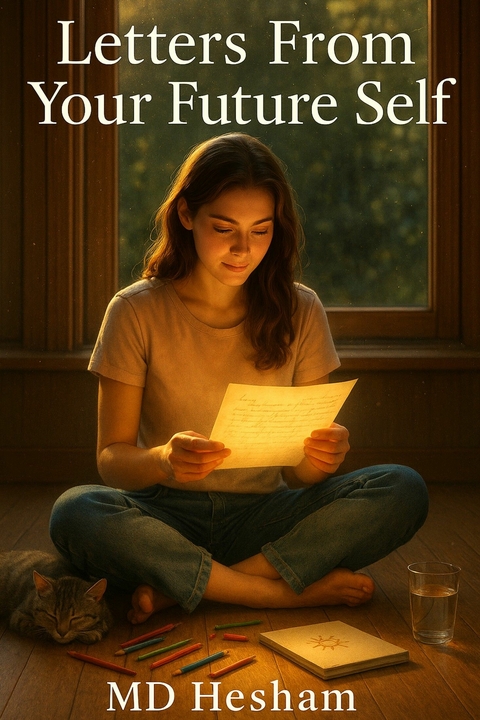
This book is a gentle companion for children and the adults who care for them. It holds sixteen heartfelt letters, each written in warm, simple language to support young minds through common emotions like doubt, joy, loneliness, or courage. These letters offer short, science-backed practices-like breathing slowly, drawing, or writing kind thoughts-that help children understand themselves better and find calm. Each letter also leaves space for readers to respond, building a habit of reflection and self-trust. Whether used individually or in group settings, this book encourages connection, emotional resilience, and gratitude without pressure or harsh advice. It promises not to fix everything but to be a steady friend-one that waits quietly on the shelf and speaks only when needed. With activities children can try immediately and science explained in everyday words, the book becomes a lantern for dark moments, helping young readers believe in their own inner light.
1. Dear You at the Starting Line
A letter of hope and courage for when you're beginning something new—whether it's a job, relationship, habit, or season. Space for reflecting on intentions, fears, and small first steps.
Dear friend, I am writing from a little way ahead on your road. I can still see the place where you now stand, right before you take your first step. I remember the mix of feelings in your chest. Your heart beats fast because you feel excited. At the same time, a small knot of worry sits in your stomach. You ask, “Can I begin and keep going?” I answer with a clear “Yes.” You have more strength than you notice, and every new journey awakens that strength.
Think about your goal like a seed in your hand. The seed appears small, yet it contains an entire tree within. When you plant a seed, you provide it with soil, water, air, and light. Your actions bring the tree out from its shell. A new job, a new friendship, or a new daily habit grows the same way. Facts support this idea. Scientists count nearly one hundred billion nerve cells in a human brain. Each time you practice a new skill, tiny connections between those cells form and thicken. The connections work like fresh roads. More roads mean faster travel for thoughts and actions. You do not see the roads, but you feel their effect when a task feels easier each day.
Write down your first thoughts tonight. Place the date in your notebook. Under the date, write two short lists. The first list starts with the word “I hope.” Fill it with hopes in simple words like “I hope I greet new friends,” or “I hope I learn three new words.” The second list starts with the word “I fear.” Fears might read “I fear mistakes,” or “I fear people will laugh.” When you name a feeling, you shine light on it. Light makes shadows shrink. A study from a children’s hospital shows that young students who journal for five minutes each school night show a twenty-percent drop in daily stress after only three weeks. You see that fact and know your notebook works like a small pocket lamp.
Now, choose one small first step. Small steps win races because they add up. If you want to read more books, pick a thin book. Please open it and read for ten minutes, not two hours. Ten minutes feel light, like lifting a paper cup. You finish and you tell your brain, “I succeed.” Success releases dopamine, a brain chemical that works like a smile inside your head. Doctors who study habits say that short, clear actions repeated daily turn into automatic behaviors after about sixty-six days on average. This number gives you patience. You do not hurry, yet you continue to move.
Let me share an example about starting a new school year. On the first morning, you might feel unsure. You notice new faces in the room. You do not yet know the class rules. To guide yourself, greet one classmate with a warm “Hi.” Then arrange your desk neatly. A neat space tells your mind that order exists, and order calms nerves. Teachers report that students who greet others and organize their space on the first day often show better teamwork scores by mid-term. Numbers support this idea: in a study of 200 students, those who used organized desks raised their average group project score from 75 to 85.
Perhaps you plan to adopt a new habit, such as brushing your teeth after lunch. Dentists note that children who brush twice daily have a forty percent lower cavity risk compared with those who brush only once. The figure comes from a survey of ten thousand school children. You use that fact as a friendly push. You tape it on the bathroom mirror. Each time you read it, you feel a spark of purpose.
You might start a friendship. Friendships grow on shared time and honest words. Brain scans reveal that friendly conversation increases oxytocin levels. Oxytocin earns the name “bonding chemical.” Higher levels of oxytocin make people feel safer and more open to others. You watch for moments to share kind words, ask questions, and listen with both ears. You also respect your friend's space when they need quiet. Balanced closeness keeps bonds strong. Researchers have noted that children with at least one steady friend often show a ten-point increase in emotional well-being scales.
Sometimes your new beginning ties to the turning of a season. When spring comes, seeds wake under the soil because the ground warms to about sixty degrees Fahrenheit. Gardeners measure and know this number. You can copy nature. Warmth equals readiness. When you feel a warm sense of preparedness, you act. When you feel cold doubt, you wait, learn, and plan. Seasons teach rhythm. You cannot rush winter away, yet you can prepare cozy spaces, gather books, and sketch ideas. Preparation turns waiting into progress.
Now you hold a simple letter outline that you can reuse. At the top, write “Dear me at the starting line.” In the first part, tell yourself what you want to begin and why it matters. In the second part, list the supports around you: family, friends, teachers, books, and even quiet parks. In the third part, choose one tiny action you can take today. In the fourth part, promise to check in with yourself after one week. Finally, sign your name and re-enter the date. Some schools tested this outline with classes of thirty students each. After two months, teachers observed that students who wrote weekly letters demonstrated a fifteen percent higher task completion rate than those who did not.
Remember to breathe as you read and write. Slow breathing signals safety to your body. You can count to four seconds, hold for two seconds, and then breathe out for four seconds. Heart experts note that this pattern can lower a child's heart rate by up to seven beats per minute. A calm heart helps a clear mind. A clear mind spots solutions faster.
You may wonder about courage. People often think courage means the absence of fear. That idea turns out to be wrong. Fear and courage can stand together. Courage means you move while fear walks beside you, not in front of you. Scientists at a youth development center define courage as “action despite worry.” They found that children who take small, brave steps each day—such as asking a question in class—strengthen a brain area called the prefrontal cortex, which plays a crucial role in guiding decision-making. Growth in that area appears on scans after only twelve weeks of steady practice.
Turn back to your notebook now. Under your lists of hopes and fears, draw a small square. Inside the square, sketch your first step. If you start a running habit, draw a shoe. If you begin a music lesson, draw a note. Art speaks to the parts of the brain that handle emotion. Pictures store feelings quickly. Later, one glance at the shoe or note will remind you of your promise.
You may hear others say, “What if you fail?” Failure means feedback. A math coach once tracked her group of twenty young learners over the course of a year. She asked them to see each wrong answer as a map. The map indicated a spot that required extra practice. By the final test, her group improved their scores by an average of twenty-two points. They felt proud, not because they never missed a question, but because they learned to study the map and adjust.
When you begin any journey, set checkpoints to guide you along the way. A checkpoint is a time when you stop, look back, and reflect on what you have learned. Maybe the checkpoint arrives every Friday. During the checkpoint, ask three simple questions. What went well? What felt hard? What will I try next week? Keep each answer short. Short notes stay clear. Clear notes guide next steps. Researchers at a youth mentoring program observed that children who used weekly checkpoints achieved a goal completion rate twice that of their peers who did not.
Your future self smiles at each small win you collect: the first page read, the first new friend greeted, the first smooth brush of teeth after lunch. Each win forms a brick in a bridge. You walk on that bridge tomorrow. Bridges do not rise in one leap. Builders place brick on brick. You also put a win on a win. Soon, you look back and see solid ground where once you saw empty air.
I stand on that ground now and wave to you. I remind you to drink water, stretch your arms, and rest when your eyes grow heavy. Body care supports new starts. Doctors recommend that children drink approximately five cups of water daily and get at least nine hours of sleep each night. Water keeps cells working. Sleep turns today’s lessons into firm memories. During deep sleep, brain cells pass electrical signals that replay the day’s learning at high speed. This replay strengthens the fresh roads you built earlier.
Sometimes you might feel alone on your path. You can reach outward. A study of 200 young volunteers found that those who sought help from at least one trusted adult when faced with a challenge moved past it twice as quickly. Help can come from a teacher, a coach, or a family member. They bring experience that lights corners you cannot yet see.
Keep your eyes open for signs of progress. A sign may include smoother handwriting, a lighter body during a run, or a wider smile from a new friend. Record each sign. Psychologists name this “evidence of growth.” Evidence builds belief. Belief fuels action. The loop continues, and each turn lifts you higher.
If a day arrives when the path feels tight and dark, pause and recall your first list of hopes. Remember the seed. Seeds wait in darkness before they sprout. Growth often remains hidden underground before it emerges as green shoots. You cannot see roots, yet you trust that they grow. Trust your hidden growth during slow days. You still build skills even if you do not feel fast.
At the close...
| Erscheint lt. Verlag | 3.8.2025 |
|---|---|
| Sprache | englisch |
| Themenwelt | Sachbuch/Ratgeber ► Gesundheit / Leben / Psychologie ► Esoterik / Spiritualität |
| ISBN-10 | 0-00-098497-3 / 0000984973 |
| ISBN-13 | 978-0-00-098497-5 / 9780000984975 |
| Informationen gemäß Produktsicherheitsverordnung (GPSR) | |
| Haben Sie eine Frage zum Produkt? |
 EPUB (Adobe DRM)
Größe: 785 KB
Kopierschutz: Adobe-DRM
Adobe-DRM ist ein Kopierschutz, der das eBook vor Mißbrauch schützen soll. Dabei wird das eBook bereits beim Download auf Ihre persönliche Adobe-ID autorisiert. Lesen können Sie das eBook dann nur auf den Geräten, welche ebenfalls auf Ihre Adobe-ID registriert sind.
Details zum Adobe-DRM
Dateiformat: EPUB (Electronic Publication)
EPUB ist ein offener Standard für eBooks und eignet sich besonders zur Darstellung von Belletristik und Sachbüchern. Der Fließtext wird dynamisch an die Display- und Schriftgröße angepasst. Auch für mobile Lesegeräte ist EPUB daher gut geeignet.
Systemvoraussetzungen:
PC/Mac: Mit einem PC oder Mac können Sie dieses eBook lesen. Sie benötigen eine
eReader: Dieses eBook kann mit (fast) allen eBook-Readern gelesen werden. Mit dem amazon-Kindle ist es aber nicht kompatibel.
Smartphone/Tablet: Egal ob Apple oder Android, dieses eBook können Sie lesen. Sie benötigen eine
Geräteliste und zusätzliche Hinweise
Buying eBooks from abroad
For tax law reasons we can sell eBooks just within Germany and Switzerland. Regrettably we cannot fulfill eBook-orders from other countries.
aus dem Bereich