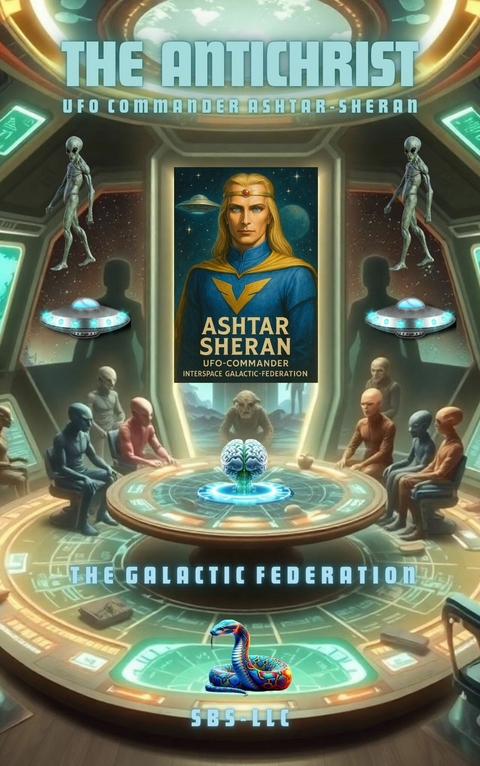
The Antichrist (eBook)
400 Seiten
Publishdrive (Verlag)
978-0-00-097892-9 (ISBN)
The Antichrist: UFO Commander Ashtar-Sheran
For 2,000 years, people have feared and awaited the appearance of the Antichrist. Generations have speculated, guessed, and wondered. But now, in our time, with rising global curiosity around UFOs, AI Technology, false New-Age teachings, and the so-called Galactic-Federation of 'Space-Brothers,' this new book steps in with deep, scholarly investigation. It examines not just ideas, but aligns them directly with Biblical prophecy, helping readers see the deceptive layers behind cosmic claims that seem so appealing on the surface.
This work dives boldly into questions that many are afraid to ask, offering a rare blend of scriptural analysis and insight into modern spiritual phenomena.
So who is the Antichrist? Is he UFO Commander Ashtar-Sheran of the Galactic Federation? The answers are in this book, which is the result of 36 years of diligent Biblically-based Christian research.
For 2000 years, people have been expecting his arrival. Centuries have come and gone, but he still hasn't appeared. Today, however, things are different! How can we know with certainty? Could the Antichrist be UFO Commander Ashtar-Sheran of the Galactic Federation, or another fraudulent false 'MESSIAH' in the Middle-East? Does the Bible provide us with enough information with which to make an educated guess as to his probable identity?
Yes, it does and the answers are in this book.
Chapter 1: The Garden of Eden & Humanity's First Betrayal
In the beginning, the world was perfect. A paradise untouched by corruption, filled with harmony between mankind and its Creator. The Garden of Eden stood as the pinnacle of divine craftsmanship—a sanctuary of abundance, beauty, and divine order. Adam and Eve, the first of humanity, lived in a realm where pain, suffering, and wickedness had no place. Yet paradise was fragile.
Within the shadows of Eden, a deceiver lurked—the serpent, Satan, God's fallen adversary. His whispers reached Eve, sowing doubt, rebellion, and the first temptation: reject God's authority and embrace forbidden knowledge. The fruit of the Tree of Knowledge dangled before her, promising something tantalizing—freedom from God's rule. She reached out. She took. She ate.
In That Moment, Everything Changed.
Sin entered the world, setting humanity on an irreversible path. The earth groaned under the weight of disobedience. The innocence of Eden shattered. God, in righteous judgment, cast Adam and Eve from the paradise He had lovingly crafted. The gates of Eden closed forever, and mankind was now bound to struggle, toil, and suffer under the burden of its rebellion.
The First Deception And Its Consequences
This first deception established a pattern that would repeat throughout human history—the promise of godlike knowledge and power leading to separation from divine truth. The serpent's words to Eve, "You will be like God, knowing good and evil" (Genesis 3:5), contained the fundamental lie that continues to resonate in modern spiritual deceptions, including those of the Ashtar Command: that humans can achieve divinity through special knowledge rather than through obedience to their Creator.
The Genesis account provides remarkable insight into the psychology of deception. The serpent's approach was subtle and multi-layered, employing tactics that would be repeated throughout history:
First, he questioned God's word: "Did God really say...?" (Genesis 3:1). This introduction of doubt remains the starting point for all spiritual deception—creating uncertainty about what God has clearly communicated.
Second, he contradicted God's warning: "You will not certainly die" (Genesis 3:4). This direct denial of consequences appears consistently in false spiritual systems, which typically downplay or reinterpret the concept of sin and judgment.
Third, he attributed malicious motives to God: "For God knows that when you eat from it...you will be like God" (Genesis 3:5). This suggestion that God withholds good things from His creation—that He is not truly loving or generous—underlies many spiritual deceptions, including the Ashtar narrative that portrays divine restrictions as limiting human potential rather than protecting from harm.
Finally, he offered a counterfeit version of what God had already promised: godlikeness. Humans were already made "in God's image" (Genesis 1:27), but the serpent offered a corrupted version of this identity—one achieved through rebellion rather than relationship.
The consequences were immediate and far-reaching. Genesis records that Adam and Eve were expelled from Eden, forced to face a hostile world where survival required constant labor. The harmony between humans and nature was broken, as was the direct communion between humanity and God.
Death—both spiritual and physical—entered human experience.
The Theological Significance Of
Eden's Fall
The events in Eden represent more than just the beginning of human suffering—they establish the fundamental problem that all spiritual systems must address: humanity's separation from God. Biblical theology understands this as the doctrine of "the Fall," with several key implications:
First, it explains the universal human experience of moral failure. As the Apostle Paul would later write, "All have sinned and fall short of the glory of God" (Romans 3:23). This universal condition stems not merely from bad examples or poor education, but from an inherited spiritual corruption—what theologians call "original sin."
Second, it establishes humanity's need for redemption from outside itself. If human rebellion caused the separation from God, then human effort alone cannot bridge that gap. This contradicts the central claim of many false spiritual systems, including the Ashtar narrative, which typically suggest that humans can evolve or ascend through their own spiritual development.
Third, it reveals the nature of sin as fundamentally relational rather than merely behavioral. The first sin was not primarily about breaking a rule but about breaking trust—choosing to believe the serpent rather than God. This relational understanding of sin explains why mere behavior modification or spiritual technique cannot restore what was lost in Eden.
Yet even in this moment of judgment, God demonstrated mercy. Genesis 3:15 contains what theologians call the "protoevangelium"—the first promise of redemption: "I will put enmity between you and the woman, and between your offspring and hers; he will crush your head, and you will strike his heel." This cryptic prophecy pointed toward an eventual conqueror who would defeat the serpent, a promise Christians understand as foretelling Christ's victory over Satan.
The Psychological Impact Of The Fall
The Fall in Eden also established psychological patterns that would characterize human experience thereafter. These patterns help explain humanity's vulnerability to spiritual deception throughout history.
First, shame entered human consciousness. Genesis 3:7 records that "the eyes of both of them were opened, and they realized they were naked." This awareness of vulnerability and inadequacy created a psychological need to cover or compensate—a need exploited by false spiritual systems that offer ways to overcome this innate sense of insufficiency.
Second, fear distorted humanity's relationship with God. When God appeared, Adam and Eve "hid from the LORD God among the trees of the garden" (Genesis 3:8). This instinct to hide from divine presence—to avoid full exposure to truth—underlies many religious substitutions that offer less demanding alternatives to direct accountability to God.
Third, blame-shifting became the human reflex when confronted with wrongdoing. Adam blamed Eve (and indirectly God who gave her to him), while Eve blamed the serpent (Genesis 3:12-13). This avoidance of personal responsibility remains a hallmark of false spiritual systems, which typically externalize evil rather than addressing the internal human condition.
Fourth, self-justification replaced humble repentance. Neither Adam nor Eve simply acknowledged their disobedience; each offered explanations and deflections. This pattern of self-justification rather than repentance characterizes many alternative spiritualities, which often reframe human failings as merely developmental stages rather than moral failures requiring forgiveness.
The Beginning Of False Worship
As humanity multiplied and spread across the earth, the memory of Eden faded, but the longing for paradise remained. This yearning, combined with humanity's fallen nature, led to the development of false worship systems—attempts to reconnect with divine power through human means.
By the time of Noah, just a few generations after Adam, Genesis 6:5 tells us that "the Lord saw how great the wickedness of the human race had become on the earth, and that every inclination of the thoughts of the human heart was only evil all the time." This corruption was so complete that God sent the Flood, preserving only Noah's family to restart human civilization.
The Development Of Idolatry
The post-Flood world quickly developed new forms of spiritual deception. Archaeological evidence from the earliest civilizations reveals sophisticated religious systems centered around idol worship.
These systems shared several characteristics that would persist throughout history
First, they materialized the divine. By creating physical representations of spiritual powers, early idolatry made the divine manipulable—something that could be controlled through ritual rather than obeyed through faith. This materialization continues in modern forms, with technology often replacing carved images as the mediator of spiritual experience.
Second, they localized divine presence. By establishing sacred spaces where gods were believed to dwell, early religions created controlled access to divine power, typically through a priestly class. This localization contradicted the omnipresence of the true God and established religious hierarchies that mediated between people and the divine—a pattern that continues in many modern spiritual movements, including the Ashtar Command structure with its hierarchy of cosmic beings.
Third, they fragmented divine attributes. Rather than worshiping one complete deity, idolatrous systems typically divided divine attributes among multiple gods—a god of fertility, a god of war, a god of wisdom, etc. This fragmentation made divine power seem more accessible but lost the holistic nature of true divinity.
Modern spiritual systems, including the cosmic hierarchy described in Ashtar communications, often continue this pattern by assigning different spiritual functions to various "ascended masters" or extraterrestrial entities.
Fourth, they ritualized relationships. True communion with God was...
| Erscheint lt. Verlag | 29.7.2025 |
|---|---|
| Sprache | englisch |
| Themenwelt | Sachbuch/Ratgeber ► Gesundheit / Leben / Psychologie ► Esoterik / Spiritualität |
| ISBN-10 | 0-00-097892-2 / 0000978922 |
| ISBN-13 | 978-0-00-097892-9 / 9780000978929 |
| Informationen gemäß Produktsicherheitsverordnung (GPSR) | |
| Haben Sie eine Frage zum Produkt? |
 EPUB (Adobe DRM)
Größe: 29,3 MB
Kopierschutz: Adobe-DRM
Adobe-DRM ist ein Kopierschutz, der das eBook vor Mißbrauch schützen soll. Dabei wird das eBook bereits beim Download auf Ihre persönliche Adobe-ID autorisiert. Lesen können Sie das eBook dann nur auf den Geräten, welche ebenfalls auf Ihre Adobe-ID registriert sind.
Details zum Adobe-DRM
Dateiformat: EPUB (Electronic Publication)
EPUB ist ein offener Standard für eBooks und eignet sich besonders zur Darstellung von Belletristik und Sachbüchern. Der Fließtext wird dynamisch an die Display- und Schriftgröße angepasst. Auch für mobile Lesegeräte ist EPUB daher gut geeignet.
Systemvoraussetzungen:
PC/Mac: Mit einem PC oder Mac können Sie dieses eBook lesen. Sie benötigen eine
eReader: Dieses eBook kann mit (fast) allen eBook-Readern gelesen werden. Mit dem amazon-Kindle ist es aber nicht kompatibel.
Smartphone/Tablet: Egal ob Apple oder Android, dieses eBook können Sie lesen. Sie benötigen eine
Geräteliste und zusätzliche Hinweise
Buying eBooks from abroad
For tax law reasons we can sell eBooks just within Germany and Switzerland. Regrettably we cannot fulfill eBook-orders from other countries.
aus dem Bereich