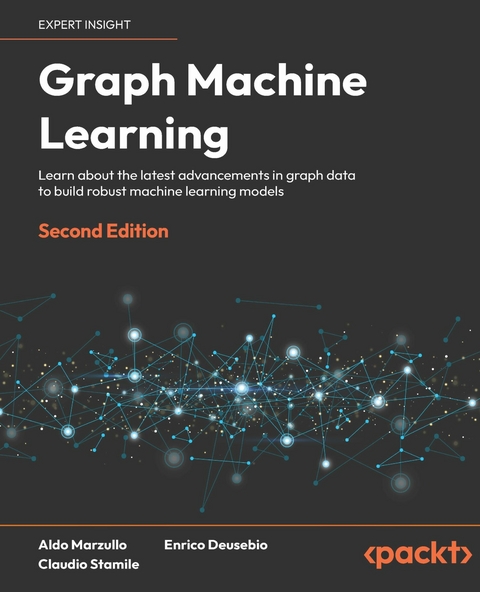
Graph Machine Learning (eBook)
434 Seiten
Packt Publishing (Verlag)
978-1-80324-661-1 (ISBN)

Graph Machine Learning, Second Edition builds on its predecessor's success, delivering the latest tools and techniques for this rapidly evolving field. From basic graph theory to advanced ML models, you'll learn how to represent data as graphs to uncover hidden patterns and relationships, with practical implementation emphasized through refreshed code examples. This thoroughly updated edition replaces outdated examples with modern alternatives such as PyTorch and DGL, available on GitHub to support enhanced learning.
The book also introduces new chapters on large language models and temporal graph learning, along with deeper insights into modern graph ML frameworks. Rather than serving as a step-by-step tutorial, it focuses on equipping you with fundamental problem-solving approaches that remain valuable even as specific technologies evolve. You will have a clear framework for assessing and selecting the right tools.
By the end of this book, you'll gain both a solid understanding of graph machine learning theory and the skills to apply it to real-world challenges.
Enhance your data science skills with this updated edition featuring new chapters on LLMs, temporal graphs, and updated examples with modern frameworks, including PyTorch Geometric, and DGLKey FeaturesMaster new graph ML techniques through updated examples using PyTorch Geometric and Deep Graph Library (DGL)Explore GML frameworks and their main characteristicsLeverage LLMs for machine learning on graphs and learn about temporal learningPurchase of the print or Kindle book includes a free PDF eBookBook DescriptionGraph Machine Learning, Second Edition builds on its predecessor's success, delivering the latest tools and techniques for this rapidly evolving field. From basic graph theory to advanced ML models, you'll learn how to represent data as graphs to uncover hidden patterns and relationships, with practical implementation emphasized through refreshed code examples. This thoroughly updated edition replaces outdated examples with modern alternatives such as PyTorch and DGL, available on GitHub to support enhanced learning. The book also introduces new chapters on large language models and temporal graph learning, along with deeper insights into modern graph ML frameworks. Rather than serving as a step-by-step tutorial, it focuses on equipping you with fundamental problem-solving approaches that remain valuable even as specific technologies evolve. You will have a clear framework for assessing and selecting the right tools. By the end of this book, you ll gain both a solid understanding of graph machine learning theory and the skills to apply it to real-world challenges.What you will learnImplement graph ML algorithms with examples in StellarGraph, PyTorch Geometric, and DGLApply graph analysis to dynamic datasets using temporal graph MLEnhance NLP and text analytics with graph-based techniquesSolve complex real-world problems with graph machine learningBuild and scale graph-powered ML applications effectivelyDeploy and scale your application seamlesslyWho this book is forThis book is for data scientists, ML professionals, and graph specialists looking to deepen their knowledge of graph data analysis or expand their machine learning toolkit. Prior knowledge of Python and basic machine learning principles is recommended.]]>
Preface
This updated and expanded second edition brings several significant improvements to help you stay ahead in the evolving field of graph machine learning. Compared to the previous version, this edition features refined chapters for improved clarity and flow, new examples utilizing both legacy tools and modern frameworks such as PyTorch and DGL, and entirely new chapters covering cutting-edge topics such as temporal graph machine learning and the integration of large language models (LLMs).
Graph Machine Learning provides a powerful toolkit for processing network-structured data and leveraging the relationships between entities for predictive modeling, analytics, and more. You’ll begin with a concise introduction to graph theory, graph machine learning, and neural networks, building a foundational understanding of their principles and applications. As you progress, you’ll dive into the core machine learning models for graph representation learning, exploring their goals, inner workings, and practical implementation across various supervised and unsupervised tasks. You’ll develop an end-to-end machine learning pipeline, from data preprocessing to training and prediction, to fully harness the potential of graph data. Throughout the book, you’ll find real-world scenarios such as social network analysis, natural language processing with graphs, and financial transaction systems. The later chapters take you through the creation of scalable, data-intensive applications for storing, querying, and processing graph data and introduce you to the recent breakthroughs and emerging trends in the domain, some of which are the interaction between graphs and LLMs used in the context of generative AI and retrieval-augmented generation (RAG) systems.
By the end of this book, you will have understood the key concepts of graph theory and machine learning algorithms, allowing you to develop impactful graph-based machine learning solutions.
Who this book is for
This book is for data analysts, graph developers, graph analysts, and graph professionals who want to leverage the information embedded in the connections and relations between data points, unravel hidden structures, and exploit topological information to boost their analysis and models’ performance. The book will also be useful for data scientists and machine learning developers who want to build machine learning-driven graph databases.
What this book covers
Chapter 1, Getting Started with Graphs, introduces the basic concepts of graph theory using the NetworkX Python library.
Chapter 2, Graph Machine Learning, introduces the main concepts of graph machine learning and graph embedding techniques.
Chapter 3, Neural Networks and Graphs, introduces Graph Neural Networks (GNNs) and the leading libraries for graph-based deep learning.
Chapter 4, Unsupervised Graph Learning, covers recent unsupervised graph embedding methods.
Chapter 5, Supervised Graph Learning, covers recent supervised graph embedding methods.
Chapter 6, Solving Common Graph-Based Machine Learning Problems, introduces the most common machine learning tasks on graphs.
Chapter 7, Social Network Graphs, shows an application of machine learning algorithms on social network data.
Chapter 8, Text Analytics and Natural Language Processing Using Graphs, shows an application of machine learning algorithms on a natural language processing task.
Chapter 9, Graphs Analysis for Credit Card Transactions, shows an application of machine learning algorithms in credit card fraud detection.
Chapter 10, Building a Data-Driven Graph-Powered Application, introduces some technologies and techniques useful to deal with large graphs.
Chapter 11, Temporal Graph Machine Learning, focuses on techniques to model and learn from dynamic, time-evolving graph data.
Chapter 12, GraphML and LLMs, explores how graph structures can enhance LLMs and how LLMs can be used for graph-based tasks.
Chapter 13, Novel Trends on Graphs, introduces some novel trends (algorithms and applications) of graph machine learning.
To get the most out of this book
We recommend that you use Docker to have a reproducible environment and stable dependency sets. The provided Docker images – one for each chapter – ship with a Jupyter installation and a Python kernel with the dependencies pre-installed, which you can use to run all the examples. For some chapters, Neo4j, JanusGraph, and Gephi are also needed.
| Software/hardware covered in the book | OS requirements |
| Python | Windows, macOS, and Linux (any) |
| Neo4j | Windows, macOS, and Linux (any) |
| Gephi | Windows, macOS, and Linux (any) |
| Docker | Windows, macOS, and Linux (any) |
A beginner-level understanding of graph databases and graph data is required. Intermediate-level working knowledge of Python programming and machine learning is also expected to make the most of this book.
The authors acknowledge the use of cutting-edge AI, such as ChatGPT, with the sole aim of enhancing the language and clarity within the book, thereby ensuring a smooth reading experience for readers. It’s important to note that the content itself has been crafted by the authors and edited by a professional publishing team.
Download the example code files
The code bundle for the book is hosted on GitHub at https://github.com/PacktPublishing/Graph-Machine-Learning. We also have other code bundles from our rich catalog of books and videos available at https://github.com/PacktPublishing. Check them out!
Conventions used
There are a number of text conventions used throughout this book.
CodeInText: Indicates code words in text, database table names, folder names, filenames, file extensions, pathnames, dummy URLs, user input, and X/Twitter handles. For example: “For this exercise, we will be using a GraphSAGE encoder with three layers of 32, 32, and 16 dimensions, respectively.”
A block of code is set as follows:
TMF_model = TMF(num_nodes, hid_dim, win_size, num_epochs, alpha, beta, theta, learn_rate, device) adj_est = TMF_model.TMF_fun(adj_list) Any command-line input or output is written as follows:
Precision: 0.9636952636282395 Recall: 0.9777853337866939 F1-Score: 0.9706891701828411 Warnings or important notes appear like this.
Tips and tricks appear like this.
Get in touch
Feedback from our readers is always welcome.
General feedback: Email feedback@packtpub.com and mention the book’s title in the subject of your message. If you have questions about any aspect of this book, please email us at questions@packtpub.com.
Errata: Although we have taken every care to ensure the accuracy of our content, mistakes do happen. If you have found a mistake in this book, we would be grateful if you reported this to us. Please visit http://www.packtpub.com/submit-errata, click Submit Errata, and fill in the form.
Piracy: If you come across any illegal copies of our works in any form on the internet, we would be grateful if you would provide us with the location address or website name. Please contact us at copyright@packtpub.com with a link to the material.
If you are interested in becoming an author: If there is a topic that you have expertise in and you are interested in either writing or contributing to a book, please visit http://authors.packtpub.com/.
Share Your Thoughts
Once you’ve read Graph Machine Learning, Second Edition, we’d love to hear your thoughts! Please click here to go straight to the Amazon review page for this book and share your feedback.
Your review is important to us and the tech community and will help us make sure we’re delivering excellent quality content.
Download a Free PDF Copy of This Book
Thanks for purchasing this book!
Do you like to read on the go but are unable to carry your print books everywhere?
Is your eBook...
| Erscheint lt. Verlag | 18.7.2025 |
|---|---|
| Sprache | englisch |
| Themenwelt | Sachbuch/Ratgeber ► Freizeit / Hobby ► Sammeln / Sammlerkataloge |
| Informatik ► Theorie / Studium ► Künstliche Intelligenz / Robotik | |
| Mathematik / Informatik ► Mathematik | |
| ISBN-10 | 1-80324-661-8 / 1803246618 |
| ISBN-13 | 978-1-80324-661-1 / 9781803246611 |
| Informationen gemäß Produktsicherheitsverordnung (GPSR) | |
| Haben Sie eine Frage zum Produkt? |
 EPUB (Ohne DRM)
Digital Rights Management: ohne DRM
Dieses eBook enthält kein DRM oder Kopierschutz. Eine Weitergabe an Dritte ist jedoch rechtlich nicht zulässig, weil Sie beim Kauf nur die Rechte an der persönlichen Nutzung erwerben.
Dateiformat: EPUB (Electronic Publication)
EPUB ist ein offener Standard für eBooks und eignet sich besonders zur Darstellung von Belletristik und Sachbüchern. Der Fließtext wird dynamisch an die Display- und Schriftgröße angepasst. Auch für mobile Lesegeräte ist EPUB daher gut geeignet.
Systemvoraussetzungen:
PC/Mac: Mit einem PC oder Mac können Sie dieses eBook lesen. Sie benötigen dafür die kostenlose Software Adobe Digital Editions.
eReader: Dieses eBook kann mit (fast) allen eBook-Readern gelesen werden. Mit dem amazon-Kindle ist es aber nicht kompatibel.
Smartphone/Tablet: Egal ob Apple oder Android, dieses eBook können Sie lesen. Sie benötigen dafür eine kostenlose App.
Geräteliste und zusätzliche Hinweise
Buying eBooks from abroad
For tax law reasons we can sell eBooks just within Germany and Switzerland. Regrettably we cannot fulfill eBook-orders from other countries.
aus dem Bereich