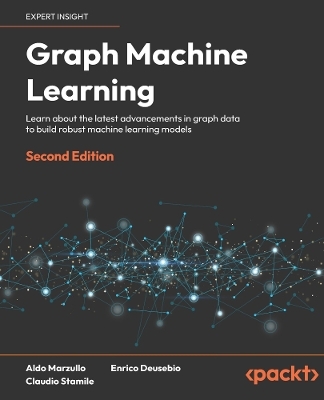
Graph Machine Learning
Packt Publishing Limited (Verlag)
9781803248066 (ISBN)
Key Features
Master new graph ML techniques through updated examples using PyTorch Geometric and Deep Graph Library (DGL)
Explore GML frameworks and their main characteristics
Leverage LLMs for machine learning on graphs and learn about temporal learning
Purchase of the print or Kindle book includes a free PDF eBook
Book DescriptionGraph Machine Learning, Second Edition builds on its predecessor’s success, delivering the latest tools and techniques for this rapidly evolving field. From basic graph theory to advanced ML models, you’ll learn how to represent data as graphs to uncover hidden patterns and relationships, with practical implementation emphasized through refreshed code examples. This thoroughly updated edition replaces outdated examples with modern alternatives such as PyTorch and DGL, available on GitHub to support enhanced learning.
The book also introduces new chapters on large language models and temporal graph learning, along with deeper insights into modern graph ML frameworks. Rather than serving as a step-by-step tutorial, it focuses on equipping you with fundamental problem-solving approaches that remain valuable even as specific technologies evolve. You will have a clear framework for assessing and selecting the right tools.
By the end of this book, you’ll gain both a solid understanding of graph machine learning theory and the skills to apply it to real-world challenges.What you will learn
Implement graph ML algorithms with examples in StellarGraph, PyTorch Geometric, and DGL
Apply graph analysis to dynamic datasets using temporal graph ML
Enhance NLP and text analytics with graph-based techniques
Solve complex real-world problems with graph machine learning
Build and scale graph-powered ML applications effectively
Deploy and scale your application seamlessly
Who this book is forThis book is for data scientists, ML professionals, and graph specialists looking to deepen their knowledge of graph data analysis or expand their machine learning toolkit. Prior knowledge of Python and basic machine learning principles is recommended.
Aldo Marzullo received an M.Sc. degree in computer science from the University of Calabria (Cosenza, Italy) in September 2016. During his studies, he developed a solid background in several areas, including algorithm design, graph theory, and machine learning. In January 2020, he received his joint Ph.D. from the University of Calabria and Université Claude Bernard Lyon 1 (Lyon, France), with a thesis titled Deep Learning and Graph Theory for Brain Connectivity Analysis in Multiple Sclerosis. He is currently a postdoctoral researcher and collaborates with several international institutions. Enrico Deusebio is currently working as engineering manager at Canonical, the publisher of Ubuntu, to promote open source technologies in the data and AI space and to make them more accessible to everyone. He has been working with data and distributed computing for over 15 years, both in an academic and industrial context, helping organizations implement data-driven strategies and build AI-powered solutions. He has collaborated and worked with top-tier universities, such as the University of Cambridge, University of Turin, and the Royal Institute of Technology (KTH) in Stockholm, where he obtained a Ph.D. in 2014. He holds a B.Sc. and an M.Sc. degree in aerospace engineering from Politecnico di Torino. Claudio Stamile received an M.Sc. degree in computer science from the University of Calabria (Cosenza, Italy) in September 2013 and, in September 2017, he received his joint Ph.D. from KU Leuven (Leuven, Belgium) and Université Claude Bernard Lyon 1 (Lyon, France). During his career, he developed a solid background in AI, graph theory and machine learning with a focus on the biomedical field.
Table of Contents
Getting Started with Graphs
Graph Machine Learning
Neural Networks and Graphs
Unsupervised Graph Learning
Supervised Graph Learning
Solving Common Graph-Based Machine Learning Problems
Social Network Graphs
Text Analytics and Natural Language Processing Using Graphs
Graph Analysis for Credit Card Transactions
Building a Data-Driven Graph-Powered Application
Temporal Graph Machine Learning
GraphML and LLMs
Novel Trends on Graphs
| Erscheinungsdatum | 12.10.2024 |
|---|---|
| Verlagsort | Birmingham |
| Sprache | englisch |
| Maße | 191 x 235 mm |
| Themenwelt | Informatik ► Theorie / Studium ► Künstliche Intelligenz / Robotik |
| ISBN-13 | 9781803248066 / 9781803248066 |
| Zustand | Neuware |
| Informationen gemäß Produktsicherheitsverordnung (GPSR) | |
| Haben Sie eine Frage zum Produkt? |
aus dem Bereich