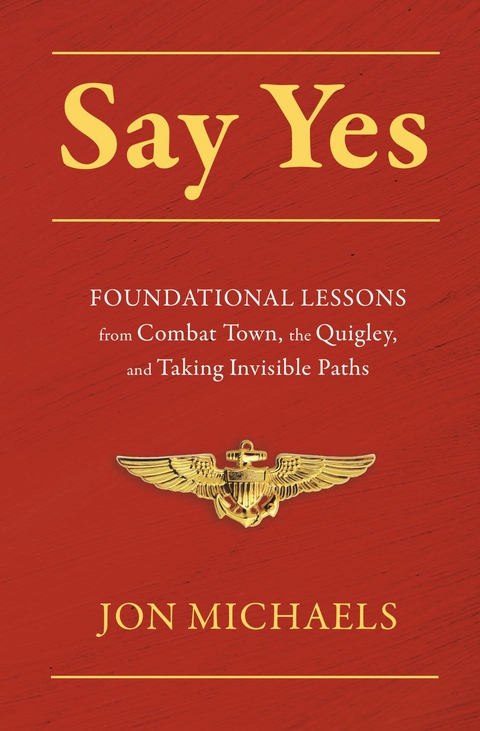
Say Yes (eBook)
136 Seiten
Bookbaby (Verlag)
979-8-3509-7641-0 (ISBN)
Jon Michaels spent close to ten years on active duty with the United States Marine Corps as a captain and naval aviator. He flew the CH-53E Super Stallion helicopter and was deployed twice overseas, then finished his military career as a flight instructor teaching new lieutenants how to fly. He then attended graduate school and received a Master of Business Administration degree. After working with his family's retail business, Jon transitioned to the energy and environment space, where he has since been dedicating his time and efforts. He lives in San Francisco with his wife, two sons, and dog. 'Say Yes' is his first book.
The seemingly small and insignificant events that happen to all of us have great potential to turn into significant personal and professional development experiences in the ensuing years and decades. A person is fortunate if they can recognize that even one of these foundational events has occurred and is able to learn from it. These basic lessons can be instrumental in helping us become the best version of ourselves. In Say Yes, Jon Michaels explores and reflects on universal lessons by drawing on personal stories from his time as a Marine officer and naval aviator, as well as an amateur athlete. He describes the importance of having a strong north star, understanding that little jobs aren't bad jobs, and saying yes to meaningful opportunities when they present themselves. By combining heartfelt experiences, humility, and personal reflection, he then shares how these events and associated lessons have guided him in further developing his leadership approach today. From those just starting their career, who may not have had many foundational experiences, to mid-career professionals who could benefit from reflecting on their own experiences, to senior leaders looking for ways to inspire and mentor their teams, Say Yes shares simple wisdom, practical advice, and an optimistic outlook that everyone can apply to their personal and professional life.
Marine Officer Candidate School (OCS) is a ten-week test of perseverance. Most candidates, like me, enter the barracks at Quantico as recent college graduates who are seeking a challenge, want to make a difference, and see becoming a leader of Marines as their way of pursuing that challenge. OCS is the Marine Corps’ way of figuring out if you have what it takes.
There are multiple ways to become a Marine officer. Perhaps the most well-known is to graduate from the Naval Academy in Annapolis, Maryland. Another is to complete Naval Reserve Officers Training Corps (ROTC) while attending a participating college or university.
A third path is the one I chose, which runs through Quantico, Virginia, and involves attending OCS.
OCS is located among the pine trees and rolling hills of Marine Corps Base Quantico, about thirty miles southwest of Washington, DC, along the west shore of the Potomac River. Known as the Crossroads of the Corps, Quantico is home to multiple Marine units that include the Marine Corps Combat Development Command and Marine Corps Air Station Quantico, home to HMX-1. If that last alpha-numeric combination doesn’t ring a bell, perhaps you have seen those iconic green-and-white-topped helicopters that fly the president around; HMX-1 is the name of that squadron. The base is also home to the FBI Academy, FBI Laboratory, and Drug Enforcement Agency Training Academy, among others. Quantico is a large base, and OCS takes up a very small part of it.
The facilities of OCS are simple yet functional—barracks for sleeping, a large parade ground for marching and close-order drill, grass fields for physical training, and the surrounding terrain of gravel trails and dense woods for land-navigation exercises. It is these basic facilities where officer candidates are trained and evaluated on their leadership skills, academics, and physical fitness. The leadership evaluations are based on command presence, communication skills, decision-making, and the ability to lead subordinates. I remember feeling excited, nervous, and more than a little bit scared in taking that first step off the bus and onto those grounds.
The military is a world unfamiliar to most. It starts with two days of administrative intake that encompasses getting haircuts, procuring uniforms, and completing medical screenings. Basic onboarding activities needed to be completed, and it wasn’t until the end of those first two days that we met our commanding officer, the colonel who led OCS.
The colonel gave a short talk that morning. He not only commanded the unit but our attention as well. He didn’t have to say much to have an impact on each of us when he introduced us to fierce historical battles like Iwo Jima and Belleau Wood and exposed us to names of legendary Marine warriors like Chesty Puller and Smedley Butler. As he brought his comments that afternoon to a close, he finished with, “Platoon commanders, carry out the plan of the day,” and then smartly about-faced and left the room.
The platoon commanders then stepped to the center of the room, and the senior one commanded, “Platoon sergeants, carry out the plan of the day.” Those captains about-faced and walked down the long center aisle and out the back of the hall.
Then it was quiet. For about three seconds. The next ten weeks would be like nothing I had ever experienced before. It changed my life in those moments and for many decades following.
Though common in movies and TV, the title “Drill Instructor” isn’t used at OCS. The enlisted staff sergeants are rather referred to as a platoon sergeant or sergeant instructor, the former being the senior of the two. I’ll just refer to them collectively as platoon sergeant here, as it’s not important to distinguish between the two for what I’m sharing.
Titles didn’t matter anyway at this point. The collective group descended on the candidates and started doing what they do best: Making Marine officers. It was a blur of shouted commands, sounding off, and starting to live in this new world. In the next few days we learned to march, tackled the obstacle course, and battled with pugil sticks (picture a broomstick with large, heavy padding on each end, kind of like a giant cotton swab, that is used to simulate close-quarters combat with a rifle and bayonet). Some of the most important and memorable lessons, though, were the ones that weren’t formally on the training schedule. Instead, these seemingly impromptu lessons (but likely planned as they are good at what they do) taught by those platoon sergeants helped us understand that the way you do little things is the way you will likely do big things.
My first lesson in understanding the importance of these little things came two days after the colonel’s welcome. Our platoon sergeants had been giving us a crash course in all things military that included how to properly wear the uniform, how to polish our boots, and how to salute smartly. One of the biggest and most visible was how to march as a unified group. We’ve all seen it in the movies as the salty sergeant calls out, “Left, right, left, right,” and the perfectly aligned rows and columns of Marines march in impressive unison. Simple, right? That’s what I thought, too, until I found out I was chosen as the first candidate to spend two days serving as the candidate platoon sergeant. Talk about learning a hard lesson about the importance of little things.
Officer candidates are assigned turns acting in different leadership roles; one small way of learning and being evaluated, at the same time. As the candidate platoon sergeant, I took on the responsibilities of the actual platoon sergeant; no small feat considering he had more than a dozen years of military experience and I had a whopping two days.
My first task that day was to march our platoon to the chow hall for breakfast. I stood before the assembled platoon and called, “Right face. Forward march.” Off we went. The first few steps were smooth, and I started to consider myself a quick learner.
They are doing it? This is great!
It was great until we made it to a small footbridge that would take us the final steps to the chow hall. I needed our platoon to make a right turn and was attempting to calculate when exactly to give the “Column right, march” command. At the perfect moment I gave the command . . . and then all hell broke loose.
I should share at this point a finer point about giving commands to a marching platoon. There are various commands you can give: column right, column half-right, mark time, and halt, to name a few. These commands are given in rapid fire components broken down into syllables that sound like “Col-umn right, march” with each syllable perfectly aligning with a left or right foot strike. The key to having the platoon move in perfect unison is to begin the first syllable of the command, “col” in this situation, on the proper left or right foot strike. With all of a few days of military training behind me, that was a nuance I had yet to master. So in addition to initiating my command on the wrong foot strike, I was also a bit nervous and commanded the platoon to turn left instead of right.
Half the platoon started to turn left as I commanded them to do. The other half, obviously knowing a right turn was the proper way to take us to the chow hall, pivoted that way. Combine that with my mistake of initiating the command on the wrong foot, and it took less than a second for the entire platoon to be facing four different directions and scattered like kids on a playground.
“Candidate Michaels! What is going on? What are you doing?” The platoon sergeant’s language may have been a bit more colorful than that.
I didn’t have an answer as I looked at the other candidates and they looked at me. The stare of the platoon sergeant said all that needed to be said. I hadn’t listened and paid attention enough to fully grasp the importance of how you command a group while marching. It’s so simple . . . if you understand the basics. If you can’t march a platoon, how can you lead them in combat?
That was my first lesson in understanding the importance of little things and doing them properly.
We soon took our initial Physical Fitness Test (PFT), and that proved to be yet another lesson.
The PFT is one of the first activities at OCS. At the time, the PFT consisted of three parts: a three-mile run, pull-ups, and sit-ups. To get the maximum score, you needed to run the three miles in eighteen minutes or less, perform twenty pull-ups, and then one hundred sit-ups. One area of your performance at OCS you can control is how well conditioned you are when you arrive; my previous best was just under nineteen minutes for the three miles. My adrenaline was pumping that morning of the initial PFT. I ran an 18:09 . . . a personal best! The smile on my face lasted but a few seconds until our platoon sergeant got in my face and let it fly.
“Candidate Michaels! What was that? I guess you decided to just not try today and give up at the end, huh? (again, his words were slightly more colorful). And you want to be an officer in my Marine Corps?” He berated my obvious lackluster effort (to him, at least) for a bit longer before finishing with a curt, “Get out of here!”
Still breathing hard, I smartly about-faced and got out of there as fast as I could. Eighteen minutes and nine seconds. It was a good run, a great run in my mind, but I came up a bit short at the end. Nine seconds short. About how long it takes to tie your shoes. Doesn’t matter that it was a personal...
| Erscheint lt. Verlag | 7.10.2024 |
|---|---|
| Sprache | englisch |
| Themenwelt | Sachbuch/Ratgeber ► Beruf / Finanzen / Recht / Wirtschaft |
| ISBN-13 | 979-8-3509-7641-0 / 9798350976410 |
| Informationen gemäß Produktsicherheitsverordnung (GPSR) | |
| Haben Sie eine Frage zum Produkt? |
 EPUB (Ohne DRM)
Größe: 2,1 MB
Digital Rights Management: ohne DRM
Dieses eBook enthält kein DRM oder Kopierschutz. Eine Weitergabe an Dritte ist jedoch rechtlich nicht zulässig, weil Sie beim Kauf nur die Rechte an der persönlichen Nutzung erwerben.
Dateiformat: EPUB (Electronic Publication)
EPUB ist ein offener Standard für eBooks und eignet sich besonders zur Darstellung von Belletristik und Sachbüchern. Der Fließtext wird dynamisch an die Display- und Schriftgröße angepasst. Auch für mobile Lesegeräte ist EPUB daher gut geeignet.
Systemvoraussetzungen:
PC/Mac: Mit einem PC oder Mac können Sie dieses eBook lesen. Sie benötigen dafür die kostenlose Software Adobe Digital Editions.
eReader: Dieses eBook kann mit (fast) allen eBook-Readern gelesen werden. Mit dem amazon-Kindle ist es aber nicht kompatibel.
Smartphone/Tablet: Egal ob Apple oder Android, dieses eBook können Sie lesen. Sie benötigen dafür eine kostenlose App.
Geräteliste und zusätzliche Hinweise
Buying eBooks from abroad
For tax law reasons we can sell eBooks just within Germany and Switzerland. Regrettably we cannot fulfill eBook-orders from other countries.
aus dem Bereich