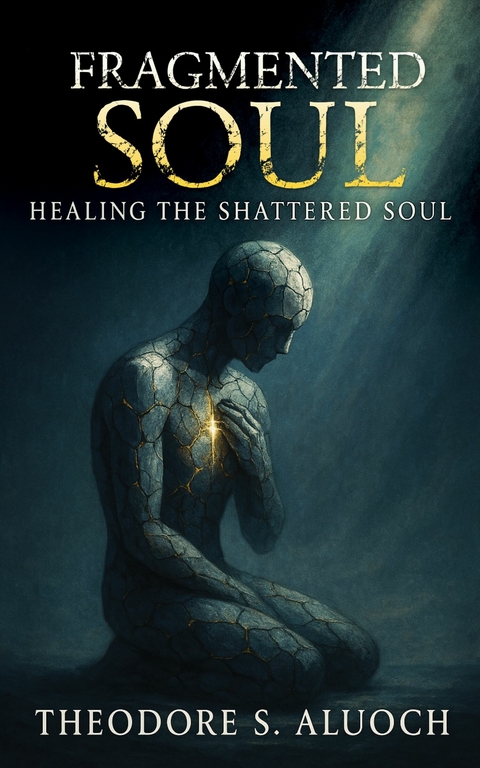
Fragmented Souls (eBook)
144 Seiten
Bookbaby (Verlag)
979-8-3178-0769-6 (ISBN)
Theodore S. Aluoch, a prophet, revivalist, and preacher, is the visionary founder of Call to Holiness Intl Ministry (CTHIM). His passion lies in guiding the church towards a deep-rooted lifestyle of holiness, as he believes in earnestly awaiting the blessed hope. Theodore is the author of inspiring books such as 'Recover Thyself' and 'Divine Footprints on Bronze.' He is endowed with a unique spiritual grace that encompasses the gifts of healing, working miracles, and prophecy. More than just a preacher, he is a profound teacher of the Word, fulfilling his role as a prophet with unwavering commitment to Jesus. Alongside his wife, Esther Aluoch, Theodore leads the congregation at CTHIM Church in Grove City, Ohio. Together, they are dedicated to spreading their spiritual insights and guiding their community towards a fulfilling journey of faith and holiness.
The jagged edges to our past-the raw, bleeding heartache, the catastrophic debris of shattered relationships, the crushing weight of illness pressing down-these wounds, self-inflicted or thrust upon us by a cruel, indifferent universe, are etched onto our souls. They leave us fractured, gasping for breath in the desolate wasteland of despair, convinced we are irrevocably broken, beyond mending, and beyond hope. However, in the suffocating darkness, a flicker ignites. Jesus doesn't just sweep up the shattered remnants of our lives; he delves into the very marrow of our being, his touch searing yet healing. He meticulously reconstructs us, bone by agonizing bone, sinew by agonizing sinew, forging from the wreckage something breathtakingly beautiful and stronger than we ever dared imagine. Only His divine power possesses the audacity to mend what we deem irreparable. God's love isn't a gentle whisper it's a roaring inferno of compassion, a force that refuses to abandon us to the desolate ruins of our own making. His unwavering commitment wasn't a mere promise; it was a seismic shift, a warrior who walked among us, tasting the bitterness of our despair, shouldering that crushing weight of our sins, and ultimately sacrificing Himself a brutal, agonizing act of love. This wasn't symbolism; it was a defiant scream of his desperate yearning for connection, a violent tearing down of the walls we had built around our broken hearts, a blood-soaked testament to his unyielding desire to restore our fractured communion. In "e;Fragmented Souls,"e; begin to comprehend the profound anguish of shattered aspirations, the searing pain of severed bonds, the treachery of violated trust, the crushing burden of self-reproach, and the relentless torment of remorse. If you feel your world is irrevocably crumbling, understand this: your suffering is not unique; God has not forsaken you. His unwavering presence endures even in your deepest despair. Your story is incomplete, and the conclusion remains unwritten.
Chapter 1 What is man?
Within the biblical text, the word “man” possesses a dual significance. While it can refer to an individual male, its broader and more prevalent usage encompasses the entire human species, embracing both genders. Terms such as “humankind,” “humanity,” and “mankind” serve as overarching labels for all people—divine creations bearing God’s likeness, a unique attribute that sets them apart from both the animal kingdom and their divine Creator. This distinction underscores the exceptional nature of human beings.
The opening chapters of Genesis unveil the majestic crafting of the cosmos, culminating in the awe-inspiring genesis of humanity. In a profound declaration, God decreed the creation of humankind in His own likeness, bestowing upon them dominion over the aquatic life, the avian world, the terrestrial animals, and all creatures that crawl upon the earth. This divine act resulted in the formation of human beings—male and female—fashioned in the very image of their Creator. The Hebrew term often rendered as “man” encompasses the entire human race, a duality of genders, intricately woven into the fabric of existence. Modern translations frequently employ more inclusive phrasing such as “humanity” or “humankind” to accurately reflect the comprehensive scope of God’s creative endeavor.
Humanity’s origin was not a gradual ascent from simpler organisms; rather, we were divinely fashioned—a direct creation mirroring the very essence of God (Genesis 1:26-31; James 3:9). As the Architect of existence, God appointed humankind as stewards over Earth, entrusting them with unparalleled authority over creation. Consider the vast celestial tapestry—the moon, the stars, the meticulously crafted heavens—and marvel at the elevated position of humanity:
“What is humanity that You are mindful of them, mortals that You
care for them? You have placed them just below the angelic host,
adorning them with glory and majesty. You have appointed them
dominion over Your handiwork, subjugating all beneath their feet:
the livestock, the wildlife, the airborne creatures, and the ocean’s
myriad inhabitants” (Psalm 8:3-8).
Human life’s inherent sacredness stems from our creation in God’s likeness, a truth powerfully declared: “Whoever sheds the blood of a human, by humans their blood shall be shed; for in God’s image God created humankind” (Genesis 9:6). This divine imprint signifies God’s absolute ownership of humanity, a unique mark of His authority (Mark 12:13-17). This image, bestowed equally upon male and female, establishes inherent equality before God. Consequently, all individuals possess equal worth in His sight, irrespective of racial, ethnic, social, or economic distinctions (Proverbs 22:2; Matthew 20:25-28; Galatians 3:28). Only through the unified efforts of every nation, tribe, and people—men and women working together—can we fully comprehend and reflect God’s image.
God fashioned humankind as a union of body and soul, blending the physical with the spiritual. While the body is temporal, the soul is immortal, enduring beyond physical death (Genesis 2:7; 2 Corinthians 5:1-8). Though humanity’s fall profoundly corrupted our nature, it did not erase God’s image. However, sin marred our being, leaving us spiritually dead and intellectually impaired (Genesis 4; 6:5; Jeremiah 17:9; Ephesians 4:17-19). As a result, we became spiritually and intellectually blind, subject to both physical death and the ultimate judgment (Ephesians 2:1; Ephesians 4:17-19; Romans 5:12-21; 8:10; 14:12; Hebrews 9:27). This sobering reality underscores both the weight of our creation and the depth of our fallen state.
Yet, out of His boundless compassion, divine benevolence, and limitless clemency, the Almighty did not consign humankind to the abyss of annihilation. Instead, a pathway to liberation and eternal life was divinely ordained through unwavering faith in Jesus Christ. This profound act of grace is eloquently described: “Because of His immense affection for us, even while we were spiritually deceased in our transgressions, God, overflowing with mercy, granted us new life alongside Christ. This salvation is an unmerited gift, a free bestowment of grace, received through faith. We were resurrected with Christ and enthroned with Him in the celestial realms. This glorious elevation demonstrates God’s inexhaustible bounty, a testament to His unending kindness towards us, revealed throughout eternity. For salvation is not achieved through our own efforts; it is a divine present, a sacred offering from God Himself.”
Understanding the Human Body’s Intricacies
The profound question, “What constitutes humanity?” compels us to examine both the dual nature of sinners and the tripartite nature of believers, distinguishing between the perishable and the eternal. While the Bible unequivocally addresses the transient nature of the physical form, the concept of an inherently immortal soul lacks explicit scriptural validation. True immortality, strictly defined, pertains to the transformation of the body—where the perishable gives way to the imperishable, and mortality is replaced with deathlessness. This radical metamorphosis is prophesied: “For this corruptible body must clothe itself in incorruption, and this mortal body must put on immortality. Then shall come to pass the Scripture: ‘Death is swallowed up in victory’” (1 Corinthians 15:53-54).
The precise Greek term, “athanasia,” meaning immortality or ultimate invincibility, appears sparingly in the New Testament. This ultimate invincibility is not an inherent human trait but rather a transformation promised in Scripture. Within the human context, mortality and immortality pertain to the physical realm. However, this deathless state is not our present reality—humans undeniably perish. Yet, Scripture affirms that the spirit and soul transcend physical death (Ecclesiastes 12:7; Matthew 10:28). A vital life force, distinct from the decaying body, resides within us. While often referred to as the “immortal soul,” the accuracy and theological implications of this designation require careful consideration.
True immortality is not merely a state of endless existence; it is the pinnacle of vibrant, divine life. This unparalleled attribute belongs to God exclusively, inherent to His very being: “For He alone possesses unending existence, dwelling in inaccessible light, whom no one can see or has seen; to Him be everlasting glory and dominion…” (I Timothy 6:16). God’s unique immortality does not preclude Him from bestowing this gift upon others. Rather, it affirms that all life originates from His eternal nature, the wellspring of existence itself.
The eternal life granted by God encompasses this very immortality (I Corinthians 15:53-54). His merciful grace shields the faithful from spiritual annihilation, yet the complete, unalloyed experience of life remains unrealized until mortality itself is vanquished by the ultimate triumph of life (2 Corinthians 5:4).
Some scholars equate the Greek terms “athanasia” and “aphtharsia,” both of which convey the ideas of incorruptibility, immortality and imperishability. These scholars assert their interchangeable use in 1 Corinthians 15:53-54, where they are rendered as “immortality” and “incorruptible.” To support this view, they cite 1 Timothy 6:16, which refers to God’s athanasia, and 1 Timothy 1:17, where the adjective aphthartos is attributed to God, as evidence of semantic equivalence. However, this interpretation overlooks a crucial distinction.
A thorough examination reveals a nuanced difference: athanasia denotes not merely the absence of death but the inherent, vibrant nature of immortal existence, while aphtharsia emphasizes the enduring, incorruptible substance of that life—its resistance to decay and dissolution. The noun aphtharsia appears eight times in the New Testament, translated variously as “immortality,” “incorruption,” and even “integrity,” depending on context. It applies to the divine essence, the transformed bodies of believers, and the unblemished purity of genuine faith and teaching. The adjective aphthartos, occurring seven times, similarly underscores the enduring, uncorrupted nature of God and His attributes.
The concept of incorruptibility, rendered in Scripture as “incorruptible,” “imperishable,” or “immortal” (Romans 1:23; 1 Corinthians 9:25; 15:52; 1 Peter 1:4, 23; 3:4; 1 Timothy 1:17), embodies a profound spiritual reality. This divine attribute— ascribed to God, the celestial reward of righteousness, the believer’s eternal legacy, spiritual rebirth, and the purity of faith— stands in stark contrast to the human condition. The Greek term “athanasia” (immortality) directly opposes thanatos (death). Humanity was not created inherently immortal; rather, God’s...
| Erscheint lt. Verlag | 1.7.2025 |
|---|---|
| Sprache | englisch |
| Themenwelt | Sachbuch/Ratgeber ► Gesundheit / Leben / Psychologie ► Esoterik / Spiritualität |
| ISBN-13 | 979-8-3178-0769-6 / 9798317807696 |
| Informationen gemäß Produktsicherheitsverordnung (GPSR) | |
| Haben Sie eine Frage zum Produkt? |
 EPUB (Ohne DRM)
Größe: 801 KB
Digital Rights Management: ohne DRM
Dieses eBook enthält kein DRM oder Kopierschutz. Eine Weitergabe an Dritte ist jedoch rechtlich nicht zulässig, weil Sie beim Kauf nur die Rechte an der persönlichen Nutzung erwerben.
Dateiformat: EPUB (Electronic Publication)
EPUB ist ein offener Standard für eBooks und eignet sich besonders zur Darstellung von Belletristik und Sachbüchern. Der Fließtext wird dynamisch an die Display- und Schriftgröße angepasst. Auch für mobile Lesegeräte ist EPUB daher gut geeignet.
Systemvoraussetzungen:
PC/Mac: Mit einem PC oder Mac können Sie dieses eBook lesen. Sie benötigen dafür die kostenlose Software Adobe Digital Editions.
eReader: Dieses eBook kann mit (fast) allen eBook-Readern gelesen werden. Mit dem amazon-Kindle ist es aber nicht kompatibel.
Smartphone/Tablet: Egal ob Apple oder Android, dieses eBook können Sie lesen. Sie benötigen dafür eine kostenlose App.
Geräteliste und zusätzliche Hinweise
Buying eBooks from abroad
For tax law reasons we can sell eBooks just within Germany and Switzerland. Regrettably we cannot fulfill eBook-orders from other countries.
aus dem Bereich