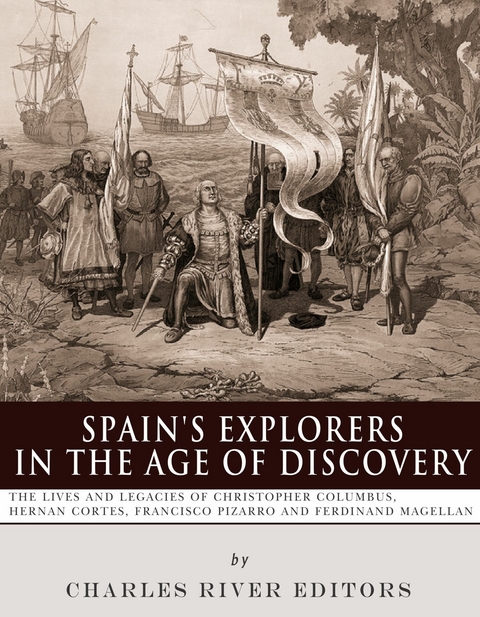
Spain’s Explorers in the Age of Discovery (eBook)
181 Seiten
Charles River Editors (Verlag)
978-1-4753-2913-1 (ISBN)
The most seminal event of the last millennium might also be its most controversial. As schoolchildren have been taught for over 500 years, 'In 1492 Columbus sailed the ocean blue.' In October of that year, the Italian Christopher Columbus immortalized himself by landing in the New World and beginning the process of European settlement in the Americas for Spain, bringing the Age of Exploration to a new hemisphere with him. Ironically, the Italian had led a Spanish expedition, in part because the Portugese rejected his offers in the belief that sailing west to Asia would take too long.
Columbus had better luck with the Spanish royalty, successfully persuading Queen Isabella to commission his expedition. On October 7, 1492, the three ships spotted flocks of birds, suggesting land was nearby, so Columbus followed the direction in which the birds flew. On the night of October 11, the expedition sighted land, and when Columbus came ashore the following day in the Bahamas, he thought he was in Japan, but the natives he came into contact with belied the descriptions of the people and lands of Asia as wealthy and resourceful. Instead, the bewildered Columbus would note in his journal that the natives painted their bodies, wore no clothes and had primitive weapons, leading him to the conclusion they would be easily converted to Catholicism. When he set sail for home in January 1493, he brought several imprisoned natives back to Spain with him.
During the Age of Exploration, some of the most famous and infamous individuals were Spain's best known conquistadors. Naturally, as the best known conquistador, Hernán Cortés (1485-1547) is also the most controversial. Like Christopher Columbus before him, Cortés was lionized for his successes for centuries without questioning his tactics or motives, while indigenous views of the man have been overwhelmingly negative for the consequences his conquests had on the Aztecs and other natives in the region. Just about the only thing everyone agrees upon is that Cortés had a profound impact on the history of North America.
If Columbus and Cortés were the pioneers of Spain's new global empire, Pizarro consolidated its immense power and riches, and his successes inspired a further generation to expand Spain's dominions to unheard of dimensions. Furthermore, he participated in the forging of a new culture: like Cortés, he took an indigenous mistress with whom he had two mixed-race children, and yet the woman has none of the lasting fame of Cortés's Doña Marina. With all of this in mind, it is again remarkable that Pizarro remains one of the less well-known and less written about of the explorers of his age.
Ferdinand Magellan, known in his native Portugal as Fernão de Magalhães and in Spain, where he moved later in life, as Fernando de Magallanes, was unquestionably one of the more remarkable figures of the so-called Age of Discovery, a period in which Europeans spread their political and commercial influence around the globe. Accordingly, his name is often invoked alongside that of Columbus, but the nature of his achievements has sometimes been misunderstood. Magellan has sometimes been credited with 'proving the world was round,' since he and his crew were the first Europeans to reach Asia via a westward route. But such a claim is based on a popular misconception, referred to by historian Jeffrey Burton Russell as the 'myth of the flat earth': the belief that medieval Europe had erroneously believed the earth was flat. In reality, essentially no educated Europeans of the late 15th and early 16th centuries doubted the spherical shape of the earth, which had been persuasively established by the scientists of ancient Greece - even down to Eratosthenes's relatively accurate measurement of its circumference in the third century B.C.
| Erscheint lt. Verlag | 20.6.2025 |
|---|---|
| Sprache | englisch |
| Themenwelt | Literatur ► Biografien / Erfahrungsberichte |
| Sachbuch/Ratgeber ► Freizeit / Hobby ► Sammeln / Sammlerkataloge | |
| Schlagworte | aztec • Genocide • Inca • Maya • Mexico • Native American • Spanish |
| ISBN-10 | 1-4753-2913-X / 147532913X |
| ISBN-13 | 978-1-4753-2913-1 / 9781475329131 |
| Informationen gemäß Produktsicherheitsverordnung (GPSR) | |
| Haben Sie eine Frage zum Produkt? |
 EPUB (Ohne DRM)
Digital Rights Management: ohne DRM
Dieses eBook enthält kein DRM oder Kopierschutz. Eine Weitergabe an Dritte ist jedoch rechtlich nicht zulässig, weil Sie beim Kauf nur die Rechte an der persönlichen Nutzung erwerben.
Dateiformat: EPUB (Electronic Publication)
EPUB ist ein offener Standard für eBooks und eignet sich besonders zur Darstellung von Belletristik und Sachbüchern. Der Fließtext wird dynamisch an die Display- und Schriftgröße angepasst. Auch für mobile Lesegeräte ist EPUB daher gut geeignet.
Systemvoraussetzungen:
PC/Mac: Mit einem PC oder Mac können Sie dieses eBook lesen. Sie benötigen dafür die kostenlose Software Adobe Digital Editions.
eReader: Dieses eBook kann mit (fast) allen eBook-Readern gelesen werden. Mit dem amazon-Kindle ist es aber nicht kompatibel.
Smartphone/Tablet: Egal ob Apple oder Android, dieses eBook können Sie lesen. Sie benötigen dafür eine kostenlose App.
Geräteliste und zusätzliche Hinweise
Buying eBooks from abroad
For tax law reasons we can sell eBooks just within Germany and Switzerland. Regrettably we cannot fulfill eBook-orders from other countries.
aus dem Bereich