Sacred Shit (eBook)
375 Seiten
Bookbaby (Verlag)
979-8-3509-9851-1 (ISBN)
Yoyo was born in Amsterdam in 1944, during the Second World War, when the Netherlands was occupied by the Nazis. It was just before the Hunger Winter, in which 20,000 people died of starvation. From these life-threatening times, Yoyo derived an indestructible lust for life. Her childhood was profoundly shaped by the painful divorce of her parents when she was just six years old. This experience sparked a lifelong passion for bridging seemingly irreconcilable opposites. With deep reverence for the sacred and a keen wit regarding life's absurdities, she shares her spiritual journey with wisdom and humour. As a visual artist, she was able to process part of her unresolved childhood traumas through her paintings. Eventually she won a prestigeous first prize for European painting with her poignant works that capture both the beauty and the suffering of the human condition. As a body-oriented therapist, she guided others in releasing deep-rooted tensions and inner conflicts. As a spiritual seeker, she travelled the world and absorbed the healing wisdom of mystics and non-duality teachers in both the East and the West. For Yoyo, spirituality isn't about escaping life's challenges - it's about transforming them. She reveals how our inner chaos (our fears, shadows, and existential struggles) and the quagmire of the world can be transmuted into rich compost that nourishes the blossoming of consciousness. Her refreshingly honest life story illustrates that even our toughest trials can become the fuel for spiritual growth and unconditional love. In her Mystery School for the Art of Living, Yoyo offers a unique path to wholeness and inner peace through (online) counselling, workshops, courses and immersive live retreats, inspiring spiritual seekers around the world.
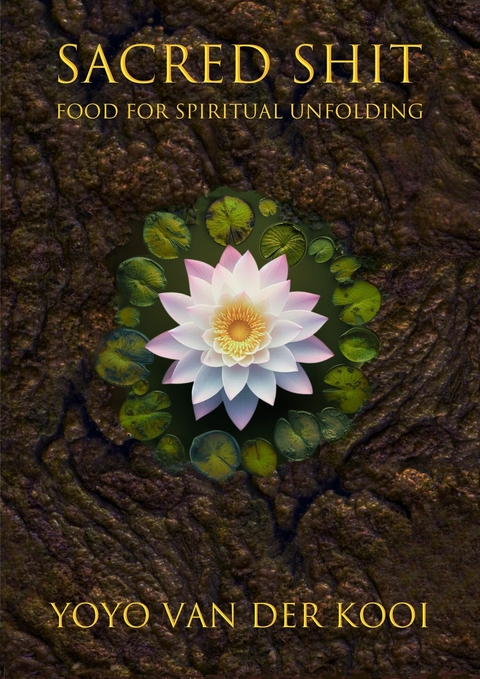
Yoyo takes us on a deeply personal yet universally relatable journey through eight life cycles, each one seen as a stage of spiritual awakening. She guides the reader through these transformative phases and compares the process to the mystery of the lotus flower, that miraculously turns stinking mud into purity and beauty. Each phase brings challenges, lessons and opportunities for a deeper self-awareness and sheds light on what life is really about. Born during the Second World War and growing up in trying times, Yoyo had to find meaning in a desolate world. Her story begins in her childhood, when she was just six years old, with three younger siblings and a mother who completely collapsed after an unexpected divorce. From that moment on, we witness Yoyo go through her own survival struggles, discover her sexuality, encounter her ego, overcome her first heart-breaks, explore her creativity, pursue her dreams, wrestle with challenging relationships, and work her way through existential crises that at times make her doubt everything. But that's not all about her journey. As Yoyo steadily peels away layers of conditioning and illusion, she discovers profound insights about life and herself, and ultimately reaches a place of radical trust, inner peace and spiritual rapture. With refreshing honesty and vulnerability, Yoyo shares the highs and lows of her quest - from ego-crushing moments in the ashram of an Indian mystic to profound experiences in the tantric temples of Khajuraho. Her story is gripping, shocking, and sometimes heartbreaking, yet at the same time deeply inspiring. It is an invitation to everyone who feels that there must be more to life a call to embrace the journey of spiritual unfolding.
‘Peace of mind facing horror’ (oil painting)
INTRODUCTION
About the challenges of life
If we derive our view of the world and humanity from what the media and history books dish out, our planet appears to be one huge cesspool of misery, disaster, disease, war and corruption in innumerable forms and combinations. Throughout all times, civilisations and cultures, there is a battle waging between ‘good’ and ‘evil’ - at both micro and macro levels - that never seems to end.
The fear this evokes drives us to seek safety with a partner, a home, a family, a bank account, a (religious) community, prestige, power and insurances of all kinds – from the cradle to the grave. To no avail. Sickness, old age and death eventually overtake us and wipe us out. Many of us have been – and will be – ‘recycled’ without ever having wondered if all this drama served a purpose, and if so, what purpose.
Yet there is a different way we can look at the short time span we are given. Our world – or rather: our perceived ‘reality’ of it – is not static. It is a plastic and ever-changing reflection of our state of mind, our mental programming and the mood from which we observe it.
At the basis of our development, we are mammals, following a perennial biological programme of surviving, procreating and dying. Whether we enjoy this phase or not depends on the degree to which we accept or reject our this animalistic aspect of ourselves.
In the middle stages we are time-bound creators of new ideas, forms and systems. Here, we see the world as a challenge and an arena. We compare ourselves to others and distinguish ourselves by our views and accomplishments. We are in a hurry, because we want to become someone, make a difference, gain recognition, assert ourselves, and – if possible – accumulate assets.
In the higher stages of our unfoldment we gradually step ‘out of time’ and become aware of our finiteness and our (divine) origin. We begin to realize that we are part of a larger context, a cosmic order in which all things, both material and immaterial, appear and disappear and that – in that sense – we are immortal.
Hell and heaven are no longer abstract places somewhere out there; they reside in the depth of our being as fear and trust. As our awareness grows, we feel freer. Now we can consciously choose and change our identity. Ultimately, we discover that we can even let go of all identifications. Thus, in the end, we transcend the apparent opposites in which the world presents itself to and in us.
This book is about consciousness transformation and awareness. Its subtitle ‘Food for Spiritual Unfolding’ was chosen as a metaphor for the lotus flower that is rooted in the stinking mud and transforms it into purity and beauty. Likewise, we humans can assimilate and transform all that is seemingly rotten, despicable and disgusting – inside us and around us – into innocence, compassion, creativity and unconditional love.
The drive to write this book and the way it has taken shape cannot be separated from my personal history. Therefore, from a bird’s-eye view, here now follows a synopsis of the main events of my life.
In retrospect
When I look back at my life, I see a great longing to connect seemingly irreconcilable extremes. It started with the divorce of my parents at age six, when my father left my mother for a new love, after which they never saw each other again.
This rift between the two people that I owe my earthly existence to and whom I loved equally, tore my life apart. I have always carried that pain with me and, for the longest time, I thought it would never go away.
That thought was reinforced as the ‘real world’ ruthlessly started to impose itself and I discovered that division is not limited to human relationships, but that whole nations fight and destroy each other over a piece of land, faith, material gain or ‘who is right’.
To my great joy, I found a medium through which I could express my existential pain: painting. Consequently, my early work (1972-1979) was mainly a form of self-therapy.
Meanwhile, my relationships floundered. There was a deep fear of an intimate bond failing, like my parents’. Additionally, I was unknowingly searching for a surrogate father figure, which did not help the cause.
After an ‘impossible’ first love affair, an abortion, many superficial contacts and one stormy relationship that went awry, I finally found a ‘serious’ partner with whom I felt that it might ‘work out’. However, after two years, when I began to yearn for a child, he appeared not to be open to the idea, since he already had two children from a previous marriage.
I fell into a deep depression, which was intensified by the fact that my painting ‘Inner Contact’ did not come out the way I imagined, however hard I tried. At that time (1979), I read a book by the Dutch psychiatrist Jan Foudraine entitled ‘Original Face – A Journey back Home’, about his experiences with an Indian guru. A few months later, I travelled to Poona, to join the ashram of that guru, Bhagwan Shree Rajneesh, later known as Osho. I stayed for seven weeks, followed his lectures, participated in therapy groups and meditations. and then asked to be initiated as ‘sannyasin’ (one who has come to realise that the main purpose of life is to perfect your understanding of the spiritual dimension). This was an impactful turning point in my life and work..
After having won a first prize for European painting, I started offering creative workshops.
I soon noticed that many of my participants were very tense while ‘performing’, which hampered their spontaneous expression. It occurred to me to have them give each other a nice head, neck and shoulder massage before we started, to loosen them up. The difference in what came out during the sessions after that was striking. I began to see the link between physical relaxation and creative output.
In 1986, therefore, I enrolled in a 3-year course of body-psychotherapy, a method that uses deep tissue massage to release chronic physical tensions by encouraging the expression and integration of unresolved emotions.
Towards the end of the course, in 1988, my ‘childless’ relationship of twelve years suddenly came to an end, with my partner falling head over heels in love with another woman (the story of my parents repeating itself!) and my world collapsed.
Right at that moment, a Swiss shamanka (female shaman) showed up in my life, who claimed to be Osho’s ‘field worker’. She was enchantingly spontaneous, straightforward – and frightening. “Forget all about relationships,” she said, “and learn the art of Relating.”
With a small group of spiritual seekers, I spent twice three months with her in India near the Tantric temple town of Khajuraho. During that stay my entire frame of reference was shattered and deep-seated emotions – that I didn’t know I had – came to the surface.
When I dropped out of her group I no longer knew who I was and what life was about. Also, most of my friends and family had given up on me when I had started my ‘weird’ spiritual quest. I was alone.
As a result I plunged into what is called ‘the dark night of the soul’.
I immersed myself in “A Course in Miracles” and did all the exercises in the workbook every day for over a year. I also found comfort in reading Jiddu Krishnamurti and George Gurdjieff. A session with the Californian harpist and ‘channel’ Joel Andrews (who in 1981 had made an individual attunement of five of my ‘past lives’ and happened to be in the Netherlands at the time) further helped me to get out of that pit.
New perspectives came into view. I opened my own practice for deep holistic bodywork and clients started coming. Then I discovered the Avatar material. Avatar is a course based on the premise that the “reality” we perceive is created by our own (unconscious) “programming”: thought patterns, assumptions, beliefs and interpretations. It offers tools to let go of sabotaging conditioning and to create a new (subjective) reality by changing our mindset.
I enrolled, and somewhere during the courses – which extended over most of the nineties – in a flash, I experienced myself as ‘the observer behind the projector’. Suddenly there was the realisation that in essence we arise from an infathomable ‘no-thingness’ in which the universe and all things material and immaterial appear, and disappear, and where each of us plays a game we call ‘Living’.
It also dawned on me that self-realisation or enlightenment is not something that can be achieved, but something that spontaneously pops up the moment we become aware of this and drop all our assumptions – including the idea of a separate ‘self’.
As I progressed through the successive Avatar levels, I studied Neuro-Emotional Integration, practiced voice work, and took drama and clowning classes, thus broadening the scope of my body-oriented practice.
Towards the end of the century I felt it was time to pool my resources and make them available to people seeking the essence of life.
Thus in 1999 I started a small-scale school for the Art of Living, with the help of a few friends. It became an experiential meeting place for self-exploration, creative expression and spiritual unfoldment.
In 2001 it escaped a near-bankruptcy thanks to a generous donation. in 2011 it only just survived the economic crisis and between 2020-2022 it wrestled its way through the Covid-19 pandemic. But it is still there!
The ‘Flowering’ courses I offer together with my assistants have inspired me to write this book.
It covers eight...
| Erscheint lt. Verlag | 29.5.2025 |
|---|---|
| Sprache | englisch |
| Themenwelt | Sachbuch/Ratgeber ► Gesundheit / Leben / Psychologie ► Esoterik / Spiritualität |
| ISBN-13 | 979-8-3509-9851-1 / 9798350998511 |
| Informationen gemäß Produktsicherheitsverordnung (GPSR) | |
| Haben Sie eine Frage zum Produkt? |
 EPUB (Ohne DRM)
Größe: 9,2 MB
Digital Rights Management: ohne DRM
Dieses eBook enthält kein DRM oder Kopierschutz. Eine Weitergabe an Dritte ist jedoch rechtlich nicht zulässig, weil Sie beim Kauf nur die Rechte an der persönlichen Nutzung erwerben.
Dateiformat: EPUB (Electronic Publication)
EPUB ist ein offener Standard für eBooks und eignet sich besonders zur Darstellung von Belletristik und Sachbüchern. Der Fließtext wird dynamisch an die Display- und Schriftgröße angepasst. Auch für mobile Lesegeräte ist EPUB daher gut geeignet.
Systemvoraussetzungen:
PC/Mac: Mit einem PC oder Mac können Sie dieses eBook lesen. Sie benötigen dafür die kostenlose Software Adobe Digital Editions.
eReader: Dieses eBook kann mit (fast) allen eBook-Readern gelesen werden. Mit dem amazon-Kindle ist es aber nicht kompatibel.
Smartphone/Tablet: Egal ob Apple oder Android, dieses eBook können Sie lesen. Sie benötigen dafür eine kostenlose App.
Geräteliste und zusätzliche Hinweise
Buying eBooks from abroad
For tax law reasons we can sell eBooks just within Germany and Switzerland. Regrettably we cannot fulfill eBook-orders from other countries.
aus dem Bereich