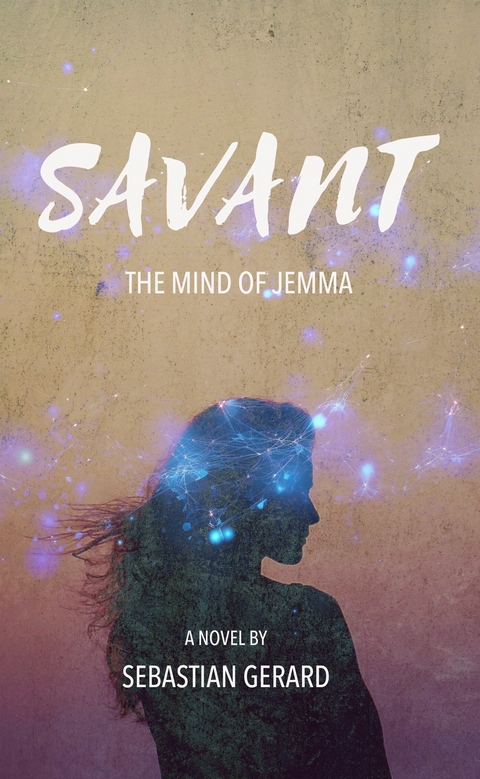
SAVANT (eBook)
280 Seiten
Bookbaby (Verlag)
9798317803971 (ISBN)
SEBASTIAN GERARD Gerard's first full-length work of fiction, For Goodness Sake, A Novel of the Afterlife of Suzie Wong, written as Sebastian Gerard, was published in Hong Kong in 2008 and he has scripted the story for production as a feature motion picture. In 2014 it was published in French by GOPE in France under the title A la Poursuite de Suzie Wong. A book of his aphorisms, Lifelines, writing as Sebastian Gerard, was published in May 2004. Stumbling Blocks & Stepping Stones, a Novel of Growing Up Catholic (2015) The Babo Gospels: Essays and Parables on Faith and Reason (2018). The River Dragon's Daughters, a novel of Four Women of the Yangtze was published in 2019. Forsaken a novel that deals with a terrorist attack and religious hypocrisy in a small town in upstate New York was published in 2020. His most recent publication is The Moneylender, a Novel of the Inner Life of Shakespeare's Shylock (2024). Gerard also writes nonfiction books under the name James A. Clapp. His first full-length work of fiction, For Goodness Sake, A Novel of the Afterlife of Suzie Wong, written as Sebastian Gerard, was published in Hong Kong in 2008 and he has scripted the story for production as a feature motion picture. In 2014 it was published in French by GOPE in France under the title A la Poursuite de Suzie Wong. A book of his aphorisms, Lifelines, writing as Sebastian Gerard, was published in May 2004. Stumbling Blocks & Stepping Stones, a Novel of Growing Up Catholic (2015) The Babo Gospels: Essays and Parables on Faith and Reason (2018). The River Dragon's Daughters, a novel of Four Women of the Yangtze was published in 2019. Forsaken a novel that deals with a terrorist attack and religious hypocrisy in a small town in upstate New York was published in 2020. His most recent publication is The Moneylender, a Novel of the Inner Life of Shakespeare's Shylock (2024). Dr. Clapp has taught on the faculty of the University of California and was appointed by the French Ministry of Education as a Visiting Professor at the University of Paris VII in 1989 and 1999, where he lectured on both film and American urbanism. He also taught for the Syracuse University Division of International Programs in Hong Kong in 1997 and was a guest lecturer at TongJi University, Shanghai that year. He has also delivered lectures at Peking and Tsinghua Universities and the Academy of Social Sciences in Beijing. In 2008 he was made an 'Honorary Professor' of Beijing City University. Articles based on his lectures there have been published in Chinese. In the year 2000 he was the Fulbright Scholar at Lingnan University and the School of Creative Media at City University, in Hong Kong. From 1977 to 2003 he conducted annual summer travel-study courses in European, Asian, North African, and Middle Eastern cities. Dr. Clapp's work in media and journalism began in 1980 when as Ch
Savant syndrome is a rare mental condition and one of the most fascinating phenomena in the study of human differences in cognitive psychology. It is a rare condition and is often identified and classified among mental disabilities and disorders, including the autism spectrum. People diagnosed with savant syndrome display one or more mental capacities of extraordinary brilliance or ability, differentiating it from other mental disorders and conditions. The abilities of savants occur spontaneously. They are not the result of training, ambition, or even prior awareness of possession. The condition may manifest genetically but may also develop in prenatal through post- natal phases of growth. In other instances, the syndrome may appear later in life, following head injuries, strokes, injuries to the central nervous system or as a result of disease. A paradox of the syndrome is that savants possessing exceptional abilities in certain areas like mathematical calculation, memorization, polyglotism, music and art that normally take a very high intelligence quotient to perform, are often of otherwise low intelligence, and sometimes suffer from mental retardation or are severely autistic. Savant presentation may also be associated with other types of disorders such as Williams' syndrome, Smith-Magenis syndrome, Prader-Willis syndrome, or damage to the corpus callosum. Why it manifests slightly six times more frequently in men than in women remains a mystery. Perhaps the most likely hypothesis for savant syndrome is a connection with a dysfunction of the left hemisphere of the brain, where skills at abstraction and logical and symbolic thinking are performed. However, there are many contending hypotheses associated with biological causes for savant syndrome. Hence the purpose of the proposed documentary series is to explore cases of this unusual syndrome with the assistance of researchers and clinicians in brain science, and to present them with care and respect for better understanding by the general public. Central to this exploration will be the case of Jeanne-Marie Massot Archer, also known as "e;Jemma"e; a mute twenty-one-year-old woman in San Diego, California who suddenly began writing a story on a computer containing details she could only have been exposed to as a baby less than a year old. Her story has caused considerable public interest in various media, including speculative Internet sites because of its possible relationship to the death of her mother over two decades ago. It is hoped that this production will inspire further research and development of possible clinical outcomes where necessary and appropriate for a variety of brain and mind conditions such as stroke, CTE, psychosis, and suicide ideation, among other physiological and mental disorders.
ONE Hilltop Mental Health Hospital
Door locked and window shades pulled down, Hillltop Mental Health Hospital Administrator Ed Kessler was engaged in another “nooner” with Elaine Drewe in his office annex, the third time this week. Maybe this time he would be able to “perform.”
But talk of money is not a good preamble for sex. He ought to know, he’s got two degrees, and nearly a third, in Psychology. Elaine should know it, too; she’s an administrative assistant. Yet it is Elaine who just keeps pushing him to move up: finish his degree, change jobs, and make more money. She wants to quit work and have babies—his babies. But he is going to have to make enough to pay alimony and child support once he divorces Amanda.
Stress and libido, they are incompatibles. Frustrated with his third “EDysfunction” in the past two weeks, Ed had just finished zipping up his fly when he heard someone come through the main office door. Ed emerged from the annex and glared at Pedro with a reminder that he is “supposed to knock.” Pedro smiled because he knows what’s for “lunch” in this office, and then aggressively announced “Have a look at this shit, Ed,” tossing a few pages of printed paper on the Administrator’s desk.
“What’s this?” Ed asked, taking a cursory glance and sliding the pages aside.
“Somebody—there is no author’s name—is writing on the computer we use to keep the medication records for the hospital. I asked the night nurse if she’s using the computer for personal stuff and, if so, to knock it off because if she crashes the damn thing and loses the drug records the shit will hit the fan. But the nurse says she’s not doing it.”
Ed did not seem that concerned, but Pedro just wanted to get it on the record that he is concerned so “it’s not my ass that’s fired when our drug records get fucked up.”
Ed tells Pedro that it will probably end when this writing project is over and to just relax.
Pedro is not the relaxing type.
But after Pedro leaves, Ed picked up the pages Pedro brought and started reading. “Shit,” he mumbled, recognizing immediately that he is going to have to rely somewhat on his very inadequate high school French.
LE MORT DE MA MÉRE
I could have written this en Française if I wished. But I have no one to speak French to, or English for that matter, since I refuse to speak at all.
Don’t ask me why.
My mother, Isabelle Massot, began speaking French to me immediately after I was born. The first words she spoke to me she told me she wanted me to be able to speak her native language, and that the best way to learn was to begin as a child. I was not even a child; I was a bebe, as they say in French, still only a few weeks old. My mother spoke to me, but I could not speak back to her. En fait, I never conversed with my mother in French because my mother was dead before I was even one year old and able to speak at all. When I was able, I refused to speak.
Don’t ask me why.
Yet I went on to learn French from books and the Internet, and I speak to my mother in my mind in French and when she appears in my dreams we converse in French. It is the way I keep her alive to me.
I had to learn most everything about my parents, not from them, but from other sources, like newspapers, the Internet, and movies. So I must begin my story by telling you what I have learned about them.
If you have not seen an Isabelle Massot movie, I must recommend that you do. I also expect that you will then want to see the rest of them, although that won’t take you very long because there are only three.
Just three, one might wonder.
One movie reviewer referred to her as “the French James Dean” because her career was like a Roman candle—bright, explosive and brief, and the way it ended. But I do not want to get ahead of my story, which I think you will better understand with more background.
It begins when my mother was discovered by Charles Archer, an American former actor, film agent and sometime producer, when he was attending the Cannes Film Festival. My mother was an unknown and aspiring actress from Strasbourg in the Alsace-Lorraine and also had fluency in German and English thanks to her multilingual parents, both teachers. She was in a small independent French film that was in the Festival and Archer saw a lovely, captivating girl of physical delicacy and grace that was combined with an almost mischievous sense of humor. He saw her as a “French Audrey Hepburn.”
Kessler turned the page and saw printer versions of a couple of what must have been glossy black and white professional photographs. One photo was a headshot with just a hint of a smile, the other was a gamine shot of her balanced on the limb of a tree, accenting her lissome figure and graceful arms and legs. “Wow, she is—was—a beauty. I see the Audrey Hepburn reference, too” he said to himself. “There is that girlishness, but definitely an undercurrent of sexuality. It comes through even in these printer photos.” More curious now, he read on.
Because my father emphasized that Hepburn was cast many times in movies where she was the love interest of older men, I tried to see as many of her movies as possible. This was important, as will eventually be clear.
I first saw Hepburn in a movie with Humphrey Bogart … Sabrina, and he was definitely older.
So was Gary Cooper, her love interest in Love in the Afternoon, in Paris, where she was also cast with Cary Grant, William Holden, and even Fred Astaire—all men older than her in other Paris movies. There are more, but I got the idea of what my father was seeing as the same special allure in Isabelle Massot—and with a French accent. He was her agent, advisor, and husband, with the exclusive authority to guide her career.
He fell in love with her. I don’t think she felt the same way towards him, perhaps accepting his proposal of marriage because she felt it was the right thing to do for her career. But one can never know the heart of someone else.
As her agent he got her cast in two films after commissioning scripts, since he was also one of the producers, that could give her that Audrey Hepburn appeal to older men. The first one, Paris Etoile, had all the exteriors shot in Paris, using the same director and cinematographer she had worked with before. Everybody loves Paris and, although I have never been there, they made me feel that I belonged. The interiors were filmed in Hollywood. The problem was that my father, who also acted as executive producer on the film, was going after something like the very role that launched Audrey Hepburn.
That was 1953 and Hepburn’s first role. She won the Academy Award for best actress in Roman Holiday, playing opposite Gregory Peck, another more mature leading man. It’s sort of a bittersweet romantic comedy, shot entirely in Rome and directed by William Wyler. Hepburn plays a princess from some unnamed Scandinavian country who has to choose between love and duty, and it was much too obvious that my father was trying to replicate that in a Parisian setting.
In the Shadow of the Moon was the first movie Archer produced starring Isabelle, and you did not have to be a movie aficionado to see that he commissioned some kind of cockamamie script that sort of was a mish-mash of Roman Holiday and Sabrina, two of Hepburn’s films. My mother was made-up and dressed to look like Hepburn and the story even included racing around the streets on a Vespa. Reviewers saw it for what it was, denounced it, and it was soon pulled from release.
I think my mother resented that her husband was trying to turn her into a recreation of Audrey Hepburn as she really wanted to be herself, to find her own cinematic identity. It was the beginning of the unraveling of their relationship and led to other problems.
It just didn’t work at all. I’ve seen it, but I don’t think one can find a copy of it anywhere these days. The second movie, Sacred Ecstasy, tried to go “art house” with the story of a nun in a convent up in Quebec who thinks that she is literally the bride of Jesus and has some kind of a parthenogenic pregnancy. This was definitely a better movie, thanks to a director who let Isabelle be herself and tap into her own acting ability. Archer took the film to the Venice Biennale, and she got some good reviews and press coverage.
The reason I must document all of this is because it is at the core of the breakdown in the marriage of my parents, my mother’s depression, and my father’s excessive drinking and violent rages, and how these circumstances contributed to the death of my mother.
Et moi? Yeah, what about me? Je ne suis presque rien dans cette affaire, une mouche sur le mur. For now, I choose not even to say who I am, although my identity I am sure will be soon surmised.
Kessler finished reading just as Elaine came into his office. She noticed the rather contemplative expression on his face.
“Were you in some faraway place, my dear? If it was Belize I hope I was there with you.”
Kessler shook his head a little, as if to snap himself out of his reverie. “Uh, not...
| Erscheint lt. Verlag | 12.7.2025 |
|---|---|
| Sprache | englisch |
| Themenwelt | Sachbuch/Ratgeber ► Gesundheit / Leben / Psychologie ► Esoterik / Spiritualität |
| ISBN-13 | 9798317803971 / 9798317803971 |
| Informationen gemäß Produktsicherheitsverordnung (GPSR) | |
| Haben Sie eine Frage zum Produkt? |
 EPUB (Ohne DRM)
Größe: 1,9 MB
Digital Rights Management: ohne DRM
Dieses eBook enthält kein DRM oder Kopierschutz. Eine Weitergabe an Dritte ist jedoch rechtlich nicht zulässig, weil Sie beim Kauf nur die Rechte an der persönlichen Nutzung erwerben.
Dateiformat: EPUB (Electronic Publication)
EPUB ist ein offener Standard für eBooks und eignet sich besonders zur Darstellung von Belletristik und Sachbüchern. Der Fließtext wird dynamisch an die Display- und Schriftgröße angepasst. Auch für mobile Lesegeräte ist EPUB daher gut geeignet.
Systemvoraussetzungen:
PC/Mac: Mit einem PC oder Mac können Sie dieses eBook lesen. Sie benötigen dafür die kostenlose Software Adobe Digital Editions.
eReader: Dieses eBook kann mit (fast) allen eBook-Readern gelesen werden. Mit dem amazon-Kindle ist es aber nicht kompatibel.
Smartphone/Tablet: Egal ob Apple oder Android, dieses eBook können Sie lesen. Sie benötigen dafür eine kostenlose App.
Geräteliste und zusätzliche Hinweise
Buying eBooks from abroad
For tax law reasons we can sell eBooks just within Germany and Switzerland. Regrettably we cannot fulfill eBook-orders from other countries.
aus dem Bereich