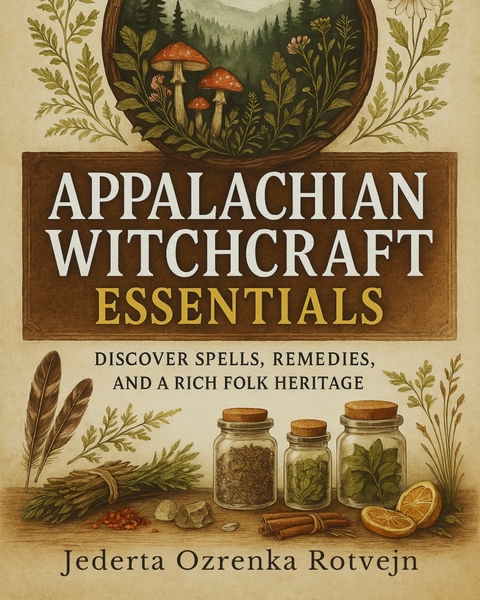
Appalachian Witchcraft Essentials (eBook)
293 Seiten
Seahorse Pub (Verlag)
978-0-00-080600-0 (ISBN)
Step into the mystical world of Appalachian Witchcraft , where ancient wisdom meets practical magic. In Appalachian Witchcraft Essentials , you'll uncover the secrets of a timeless tradition deeply rooted in the mountains' rich folk heritage. Whether you're a curious beginner or an experienced practitioner, this guide offers everything you need to harness the power of spells , remedies , and Appalachian lore.
Discover how to craft simple yet potent spells for protection, love, and prosperity, all grounded in authentic Appalachian practices. Learn herbal remedies passed down through generations, designed to heal both body and spirit. Each chapter dives deep into the history and cultural significance of this unique witchcraft tradition, ensuring you gain not only practical tools but also a profound connection to its origins.
Packed with step-by-step instructions, this book makes Appalachian Witchcraft accessible to everyone. From creating your own magical tools to understanding the symbolism behind local folklore, you'll find yourself immersed in a journey of self-discovery and empowerment.
Whether you're drawn to folk magic , eager to explore regional traditions, or seeking actionable solutions for modern challenges, Appalachian Witchcraft Essentials is your gateway to a vibrant, living legacy. Embrace the wisdom of the past and transform your life today-because true magic begins when we honor the roots of our ancestors.
Chapter One
The morning dew hadn't yet dried when my grandmother would lead me out to gather herbs. I couldn't have been more than seven years old, but she'd say, "These old hands won't always be here to show you." Granny knew every plant that grew on our mountain—what it could heal, what harm it might cause if handled wrong.
"You see how the leaf of this yellowroot curves just so?" she'd ask, her weathered finger tracing the plant's edge. "The good Lord puts His signature on everything He creates. This here's for the yellow bile when a body's liver ain't working right." She'd carefully dig around the roots, never taking the whole plant. "Always leave enough so it comes back stronger next season," she'd remind me.
Folks from three hollers over would come to our porch when the doctor in town was too expensive or hadn't helped. Granny never turned nobody away. She didn't call herself no witch or conjurer—would've been offended by such talk. "Just knowledge passed down," she'd say, "from them that came before to them that come after."
I remember watching her tie red thread around my cousin James's wrist to stop his nosebleeds, muttering words I couldn't quite catch—something from Ezekiel, I think. When I asked her why it worked, she just said, "Faith and knowing—you need both for the healing to take." The bleeding stopped that very day.
Sometimes she'd have me collect water from the east-running spring before sunrise, saying it had special power. We'd use it for making teas or washing a newborn. There weren't no spooky business about it—just the way things was done. Some call it superstition now, but I saw too much with my own eyes to dismiss it so easy.
This wisdom wasn't written in books but carried in memory and shared through working hands. That's how I learned it—watching, listening, doing—same as my grandmother before me, and her grandmother before her.
Defining Appalachian Folk Magic
The practices shared in Edna Mae's narrative represent more than isolated customs or quaint superstitions—they form part of a complex, living system of knowledge and belief that has sustained Appalachian communities for generations. What exactly constitutes "Appalachian folk magic" requires careful definition, as the term encompasses a diverse array of practices that developed in specific cultural and geographical contexts.
Terminology itself presents the first challenge. Throughout this book, you'll encounter several related terms: folk magic, folk medicine, conjuring, root work, and occasionally, witchcraft. While "witchcraft" often appears in outsider accounts and some scholarly literature, many traditional practitioners would reject this label. As folklorist Vance Randolph noted in his studies of Ozark traditions (which share many similarities with Appalachian practices), "Most mountain people who practice these arts would be deeply offended to be called 'witches'—they see themselves as using God-given knowledge of the natural world and Biblical wisdom." Instead, they might describe themselves as "healers," "granny women," or simply say they "know things" or "have the gift."
"Folk magic" serves as our primary term because it encompasses both the practical applications and underlying belief systems without imposing contemporary or historically charged labels. "Folk medicine" refers specifically to health-related practices, while "conjure" and "root work" reflect stronger influences from African American traditions that became interwoven with European-derived practices in parts of Southern Appalachia.
Geographically, when we speak of "Appalachia," we refer primarily to the cultural region extending from southern Pennsylvania through western Virginia, West Virginia, eastern Kentucky, eastern Tennessee, western North Carolina, and into parts of northern Georgia and Alabama. However, Appalachia is not culturally homogeneous—significant regional variations exist in practices, terminology, and influences. The Blue Ridge traditions differ from those in the Cumberland Plateau, just as northern Appalachian practices show different European influences than those in the southern region where African American and Cherokee contributions are more prominent.
What makes these practices distinctly "Appalachian" is their development in the specific environmental and social conditions of the mountain region. Geographic isolation, economic self-sufficiency, and limited access to formal education and medical care created conditions where practical knowledge of local resources became essential for survival. These practices evolved through creative adaptation of diverse cultural traditions carried by settlers and their interactions with Indigenous knowledge.
Appalachian folk magic fundamentally represents a syncretistic tradition—one formed through the blending of multiple cultural streams:
- European foundations from Scots-Irish, German, and English settlers who brought folk beliefs from their homelands
- Indigenous knowledge, particularly Cherokee plant medicine and spiritual concepts
- African American conjure traditions that traveled upward from Southern plantation regions
- Christian beliefs and Biblical references that became interwoven with older practices
- Adaptations to the specific flora, geography, and social conditions of the Appalachian region
What distinguishes authentic Appalachian folk magic from contemporary misconceptions and commercialized versions is its deeply practical nature and embeddedness in community life. These were not esoteric practices performed in ceremonial settings but everyday actions integrated into household management, healthcare, agriculture, and community relationships. The magical and the mundane were not separated as they often are in modern thinking.
Several core principles characterize traditional Appalachian folk magic:
- Practicality—focused on immediate needs related to health, prosperity, protection, and social harmony
- Orality—transmitted through direct teaching, observation, and memorization rather than written texts
- Localism—utilizing materials available in the immediate environment
- Adaptability—incorporating new influences while maintaining core frameworks
- Religious integration—existing alongside and within Christian practice rather than in opposition to it
- Community embeddedness—practitioners serving specific social roles and functions
Modern representations of "Appalachian witchcraft" often diverge significantly from these historical realities. Popular culture, tourism industries, and some contemporary magical traditions have romanticized, simplified, or fundamentally misrepresented these practices. Social media has accelerated this process, with trending hashtags like #AppalachianWitchcraft often showcasing practices that bear little resemblance to documented traditions.
This book aims to distinguish between verifiable tradition and modern invention—not to police authenticity, but to provide solid historical grounding for those genuinely interested in understanding and potentially practicing these arts with proper respect and context. Some innovations and adaptations are inevitable and necessary in living traditions, but these should build upon accurate historical understanding rather than misrepresentation or stereotyping.
Historical and Cultural Context
To understand Appalachian folk magic properly, we must situate it within the broader historical development of the region and the specific cultural conditions that allowed these practices to flourish and evolve. While a comprehensive history exceeds our scope, this condensed timeline highlights key developments that shaped traditional practices.
The settlement of Appalachia by European immigrants began in earnest during the mid-18th century. The earliest significant wave consisted primarily of Scots-Irish settlers—descendants of Scottish Presbyterians who had previously settled in Ulster, Ireland—who brought with them folk beliefs from their Celtic heritage, already modified by their Irish experience. German immigrants, particularly from regions like Bavaria and the Palatinate, settled throughout much of Pennsylvania and followed the mountain valleys southward, carrying their own distinctive "Pow-wow" or "Braucherei" folk magic traditions. English, Welsh, and smaller numbers of French Huguenot immigrants added additional cultural influences.
Between 1750 and 1800, these European settlers encountered and interacted with Indigenous peoples—predominantly Cherokee, Shawnee, and Creek nations—who possessed sophisticated knowledge of local plants, animals, and environmental patterns. Despite often hostile relations, considerable knowledge exchange occurred, particularly regarding medicinal plants. The forced removal of many Cherokee during the 1830s Trail of Tears disrupted this knowledge transmission, though some Indigenous people remained in hidden communities throughout the region, continuing to influence local practices.
African Americans, both enslaved and free, brought distinct magical traditions sometimes called "hoodoo" or "conjure" that had preserved elements of West African spiritual systems while adapting to American conditions. These practices became particularly influential in southern Appalachian areas with larger Black populations, contributing techniques involving roots, personal concerns (hair, fingernails, footprint dirt), and specific verbal formulas.
Several historical factors proved crucial in the development and preservation of Appalachian folk traditions:
Geographic Isolation: The mountainous terrain created natural barriers that limited regular...
| Erscheint lt. Verlag | 20.5.2025 |
|---|---|
| Sprache | englisch |
| Themenwelt | Sachbuch/Ratgeber ► Gesundheit / Leben / Psychologie ► Esoterik / Spiritualität |
| ISBN-10 | 0-00-080600-5 / 0000806005 |
| ISBN-13 | 978-0-00-080600-0 / 9780000806000 |
| Informationen gemäß Produktsicherheitsverordnung (GPSR) | |
| Haben Sie eine Frage zum Produkt? |
 EPUB (Adobe DRM)
Größe: 3,0 MB
Kopierschutz: Adobe-DRM
Adobe-DRM ist ein Kopierschutz, der das eBook vor Mißbrauch schützen soll. Dabei wird das eBook bereits beim Download auf Ihre persönliche Adobe-ID autorisiert. Lesen können Sie das eBook dann nur auf den Geräten, welche ebenfalls auf Ihre Adobe-ID registriert sind.
Details zum Adobe-DRM
Dateiformat: EPUB (Electronic Publication)
EPUB ist ein offener Standard für eBooks und eignet sich besonders zur Darstellung von Belletristik und Sachbüchern. Der Fließtext wird dynamisch an die Display- und Schriftgröße angepasst. Auch für mobile Lesegeräte ist EPUB daher gut geeignet.
Systemvoraussetzungen:
PC/Mac: Mit einem PC oder Mac können Sie dieses eBook lesen. Sie benötigen eine
eReader: Dieses eBook kann mit (fast) allen eBook-Readern gelesen werden. Mit dem amazon-Kindle ist es aber nicht kompatibel.
Smartphone/Tablet: Egal ob Apple oder Android, dieses eBook können Sie lesen. Sie benötigen eine
Geräteliste und zusätzliche Hinweise
Buying eBooks from abroad
For tax law reasons we can sell eBooks just within Germany and Switzerland. Regrettably we cannot fulfill eBook-orders from other countries.
aus dem Bereich