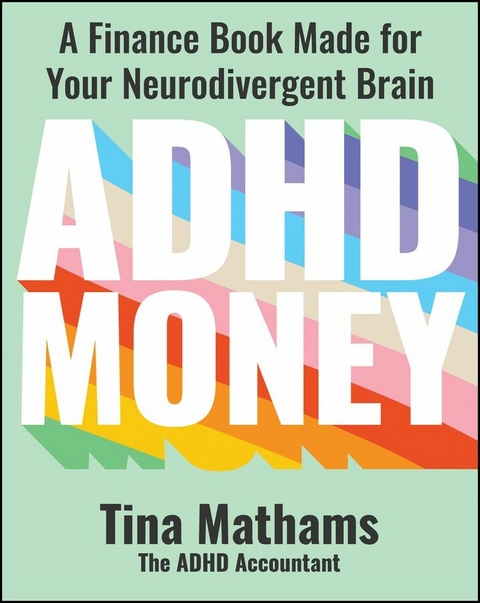
ADHD Money (eBook)
215 Seiten
Wiley (Verlag)
978-1-394-28078-0 (ISBN)
Eliminate the overwhelm and stay on track with your money goals
If you struggle with the time and energy needed to manage your money, you're not alone. So much financial advice is geared toward neurotypical brains. From checking your bank account to impulse spending and budgets that just don't work out ... It's time to find the strategies that will help you manage your money in a way that suits your brain.
ADHD Money is an empowering personal finance guide. In this book, you'll learn how and why those with ADHD (and other neurodivergent conditions) often feel frustrated by finances. You'll discover tips that work for your interest-based nervous system by using key motivation factors. And you'll get practical, psychology-based tools and worksheets to help you keep going and achieve your money goals.
Full of engaging, step-by-step exercises, this book will help you:
- identify your money values and refresh your money mindset
- create an ADHD-friendly spending plan and approach budgeting in a way that works for you
- try new methods for paying off debts and saving money
- combine money tasks with strategies like body doubling, gamifying and habit stacking
- achieve your long-term plans
The reality is that money and budgeting isn't always easy. But with ADHD Money, you'll discover how to take control, keep the spark alive and follow through on your financial dreams. Author Tina Mathams of @theadhdaccountant shares the hacks that will help you keep going and create your own money success.
Eliminate the overwhelm and stay on track with your money goals If you struggle with the time and energy needed to manage your money, you re not alone. So much financial advice is geared toward neurotypical brains. From checking your bank account to impulse spending and budgets that just don t work out It s time to find the strategies that will help you manage your money in a way that suits your brain. ADHD Money is an empowering personal finance guide. In this book, you ll learn how and why those with ADHD (and other neurodivergent conditions) often feel frustrated by finances. You ll discover tips that work for your interest-based nervous system by using key motivation factors. And you ll get practical, psychology-based tools and worksheets to help you keep going and achieve your money goals. Full of engaging, step-by-step exercises, this book will help you: identify your money values and refresh your money mindset create an ADHD-friendly spending plan and approach budgeting in a way that works for you try new methods for paying off debts and saving money combine money tasks with strategies like body doubling, gamifying and habit stacking achieve your long-term plans The reality is that money and budgeting isn t always easy. But with ADHD Money, you ll discover how to take control, keep the spark alive and follow through on your financial dreams. Author Tina Mathams of @theadhdaccountant shares the hacks that will help you keep going and create your own money success.
CHAPTER 1
Understanding ADHD and Money
In this chapter we get into …
- How and why ADHD can impact your money management
- Your brain's strengths
- Your interest-based nervous system (and why it struggles with money)
- Key motivation factors for the ADHD brain
- Recognising what you like (and maybe don’t like) about money
How I became ‘the ADHD Accountant’
When I was first diagnosed with ADHD, one of my first thoughts was, ‘Can I still be an accountant?’ I even Googled if ADHD and being an accountant were compatible!
Much of what I'd read about ADHD was how much we struggle with everything. Things like organisation, prioritisation, emotional management and, of course, money management. I wasn't sure how that could work with my job.
I started my Instagram account (@theadhdaccountant) because I had so many people ask for help. This confirmed for me I really wasn't alone — that many people with ADHD run into difficulties when it comes to managing their finances.
What did people ask? Among the most common questions were things like:
A part of me felt like a fraud. I, too, had my fair share of financial mismanagement in my time. I'd spent beyond my means. I'd been in consumer debt. I had started budgets but failed to stick to them.
However, I could easily help others manage their money. Something I'd done in my work as an accountant. I'd help businesses manage their budgets and forecasts, so why did I have so much trouble with my own finances?
This is something that is very typical in the ADHD world. We can do something that we struggle doing for ourselves quite easily for someone else.
Anyway, in among all this internal dialogue I realised I'd come a long way in my financial management from 15–20 years ago. The strategies I'd tried and tested, and ultimately put into place, had gotten me from financial ruin, to doing financially OK.
This led me into a hyperfocus on ADHD and finances. I wanted to really understand the link between two subjects that usually don't co-exist. Coupling this with my training and experience as an accountant, I worked with other neurodivergent people to help them too. What I learned was eye-opening!
For decades and across the world, ADHDers have proclaimed they are bad with money. But are we? Are we bad with money? Or do we just need to understand how our brain works and manage our finances in a neurodivergent way? Perhaps we just need a way that works with our brain rather than against it?
Spoiler alert: it's the latter.
Let's dive into what ADHD is. Briefly. Because there are plenty of resources that are better equipped to dive into the topic of ADHD itself; plus we need to get to the money part.
Attentive Deficit Hyperactivity Disorder (ADHD)
If you are reading this book, I assume you have heard of ADHD. You either have been diagnosed or identify as neurodivergent, or love someone who is neurodivergent. Whatever your relationship, you are welcome here and thank you for picking up this colourful and nothing-like-you-have-seen-before book.
ADHD is a neurodevelopmental condition that affects executive functioning and can cause inattention, impulsivity and hyperactivity. There are also emotional regulation and working memory challenges associated with ADHD.
Some of the challenges of ADHD can include:
- regulating attention
- regulating emotions
- being forgetful
- finding it difficult to organise tasks, time and belongings
- finding it hard to sit
- losing belongings
- struggling to follow through on instructions
- interrupting others
- being impulsive
- not being able to tolerate boredom.
That's just a short list of what someone with ADHD can struggle with day to day. It's not exhaustive and not diagnostic.
While there can be ways to help manage ADHD, it's a condition that most people will carry through their lifetime.
Of course, there are some amazing qualities people with ADHD can have. Again, this is not a complete list, but we have a few goodies to balance the not-so-great parts.
- We tend to be great in an emergency.
- We can have lots of ideas and be very creative.
- We can hyperfocus on topics that we are interested in.
- We can often think outside the box and see things that others cannot.
- We are resilient.
- We can have a lot of energy.
SIDEQUEST
The amazing ADHD brain
Rather than focus on what we struggle with when it comes to ADHD and money, take some time to focus on the amazing qualities we have. Some of our strengths and skills can be really beneficial when it comes to managing money.
- Which of the strengths on the next page do you relate to the most?
- Can you think of any personal strengths you might have?
ADHD strengths and skills
| Feature | Description |
|---|
| Great in an emergency | We can focus our attention, process information quickly and act fast when the pressure's on. |
| Highly creative | We are full of big ideas and have a flair for the unexpected. |
| Hyperfocused | We are passionate and know lots about what matters most to us. |
| Able to think outside the box | We come at things from different angles, and sometimes we can see solutions other people miss. |
| Resilient | We're adaptable, and we can bounce back from setbacks or disappointments stronger than ever. |
| High energy levels | We have lots of oomph and enthusiasm to fuel our work, life and dreams. |
The ADHD brain and the interest-based nervous system
ADHDers operate on an interest-based nervous system. Simply put, that means we often struggle to focus on things that don't grab our interest. While neurotypical people might be motivated by outcomes or rewards, we are generally motivated by what we find fascinating or enjoyable in the moment.
An interest-based nervous system is one reason we often prefer to research the subject of our latest hyperfocus rather than do the dishes — even though we know the dishes need to be done. It's not as simple as just telling ourselves ‘hey, the dishes are important’.
The interest-based nervous system
With an interest-based nervous system, an ADHD brain is motivated by four key factors:
- interest
- novelty
- urgency
- challenge.
As these four factors suggest, our brains like to prioritise tasks or activities that are engaging, exciting or rewarding. If a task involves some degree of interest, novelty, challenge and/or urgency, the ADHD brain is more likely to want to see it through.
So what does an interest-based nervous system mean for you when it comes to money?
This need to feel interest, novelty, urgency or challenge is one reason you might find yourself avoiding things like budgeting or reviewing your spending. Those activities may not be engaging for your brain when there is no immediate reward.
People who are not neurodivergent can find it difficult to wrap their head around this, and it's one reason they might see ADHDers as ‘lazy’.
But we are not lazy!
We just need to work with an interest-based nervous system, rather than against it.
The consequence-based nervous system
By comparison, a neurotypical brain will generally respond to the promise of possible outcomes. This is known as a consequence-based nervous system.
What motivates behaviour with this nervous system? It might be a fear of punishment or the promise of a reward. For example, the fear of potentially running out of money can be enough motivation for someone to check on their finances. Or they might think, ‘If I budget, then I will have money for everything I need.’
In this way, someone with a consequence-based nervous system can usually work well with a sequence of tasks. They are motivated to follow that sequence of tasks (like budgeting) by the promise of the end result (having, or not having, money later).
It's time to find strategies that work for you.
If you find you shaming yourself for not being able to do the things that your nervous system literally doesn't allow you to do, I hope this brings you some peace and clarity. ADHDers can absolutely still prioritise and do all the things we need to for a more financially secure future. We just need to leverage our interest-based nervous system!
Our brains like to prioritise tasks or activities that are engaging, exciting or rewarding.
ADHD brain motivation factors
Throughout this book, I aim to challenge you to look outside the neurotypical finance box and use the motivation factors that work for the ADHD brain: interest, novelty,...
| Erscheint lt. Verlag | 20.5.2025 |
|---|---|
| Sprache | englisch |
| Themenwelt | Sachbuch/Ratgeber ► Beruf / Finanzen / Recht / Wirtschaft ► Geld / Bank / Börse |
| Schlagworte | adhd books • ADHD strategies • body doubling • budget book • budget tips • Coaching • debt • Diverse Accountants • Emotional Spending • Expenses • focus • gamifying • Goal Setting • how to budget • how to save • money diary • Money Management • money mindset • Money Stories • neurodivergent • neurodiversity • neurodiversity for dummies • pay off debt • Personal development • personal finance • personal finance book • personal finance help • psychology of money • Self-Help • set goals • spectrum • stay focused • the ADHD accountant • therapy • understanding adhd |
| ISBN-10 | 1-394-28078-5 / 1394280785 |
| ISBN-13 | 978-1-394-28078-0 / 9781394280780 |
| Informationen gemäß Produktsicherheitsverordnung (GPSR) | |
| Haben Sie eine Frage zum Produkt? |
 EPUB (Adobe DRM)
Kopierschutz: Adobe-DRM
Adobe-DRM ist ein Kopierschutz, der das eBook vor Mißbrauch schützen soll. Dabei wird das eBook bereits beim Download auf Ihre persönliche Adobe-ID autorisiert. Lesen können Sie das eBook dann nur auf den Geräten, welche ebenfalls auf Ihre Adobe-ID registriert sind.
Details zum Adobe-DRM
Dateiformat: EPUB (Electronic Publication)
EPUB ist ein offener Standard für eBooks und eignet sich besonders zur Darstellung von Belletristik und Sachbüchern. Der Fließtext wird dynamisch an die Display- und Schriftgröße angepasst. Auch für mobile Lesegeräte ist EPUB daher gut geeignet.
Systemvoraussetzungen:
PC/Mac: Mit einem PC oder Mac können Sie dieses eBook lesen. Sie benötigen eine
eReader: Dieses eBook kann mit (fast) allen eBook-Readern gelesen werden. Mit dem amazon-Kindle ist es aber nicht kompatibel.
Smartphone/Tablet: Egal ob Apple oder Android, dieses eBook können Sie lesen. Sie benötigen eine
Geräteliste und zusätzliche Hinweise
Buying eBooks from abroad
For tax law reasons we can sell eBooks just within Germany and Switzerland. Regrettably we cannot fulfill eBook-orders from other countries.
aus dem Bereich