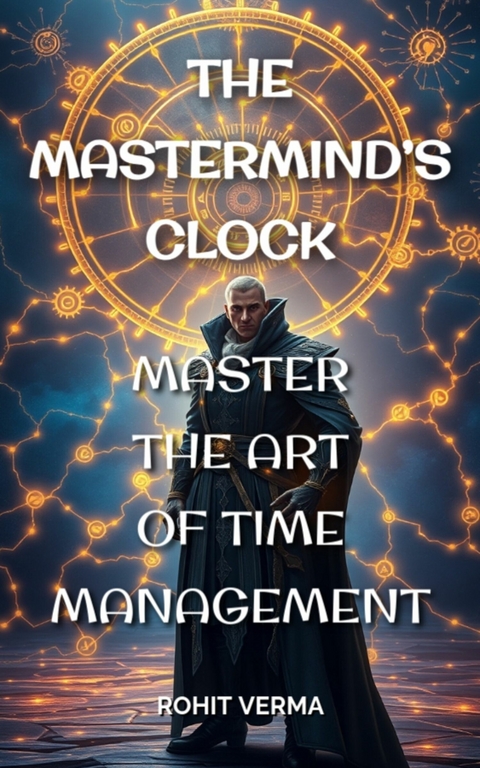
The Mastermind’s Clock (eBook)
79 Seiten
Rohit Verma (Verlag)
978-1-0670819-9-7 (ISBN)

The Mastermind's Clock is your ultimate guide to mastering time and becoming the true architect of your day. This book offers a strategic approach to time management, helping you to craft routines, set priorities, and build systems that work in harmony with your goals. With practical techniques, mindset shifts, and powerful insights, you'll learn to stay ahead of distractions, work smarter, and make time your most valuable asset. Whether you're balancing work, life, or both, this book shows you how to be the master of your time-and unlock your true potential.
Chapter 1: The Time You Have, The Time You Make
Time, as we know it, is one of the few resources in life that cannot be replenished, replenished, or replaced. Once it’s gone, it’s gone forever. And yet, it’s a paradox. We have the same 24 hours in a day, but some people seem to accomplish far more than others in that same span of time. So, what separates the highly productive from the time-challenged?
It’s simple: the way we use time.
This chapter is about understanding how to harness the time you have and make it work for you rather than being at the mercy of distractions, obligations, and poor habits. It’s about shifting your perspective to see time not just as something that passes, but as a powerful tool that you can shape, prioritize, and invest in.
1.1 Understanding the Time You Have
The first step to mastering time is accepting one simple truth: Time is finite.
No matter how much we wish we could stretch it, bend it, or pause it, we are all bound by the same 24-hour cycle each day. From the moment we wake up to the moment we go to sleep, time relentlessly ticks away. Whether we’re aware of it or not, it’s always moving forward. This is a fundamental truth that we must acknowledge to begin managing our time effectively.
Many of us live as if time is infinite, often taking it for granted. We get caught up in distractions, procrastinate, or find ourselves too busy with meaningless tasks to focus on the things that truly matter. And then, we wonder where the time went.
1.2 The Myth of Multitasking
In our modern, fast-paced world, multitasking has become a badge of honor. We often pride ourselves on being able to juggle work, social media, personal projects, and daily life simultaneously. But here’s the truth: multitasking is a myth.
When we think we’re multitasking, what we’re actually doing is rapidly switching between tasks. The human brain isn’t designed to focus on multiple things at once. Studies have shown that multitasking reduces productivity and leads to errors because our brains can only handle one cognitive task at a time.
Instead of feeling like you need to handle everything at once, the key to time mastery is recognizing when to focus on one task at a time, giving it your full attention, and then moving on to the next. It’s about quality over quantity, depth over breadth.
1.3 The Power of Intentionality
Once you realize that time is finite and that multitasking is counterproductive, the next step is understanding the power of intentionality.
To live intentionally with your time means to approach your day with a clear vision of how you want to spend each moment. It’s about purposefully selecting your tasks and actions based on what truly matters to you, rather than just reacting to whatever is happening around you. When you are intentional about how you use your time, every minute has a purpose.
Intentionality means setting your goals clearly and making decisions about how to prioritize them. Instead of being busy for the sake of being busy, you actively create a roadmap for your day. The result is not just productivity, but meaningful productivity — where every task you complete brings you closer to achieving your larger goals.
1.4 Time and Values Alignment
Time mastery goes beyond simple task management — it’s about aligning your time with your values and goals. When your time is aligned with your values, you’re more likely to feel fulfilled, energized, and motivated. Conversely, when your time isn’t aligned, even the most productive day can feel empty or unfulfilling.
Take a moment to think about what truly matters to you: family, career growth, health, personal development, or perhaps all of the above. Now, consider how much time you’re currently spending on activities that don’t align with these values. Are you spending hours on tasks that don't contribute to your personal growth? Are you prioritizing work at the expense of your well-being or relationships?
Time alignment means taking a hard look at your current schedule and making conscious choices to spend your time on what truly matters. It involves creating a framework for your daily life where your actions reflect your values.
For instance, if health is a top priority, then carving out time for exercise, meal planning, or meditation should take precedence in your schedule. Similarly, if nurturing relationships is essential to you, you’ll want to set aside time to connect with loved ones rather than constantly being “too busy.”
1.5 Time is a Resource, Not a Commodity
To truly master time, you need to shift your mindset from seeing time as a commodity to viewing it as a resource. Commodities are often treated as something you spend, use up, and replace. Resources, on the other hand, are carefully managed, conserved, and invested.
When you treat time as a resource, you begin to make more conscious choices about how you spend it. You think of time not just as something you “use up,” but as something you can invest — in relationships, self-improvement, work, and rest. Every minute spent on something productive or meaningful is an investment that yields returns over time.
For example, if you invest an hour learning a new skill or reading a book, you’re not “wasting” time; you’re enriching your knowledge base and enhancing your personal development. On the other hand, if you spend an hour scrolling through social media or engaging in activities that don’t align with your goals, you’re letting valuable time slip away, often without even realizing it.
1.6 Time Management as a Strategic Skill
Effective time management is not just about creating a to-do list or scheduling appointments. It’s a strategic skill that involves thinking critically about what needs to be done, why it matters, and how it can be done most effectively.
The most successful people are not necessarily those who work the hardest or the longest, but those who work the smartest. Strategic time management involves:
- Prioritizing tasks based on their importance and impact.
- Planning your day in advance so you know exactly what you need to do and when.
- Delegating or outsourcing tasks that are not aligned with your strengths or goals.
- Eliminating distractions that take away from your focus and productivity.
- Reviewing your progress regularly to make sure you’re staying on track and adjusting as necessary.
Strategic time management is about having a clear vision of where you’re headed, and designing your daily actions in a way that gets you there.
1.7 The Illusion of Time Freedom
Many people wish for time freedom — the ability to do whatever they want whenever they want. However, there’s an illusion associated with this desire. True time freedom doesn’t come from having fewer commitments or more free time, but from making deliberate choices about how you spend your time.
Time freedom isn’t about having no responsibilities. Instead, it’s about creating the ability to choose how to allocate your time based on your priorities. It’s about designing a life where your time is used for activities that align with your values and goals.
For instance, you might have a demanding job, but if your job aligns with your passions and helps you move closer to your goals, you won’t feel burdened by it. In contrast, if you’re spending time on tasks that drain you and don’t serve your overall purpose, that’s when you feel time-starved and overwhelmed.
1.8 The Importance of Saying No
One of the biggest obstacles to mastering time is our inability to say no. Whether it’s a colleague asking for a favor, a social obligation, or a new task being added to your plate, saying yes to everything can quickly lead to burnout and overcommitment.
Learning to say no is essential for protecting your time. This doesn’t mean you have to be rude or unhelpful; it means you have to set boundaries that protect your energy and focus. It’s okay to decline requests that don’t align with your priorities, even if you feel guilty about it.
Saying no is an act of self-care and a necessary skill for time management. When you learn to say no to the things that don’t serve you, you make more space for the things that truly matter.
1.9 Time Mastery is a Daily Practice
Mastering time isn’t something that happens overnight. It’s a daily practice. Every day, you’re faced with decisions about how to spend your time. The key is to make each decision intentionally, with awareness and purpose.
Start small by evaluating your time at the end of each day. Reflect on what worked and what didn’t. What tasks did you complete that brought you closer to your goals? What distractions did you fall into that drained your time and energy? This simple act of reflection helps you course-correct and refine your time management strategies moving forward.
As with any skill, the more you practice, the better you get. Over time, you’ll develop the habits, mindset, and systems that allow you to consistently make the most of the time you have.
In the end, time is the one resource we all have in equal measure. How we use it is what defines our success and fulfillment. The time you have is precious, and how you choose to make it work for you will determine your level of success. By being intentional, strategic, and...
| Erscheint lt. Verlag | 9.5.2025 |
|---|---|
| Sprache | englisch |
| Themenwelt | Sachbuch/Ratgeber ► Gesundheit / Leben / Psychologie ► Esoterik / Spiritualität |
| Sachbuch/Ratgeber ► Gesundheit / Leben / Psychologie ► Lebensdeutung | |
| Schlagworte | Efficiency • focus • Goal Setting • Prioritization • Productivity • Systems • Time Management |
| ISBN-10 | 1-0670819-9-2 / 1067081992 |
| ISBN-13 | 978-1-0670819-9-7 / 9781067081997 |
| Informationen gemäß Produktsicherheitsverordnung (GPSR) | |
| Haben Sie eine Frage zum Produkt? |
 EPUB (Ohne DRM)
Digital Rights Management: ohne DRM
Dieses eBook enthält kein DRM oder Kopierschutz. Eine Weitergabe an Dritte ist jedoch rechtlich nicht zulässig, weil Sie beim Kauf nur die Rechte an der persönlichen Nutzung erwerben.
Dateiformat: EPUB (Electronic Publication)
EPUB ist ein offener Standard für eBooks und eignet sich besonders zur Darstellung von Belletristik und Sachbüchern. Der Fließtext wird dynamisch an die Display- und Schriftgröße angepasst. Auch für mobile Lesegeräte ist EPUB daher gut geeignet.
Systemvoraussetzungen:
PC/Mac: Mit einem PC oder Mac können Sie dieses eBook lesen. Sie benötigen dafür die kostenlose Software Adobe Digital Editions.
eReader: Dieses eBook kann mit (fast) allen eBook-Readern gelesen werden. Mit dem amazon-Kindle ist es aber nicht kompatibel.
Smartphone/Tablet: Egal ob Apple oder Android, dieses eBook können Sie lesen. Sie benötigen dafür eine kostenlose App.
Geräteliste und zusätzliche Hinweise
Buying eBooks from abroad
For tax law reasons we can sell eBooks just within Germany and Switzerland. Regrettably we cannot fulfill eBook-orders from other countries.
aus dem Bereich