


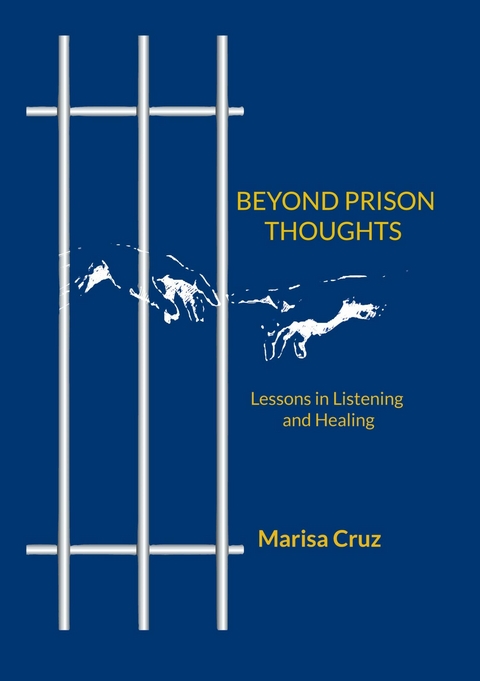
BEYOND PRISON THOUGHTS (eBook)
168 Seiten
Books on Demand (Verlag)
978-3-8192-8696-4 (ISBN)
M. Cruz is not a bestselling author - at least, not yet. This is her first published book, born from a deep passion for peace, compassion, and the power of human connection. When she's not volunteering in different ways, you'll find her dreaming about her next adventure abroad. She loves hiking, meditating, and traveling - always seeking new places that inspire her. Marisa currently lives with her family near Frankfurt, Germany, where she continues to believe in - and dream of - a little piece of heaven on earth.
INTRODUCTION
How It All Started
No, you don’t have to be an offender to experience the harsh realities of prison. You can witness it through the eyes of those who live it every day. Why should you care? Well, you don’t have to. But if you ever do, it might just change the way you see the world. It could challenge your assumptions, expand your perspective, and—perhaps most importantly—help you develop a deeper sense of empathy for people whose lives have been shaped by circumstances most of us will never fully understand. You might be wondering: What would drive someone with no background in social science or psychology—someone with a stable job, a fulfilling personal life, and an already packed schedule—to start visiting women in prison? Trust me, I’ve been asked that question more times than I can count.
And honestly? It depends on who’s asking. At work, very few of my colleagues even know I volunteer at a jail. It’s not something I bring up often—partly because it feels personal, but also because, well… it’s not exactly the easiest topic to relate to over coffee.
But one day, during lunch, a coworker and I got into a conversation about—of all things—the complex chemistry behind refining cocaine. Yep, that’s just what happens when chemists start talking! We can’t help but analyze and theorize. What started as a purely technical discussion took an unexpected turn. I shared something I had learned from my time volunteering—that in some countries, the length of a prison sentence is influenced by the purity of the drug. The higher the purity, the harsher the sentence. So, when someone decides to smuggle drugs, such as cocaine across borders, they’re not just committing a crime—they might also be unknowingly making their situation way worse if they don’t know exactly what they’re carrying. The purer the substance, the longer the punishment if they get caught.
It’s wild to think that something that starts as a "natural" product—coca leaves—ends up being transformed into a dangerous cocktail of chemicals. For context, a single coca leaf contains only about 1% cocaine, and it takes roughly 140 kg of coca leaves just to produce one kilogram of coca paste. The world of drug trafficking is complex, dangerous, and often deadly—not just for those involved in production and smuggling, but for everyone touched by its ripple effects, from law enforcement to families and entire communities. It’s a brutal, unforgiving business. And this is where the prison experience ties in.
The people caught up in this cycle aren’t just “criminals”—many of them are victims of a system that offers little to no way out. Visiting women in jail has shown me just how layered these stories are. The path to incarceration isn’t always as simple as it seems. Behind every conviction, there’s a deeper story—one of survival, desperation, or circumstances beyond a person’s control. It’s a reminder that we’re all part of a bigger picture. And sometimes, just being open to someone else’s reality is enough to change the way we see the world.
But back to my colleague—he looked at me, surprised, and asked with a mix of curiosity and amusement, "Where the hell did you learn that?" I took a deep breath and explained that I visited South American women incarcerated in Germany for drug trafficking. His response was immediate: "Why would you do that? They got what they deserved. They're there for a reason." I was taken aback. Had he never heard of compassion? I paused, not just to put myself in his shoes, but to step into his mindset. What had shaped his perspective? His reaction wasn’t uncommon but coming from someone I had always seen as kind and open-minded, it stung.
After a moment, I explained my perspective. Slowly, he began to understand, though he still cautioned me to be careful because "it could be dangerous." I thanked him for the concern and moved on. But the question lingered: What drives me to do this? If I said it was purely about following in Jesus’ footsteps, that would be an oversimplification—lacking depth, maybe even sounding superficial. That’s not the full picture.
My decision comes from something deeper—something beyond religious beliefs. It’s a universal drive that exists in all of us: a pull toward justice, a desire to do the right thing, to care for and protect others. Some might call it instinct. But I believe it’s more than that—it’s an innate sense of shared humanity, something we are born with. And back to Jesus—I’m sure that’s what he was trying to teach all along. Take a moment—just a moment—with an open mind and a peaceful heart. Think back to a time when you felt an inner call to help or protect someone. Maybe it was standing up for a classmate at school, offering a hand to a stranger struggling with their groceries, or simply sending a kind thought to someone facing an illness. We all have those moments, whether big or small—not that kindness can truly be measured anyway. Social media is filled with inspiring videos—on YouTube, TikTok, and beyond—of people jumping into action during emergencies: earthquakes, car accidents, natural disasters, or any moment where someone needs immediate help. And in those moments, no one stops to ask, "Does this person deserve to be helped? Have they made mistakes in the past?" It just happens. We just do it. Compassion takes over. We act instinctively, without hesitation, because deep down, we know it’s the right thing to do. And if you think back to a moment like that in your own life, you’ll probably remember the warmth it gave you—the quiet, unspoken joy of doing something good.
From the perspective of the person being helped, that kindness can ripple outward. It might even inspire them to pass it forward when they can. And just like that, without even realizing it, a circle of kindness is formed. This instinct to help isn’t just a human trait—it extends to the animal kingdom as well. The ancient philosopher Pythagoras believed that animals experience the full range of emotions, including fear, joy, and compassion.
We see proof of this all the time—dogs comforting their humans after trauma, elephants mourning the loss of a friend, and animals showing deep, unspoken care for one another. These moments aren’t calculated; they’re pure. As Buddha might say, they are true acts of compassion. For me, though, there’s another layer to this motivation. I currently live in Germany, near Frankfurt—a place many would consider safe. No slums, a strong social support system, and a good education structure. Of course, what counts as "good" education is up for debate, but that’s a conversation for another time.
The point is, that I live in a stable and secure environment, at least in terms of crime. But it wasn’t always this way for me. I grew up in the ghettos of São Paulo, one of the largest and most unforgiving cities in South America. My childhood—and even my early adult years—were shaped by the constant presence of crime, violence, and a sense of fear that dictated everyday life. It was an environment where survival often came before dreams, and safety was never guaranteed.
To be clear, this was about 40 years ago—things have improved a lot since then. But the experience left a mark, shaping how I see the world and, more importantly, how I see the people society often forgets. If you take the time to really look at the roots of crime and violence, you’ll see a common thread weaving through it all: drugs. From solvents to marijuana, cocaine to amphetamines—people have always found ways to chase that high, to escape reality, or to numb the weight of their existence. And the drug trade? It’s ruthless. It doesn’t care who it destroys. It infects every level of society, from street corners to corporate boardrooms, leaving devastation in its wake. I saw it firsthand. Families ripped apart. Communities crumbling. Lives lost—some to addiction, some to violence, some to both. And the impact doesn’t stop with the users or the dealers. It spreads like wildfire, pulling in parents, children, neighbors, employers—anyone close enough to get caught in the web. This is why I do what I do. I want to remind those who have been pulled into the world of drugs that they can choose again. That their past does not have to define them. Having witnessed the destruction caused by addiction in my own community and understanding the struggles of those trapped in the system, I feel a deep responsibility to do something—anything—to help.
To be clear, I don’t see the women I visit in jail as criminals. I see them as people—human beings shaped by circumstances far beyond their control. Yes, they may have made wrong choices. But I refuse to believe that one wrong choice should determine their worth. In many cases, their stories have little to do with personal failure and everything to do with a system designed to keep them stuck. And that is what drives me to volunteer—to listen, to offer compassion, and to help these women find a path toward healing and redemption. It’s about creating a space where they can reclaim their dignity, where their humanity is seen beyond their mistakes. And in doing so, I remind myself of the deeper connection we all share....
| Erscheint lt. Verlag | 12.5.2025 |
|---|---|
| Sprache | englisch |
| Themenwelt | Sachbuch/Ratgeber ► Beruf / Finanzen / Recht / Wirtschaft |
| Geisteswissenschaften ► Psychologie | |
| Schlagworte | Change Management • Forgiveness • Leadership • Peace • prison world |
| ISBN-10 | 3-8192-8696-9 / 3819286969 |
| ISBN-13 | 978-3-8192-8696-4 / 9783819286964 |
| Informationen gemäß Produktsicherheitsverordnung (GPSR) | |
| Haben Sie eine Frage zum Produkt? |
 EPUB (Ohne DRM)
Digital Rights Management: ohne DRM
Dieses eBook enthält kein DRM oder Kopierschutz. Eine Weitergabe an Dritte ist jedoch rechtlich nicht zulässig, weil Sie beim Kauf nur die Rechte an der persönlichen Nutzung erwerben.
Dateiformat: EPUB (Electronic Publication)
EPUB ist ein offener Standard für eBooks und eignet sich besonders zur Darstellung von Belletristik und Sachbüchern. Der Fließtext wird dynamisch an die Display- und Schriftgröße angepasst. Auch für mobile Lesegeräte ist EPUB daher gut geeignet.
Systemvoraussetzungen:
PC/Mac: Mit einem PC oder Mac können Sie dieses eBook lesen. Sie benötigen dafür die kostenlose Software Adobe Digital Editions.
eReader: Dieses eBook kann mit (fast) allen eBook-Readern gelesen werden. Mit dem amazon-Kindle ist es aber nicht kompatibel.
Smartphone/Tablet: Egal ob Apple oder Android, dieses eBook können Sie lesen. Sie benötigen dafür eine kostenlose App.
Geräteliste und zusätzliche Hinweise
Buying eBooks from abroad
For tax law reasons we can sell eBooks just within Germany and Switzerland. Regrettably we cannot fulfill eBook-orders from other countries.
aus dem Bereich


