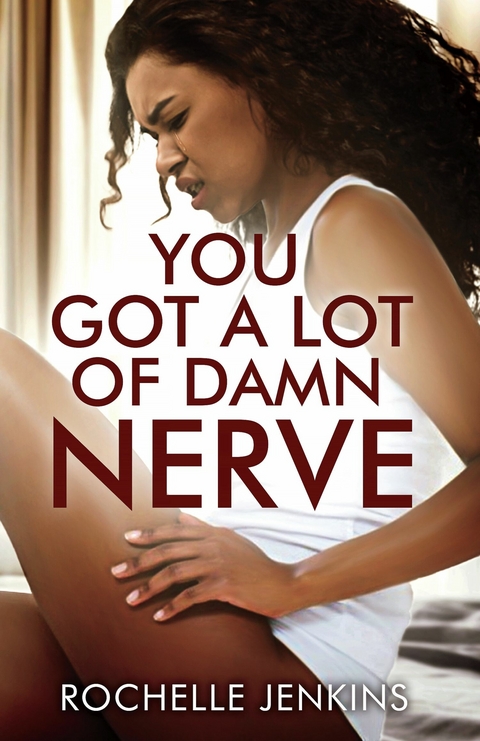
YOU GOT A LOT OF DAMN NERVE (eBook)
116 Seiten
Bookbaby (Verlag)
979-8-9899300-7-4 (ISBN)
As the author of three captivating fiction novels and two thought-provoking non-fiction works, Rochelle has a passion for storytelling that knows no bounds. She brings a unique perspective to the literary world, crafting narratives that resonate with authenticity and depth. Driven by a desire to share compelling stories with readers around the globe, Rochelle took the bold step o f founding Kitabu Publishing LLC,a boutique publishing company. Through Kitabu Publishing LLC, she has embraced the challenge of self-publishing, seeing her visions come to life. With an unwavering commitment to quality and creativity, Rochelle continues to push the boundaries of literary expression, seeking to inspire, provoke thought, and spark conversations that endure long after the final page is turned.
When pain takes over your life, how do you find a way forward?Complex Regional Pain Syndrome (CRPS) is often called the "e;suicide disease"e; for a reason its relentless pain and misunderstanding within the medical community leave too many sufferers feeling hopeless and alone. I know this reality firsthand. This book is both a personal account and an advocacy tool, shedding light on an often-misdiagnosed condition while offering insight, validation, and awareness. Through my journey, I explore the daily battles, the resilience required to endure, and the vital role of love and support. Whether you are living with CRPS, caring for someone who is, or simply seeking to understand this condition, this book offers the truth that so many have struggled to find. It is a testament to perseverance, a call for awareness, and a reminder that even in the darkest moments, we are not alone.
CHAPTER TWO MISDIAGNOSED
The nervous system, a marvel of human biology, connects the brain to every part of the body, enabling us to move, feel, and function. It's the body's communication highway, seamlessly delivering messages that allow us to think, breathe, and simply exist. But what happens when this intricate system breaks down?
The nerves that once carried routine messages to and from my brain had turned against me, flooding my body with relentless, unyielding pain signals that defied logic—transforming ordinary moments into unexpected challenges so intense that they overshadowed everything else.
Before diving deeper into this experience, I want to take a moment to share the 'why' behind this book. It all started with a car accident— though I wasn't behind the wheel. That night, I didn't feel any sharp or immediate pain, just a general soreness and aching throughout my body. Over the next few days, I relied on Tylenol, Ibuprofen, and indulgent hot tub soaks or showers. The stiffness and soreness slowly improved, and to my relief, there weren't any visible bruises.
However, one problem persisted: a deep ache that lingered in my left thigh. At first, I didn't think much of it—the cause was a complete mystery to me. My initial response was simple: I rubbed my hand back and forth on the spot, hoping it would ease the discomfort. But the pain continued to escalate, and no amount of rubbing made it go away.
At the time, I didn't connect any of what I was experiencing to the accident. When I think of car accidents, my mind goes to things like whiplash, bruises, or broken bones—not a persistent throb in your thigh. The accident was the only thing that had happened to me, but even then, I didn't make the connection. When the pain became unbearable, I decided it was time to consult my primary care doctor.
To give you some context, my medical history is about as uneventful as it gets. I've been admitted to the hospital twice in my life—both times to welcome my sons into the world. I had the usual childhood illnesses: mumps and chickenpox. I even had a strange virus in my right rib. But as an adult, seeing a doctor wasn't part of my routine. The most I ever dealt with were the occasional colds or bouts of bronchitis.
As the pain in my thigh refused to relent, the simplicity of my medical history faded into the background, and a new chapter was forming. For over a year, I lived on a carousel of changing prescriptions, each one promising relief that never came. Instead, the pain showed no signs of improvement. If anything, it intensified, becoming more consuming.
Finally, my doctor, sensing something wasn't right, scheduled a CT scan and MRI. I remember the weight of the anticipation, the questions swirling in my mind as I waited for the results.
The CT scan came back clear—no issues there—but the MRI told a different story. Hearing the words “tumor in your spine” was a shock, leaving me to grapple with the news. I was torn—relieved to finally have an explanation for the pain, yet horrified by the word tumor and its precarious location. Still, I knew I had to confront the situation head- on.
My mother's battle with Non-Hodgkin's Lymphoma loomed large in my thoughts. I remembered that rollercoaster ride all too well. Cancer wasn't a stranger in my family.
My brain immediately jumped to the worst-case scenarios: chemo, radiation, surgery. Had they caught it in time? With so little room for error near my spinal cord, I didn’t know if surgery was even an option—or if it was, what risks it might bring.
When I met with the head of the Neurology Department at a well-known hospital, I expected to discuss treatment options. Instead, the neurologist delivered a bombshell. After reviewing my scans, he calmly said, “That tiny benign tumor at the base of your spine isn't causing your pain. You've likely had it—if not your entire life, then for a significant portion of it. It's not bothering you, so there's no reason to bother it.”
What. The. Hell. Is. Happening?
I left the consultation reeling, swept up in a strange mix of emotions. On one hand, I was elated—no surgery, no grueling treatment plan, no looming battle with cancer. I had dodged a massive bullet. But the frustration was undeniable. I still had no idea what was causing this relentless pain, and that realization hit me hard. It was my breaking point with my primary care doctor. After months of being shuffled through different medications and tests without answers, I knew it was time for a change.
In November, I switched my employee insurance and took my best friend's advice to see her primary care physician (PCP). The insurance kicked in that January, but I had to wait until March to get an appointment with my new physician. And so, I found myself stuck in the dreaded waiting game—my least favorite pastime.
Despite everything, I still strutted to work, rocking my stilettos and owning my world. My leg could escalate from a twinge to an ache to feeling like I'd been kicked repeatedly with a steel-toe boot in minutes, but I had no choice but to push through it and navigate my day. Pain or not, I refused to let it slow me down.
Then, fate smiled on me—or maybe tempted me. I stumbled upon my dream car. To be fair, any sleek ride with a manual transmission would have sufficed. But this? This was perfection: a white Honda Civic Coupe Si, a six-speed marvel. Oh, how I adored that car, especially when I unleashed its power on the highway.
Those speed camera tickets? Let's just say I was merely keeping up with the flow of traffic—wink, wink. For a while, zipping around in that car became the escape I didn't know I needed—a reminder that there were still things in life that could make me feel alive and in control.
Finally, after months of waiting, I had the long-anticipated sit-down with my new physician. She was just as perplexed about my thigh trouble as I was. I braced myself for more of the same—a prescription or a dismissive shrug.
But here's the twist—unlike my previous PCP, she didn't hesitate. “Let's get to the bottom of this,” she said, scheduling an appointment with a specialist.
It wasn't just her words but the way she said them—with conviction and determination—that gave me my first glimmer of hope in a long time.
Unfortunately, the appointment wasn't immediate; I had to wait a few more weeks, which felt like an eternity. During that time, my mind ran in endless circles. Would this be another dead end? What if I finally got answers—what then?
The combination of relief and dread was dizzying. Pain is one thing, but uncertainty is another beast entirely. It gnaws at you, magnifying every ache and turning every moment of discomfort into an unsolvable clue in a relentless mystery.
On the day of the appointment, I felt a mix of emotions: nervousness, hope, and—if I'm honest—exhaustion. The waiting room was a blur of muted tones and soft murmurs. As I sat there, for some reason, my thoughts drifted to my new car, patiently waiting for me in the parking lot. The memory of zipping along the highway brought a small smile to my face. I'd learned to cling to the little joys, the anchors that could steady me through the storm.
The specialist greeted me warmly and wasted no time. For the first time, someone truly listened—really listened—to the full story of my pain: the accident, the thigh, the escalation, and all the failed attempts to treat it. He didn't rush me or dismiss me. Instead, he started piecing together the puzzle. Then, without hesitation, he decided to perform a nerve conduction study (NCS)—right then and there.
Naturally, I assumed the focus would be on my left thigh, where the pain lived. Nope. Wrong. Needles were inserted into the front and back of both legs. Both legs? Seriously? Let me just say this: needles are not my cup of tea. The only time I roll with them is when they're etching a tattoo. But hey, this was apparently necessary, so I powered through.
Post-torture, the neurologist delivered a diagnosis: Meralgia Paresthetica. Say what now?
He explained that Meralgia Paresthetica is a disorder characterized by pain, tingling, numbness, and burning sensations in the outer thigh, caused by compression of the lateral femoral cutaneous nerve as it exits the pelvis. He ruled out common causes like obesity, tight clothing, repetitive motions, pregnancy, diabetes, and certain medical conditions like hypothyroidism or pelvic tumors.
I emphasized to him that what I was feeling wasn't exactly tingling or burning—it was more like my nerves and muscles were locked in a vice grip, clamping tighter and tighter without any relief. He listened carefully, nodding along, but based on the test results and his observations, he was confident the culprit was Meralgia Paresthetica.
Then he asked me another question about the accident: “Were you wearing your seatbelt?”
“Of course I was,” I replied. He nodded, seemingly connecting the dots. Trauma to the hip or pelvic area, for instance from the seat belt he explained, can damage the nerve, potentially leading to the symptoms I was experiencing.
Later, I researched the condition myself. According to the National Institute of Neurological Disorders and Stroke, this sensory nerve compression results in sensitivity to touch, pain, numbness, and tingling in the affected area.1 The Cleveland Clinic also notes that prolonged standing or walking, injury...
| Erscheint lt. Verlag | 28.4.2025 |
|---|---|
| Sprache | englisch |
| Themenwelt | Sachbuch/Ratgeber ► Gesundheit / Leben / Psychologie ► Esoterik / Spiritualität |
| ISBN-13 | 979-8-9899300-7-4 / 9798989930074 |
| Informationen gemäß Produktsicherheitsverordnung (GPSR) | |
| Haben Sie eine Frage zum Produkt? |
 EPUB (Ohne DRM)
Größe: 1,2 MB
Digital Rights Management: ohne DRM
Dieses eBook enthält kein DRM oder Kopierschutz. Eine Weitergabe an Dritte ist jedoch rechtlich nicht zulässig, weil Sie beim Kauf nur die Rechte an der persönlichen Nutzung erwerben.
Dateiformat: EPUB (Electronic Publication)
EPUB ist ein offener Standard für eBooks und eignet sich besonders zur Darstellung von Belletristik und Sachbüchern. Der Fließtext wird dynamisch an die Display- und Schriftgröße angepasst. Auch für mobile Lesegeräte ist EPUB daher gut geeignet.
Systemvoraussetzungen:
PC/Mac: Mit einem PC oder Mac können Sie dieses eBook lesen. Sie benötigen dafür die kostenlose Software Adobe Digital Editions.
eReader: Dieses eBook kann mit (fast) allen eBook-Readern gelesen werden. Mit dem amazon-Kindle ist es aber nicht kompatibel.
Smartphone/Tablet: Egal ob Apple oder Android, dieses eBook können Sie lesen. Sie benötigen dafür eine kostenlose App.
Geräteliste und zusätzliche Hinweise
Buying eBooks from abroad
For tax law reasons we can sell eBooks just within Germany and Switzerland. Regrettably we cannot fulfill eBook-orders from other countries.
aus dem Bereich