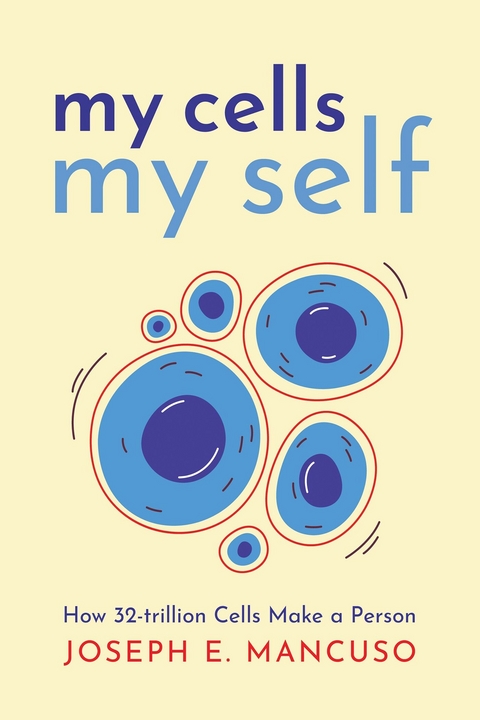
My Cells My Self (eBook)
224 Seiten
Bookbaby (Verlag)
9798350995930 (ISBN)
Mr. Mancuso's unique education has provided him with the singular conceptual vision for 'My Cells My Self.' He began his studies in human biology as a pre-dentistry student and changed his major to psychology after taking an elective abnormal psychology class that piqued his interest to understand the biological underpinnings of human thought. This shift in his academic interest allowed Mr. Mancuso to study how biology creates psychology as he earned his degree. Mr. Mancuso was board-certified as a clinical associate medical psychotherapist by the American Board of Medical Psychotherapists and Psychodiagnosticians in 1989, then as a Fellow and Diplomate in 2000. Mr. Mancuso was also licensed to practice in the State of Wisconsin as a clinical social worker in 1994, a professional counselor in 1996, a clinical substance abuse counselor in 1989, an intermediate clinical supervisor in 2001, and as an independent clinical supervisor in 2016, until his full retirement from clinical practice in 2025. Mr. Mancuso is also an artist whose work has been shown in local galleries. He uses pen and watercolor to draw nature and cartoons. He has always used his art while teaching clinically and treating his patients, using the blackboard, handouts, and PowerPoint presentations to explain difficult concepts and add humor to his lesson plans.
"e;My Cells My Self"e; is a refreshing journey into our shared human condition that the author, Joe Mancuso first began developing in 1984 and throughout his career until his retirement in 2019 from clinical practice as a senior program psychotherapist and clinical supervisor within a psychiatric hospital. It provides the reader with a map & compass of humanity to navigate life resiliently. He first created his unique perspective when he worked as a substance abuse counselor for individuals within a residential treatment facility. The individuals who sought his help during his career struggled with mental health disabilities and addictions. His clients appreciated that the information Mr. Mancuso shared was broken down so they could easily understand it without feeling insulted or demeaned. When a person purchases a new car, it comes with an owner's manual so they can understand how the car is designed and can learn how to maintain and care for it over time. We are even expected to take classes and learn how to operate cars before being allowed to drive them. When operating situations arise, the owner can look to the manual for instructions on how to operate the car, fix it, or even refer to their driving instructions to recall lessons learned, helping them proceed to their destinations safely. A full introduction to our humanity can likewise show us, we have bodies, minds, and spirits that help us to get around and get along in life. Like a car, these design features give their best performance when we have a working understanding of what they do, how they function, and opportunities to practice using them. Throughout our lives, conditions arise such as grief, depression, anger, anxiety, and physical illness that we don't know how to handle, often leading to mistakes. There is no owner's manual to the human self for us to consult until now. "e;My Cells My Self"e; is that new updated operating manual to human life. Many folks across time and cultures are drawn to the body, mind and spirit perspective and its holistic recognition of what it is to be human, but few understand its actual manifestation. Many books have been published that focus on this perspective, but none has done what "e;My Cells My Self"e; does: clarify in everyday language the natural biological foundations that give rise to human life and the body-mind-spirit connection. These concepts are presented by progressively demonstrating how our 32-trillion living cells produce our physical body, our psychology, and ultimately our personal spirituality. "e;My Cells My Self"e; takes the reader on the journey of self-discovery with humorous drawings, illustrations, and diagrams that clarify concepts, as well as practical interactive worksheets, and handouts following key chapters that summarize the information being learned. These features allow an individual to understand where they are in life so they can act in real time toward reclaiming happiness and well-being.
Introduction
When I entered this world, and as I was growing up, no one ever provided me with a full introduction to myself. I had questions. I did not always have the ability to put these questions into words. It was more of a confusing mix of thoughts and emotions that came out as, “Why do I have to eat peas?” “Why do I have to share my bedroom with my brothers?” and “Why do I have to learn to read?” As I got older, the questions became more complicated and urgent, “Will I ever find love?” “How will I make a living in life?” “Why did my brother die?” I have since realized that these questions I had were similar to the age-old questions other humans, before me, have always asked. It’s our common humanity called the human condition.
Our human condition is rooted in the truths about all our lives. That is, each and every one of us are built by the same atoms found in our universe that organize themselves with a DNA blueprint in which none of us had a say. We all began with a life all our own which we didn’t ask for and yet are tasked to learn about and take responsibility for. We all share in the same struggle with the unrelenting forces of nature that impact our very being throughout our lifetime. This includes the fact that we all cease to live at some point and until then seek our life’s meaning.
As we navigate life, we will continue to struggle with the human condition because those roots of truth grow their branches through each of us. We collectively search for life’s meaning while managing it’s needs, traversing nature and time. As a young person, I had no idea that others were also searching for the meaning of life and how best to travel through it. I figured I was the only one who didn’t know. So, I discreetly set out to explore what I could about what it is to be human.
“What I was searching for however, was knowing myself from the inside looking out.”
I found out the earliest humans left drawings and shadow paintings on cave walls, expressing as best they could, their personal life conditions and struggles. I also learned how great philosophers in early civilization, like Socrates and Plato, pondered and debated the same complicated questions I explored with my classmates in college; “What is thinking?” “What is truth?” “Is there a God?”
As I grew up, I continued to explore. I read books and listened to long lectures from wise, and some not so wise, people. Everyone I sought out and those who volunteered to help me, attempted to introduce me to myself from their perspective. Like everyone, I first learned about myself from the outside looking in. What I was searching for however, was knowing myself from the inside looking out.
Many people tried to answer my questions about life. I learned from my teachers at school about the world around me. Family members introduced me to my culture and heritage. Religious teachers explained the mysteries of my Soul. Even my opportunities to travel and meet people from other places provided new insight.
My questions about life and its meaning have made me aware that I am physically separate from the person next to me, and that my Spirit is unique and different from the spirituality of others. I understand I live alongside others who are also living inside their bodies, looking out onto this same world. They too, are striving forward in pursuit of their life’s meaning. Like me, they are also searching for a full introduction to themselves—an understanding of their Humanity.
We all coexist in this same world outside of us called Earth. Each of us experience the world around us from a unique perspective different from the next person due to our placement, orientation, or beliefs that are inherent in each of us. I can lack a perspective of an event that another witnessed firsthand because I was not there. If I am in the same room my perspective will still be different from the next person because of my placement (like having something block my view), orientation, or beliefs. Our individual perspective of life develops over time as we uniquely experience, explore, and learn from our own perspective of events around us. As we grow toward independence in life, we begin to accept and defend our unique perspectives of life as being true. We then set out to find the answers to our life questions.
Over our lifetimes, we grow wiser and come to understand why others also accept and defend their perspectives of life as being true, and why their choices and actions are different from ours. Exploring and learning about others provides unique perspectives about this outside world. Different perspectives can help us recognize and understand our shared experiences and identify mistruths that interfere with our ability to achieve meaning in life. By sharing our experiences, we help each other improve our human condition while building faith in others and ourselves. When we all strive together as one, we nurture the collective energy needed to persevere toward those answers that actually bring wellbeing to our lives and contribute positively to others.
We all experience the human condition within a difficult and challenging world as we search for answers to our life’s questions. I have not answered all my life questions, but I have come to appreciate my parents teaching me that fun does not begin when we get to our vacation destination, it begins the moment we get into the station wagon.
There are times in life when challenges are not fun, but instead feel more like a roller coaster ride. Life can be a frightening adventure into the unknown. When I look back on some of my life challenges, I experience a sense of exhilaration because I now know I learned new things about myself that I would not have learned any other way.
When we survive those frightening roller coaster rides of life, we nurture personal wisdom and learn to apply self-care, which help us avoid repeating negative life challenges when we can. As a result, we increase the fun life experiences that carry us smiling toward our future destinations.
While studying and accomplishing my Master’s Degree in Educational Psychology (M.Ed.), I learned how experienced teachers develop their master lesson plans. After several decades of teaching, they visualize the many concepts within their disciplines much like a three-dimensional tree. Helping each student by addressing their individual lesson plan needs as if jumping from branch to branch leading them to the trunk of knowledge and the roots of truth. Master teachers develop programming for diverse learners and provide successful mentorship for new teachers. After four decades of working in the field of educational psychology, I came to understand what it was to become a master teacher. What I am sharing with you is my master lesson plan.
I completed the credentials to practice as a clinical associate medical psychotherapist in 1989, and then as a fellow and diplomate of the American Board of Medical Psychotherapists and Psychodiagnosticians in 2000. I also was licensed to practice in the State of Wisconsin as a clinical social worker in 1994, a professional counselor in 1996, a clinical substance abuse counselor in 1989, an intermediate clinical supervisor in 2001, and then as independent clinical supervisor in 2016. Now, to help others going through the roller coaster rides of life, I have taken all my professional experience, along with my foundation of Educational Psychology, to create the book you now hold in your hands. This format may be especially important in helping others who may not have immediate access to psychological therapy, but are striving to build the skills necessary for healing and recovery from grief, substance use disorders, chronic mental health challenges, trauma and legal encumbrance. The journey I have mapped out for you in this book is the lessons I taught in clinical practice to guide those who sought my help navigating life and those I supervised to become licensed professionals. Back then those I helped would have learned it from a perspective of a water droplet analogy, and not the new analogy you will come to know. The new updated analogy I use to explain the complicated human Self is a perspective that can be visualized as a Map and Compass, useful tools for traveling through life. This book is your introduction to being human, and it is the practical guide that I was looking for when I was growing up.
This guide respects the dignity of each individual to study their own Map of Human Life, decide which paths to take, and how to follow their Compass to overcome and manage barriers that may arise. You do not need to be currently going through an intense roller coaster ride in life to benefit from this reading, but it will help when one presents itself.
We all strive to determine who is wise and who can be trusted for direction. I hope you will trust me as your trail guide and take this journey with me to understand your personal humanity.
Part One provides the Map of Human Life with its Four Realms of Humanity: Body, Mind, Spirit, and Self. You will learn how each human is a living organism of many cells, and how these individual living structures communicate and work together to create your unique person.
Part Two will provide the Life Compass...
| Erscheint lt. Verlag | 15.5.2025 |
|---|---|
| Sprache | englisch |
| Themenwelt | Sachbuch/Ratgeber ► Gesundheit / Leben / Psychologie ► Esoterik / Spiritualität |
| ISBN-13 | 9798350995930 / 9798350995930 |
| Informationen gemäß Produktsicherheitsverordnung (GPSR) | |
| Haben Sie eine Frage zum Produkt? |
 EPUB (Ohne DRM)
Größe: 6,8 MB
Digital Rights Management: ohne DRM
Dieses eBook enthält kein DRM oder Kopierschutz. Eine Weitergabe an Dritte ist jedoch rechtlich nicht zulässig, weil Sie beim Kauf nur die Rechte an der persönlichen Nutzung erwerben.
Dateiformat: EPUB (Electronic Publication)
EPUB ist ein offener Standard für eBooks und eignet sich besonders zur Darstellung von Belletristik und Sachbüchern. Der Fließtext wird dynamisch an die Display- und Schriftgröße angepasst. Auch für mobile Lesegeräte ist EPUB daher gut geeignet.
Systemvoraussetzungen:
PC/Mac: Mit einem PC oder Mac können Sie dieses eBook lesen. Sie benötigen dafür die kostenlose Software Adobe Digital Editions.
eReader: Dieses eBook kann mit (fast) allen eBook-Readern gelesen werden. Mit dem amazon-Kindle ist es aber nicht kompatibel.
Smartphone/Tablet: Egal ob Apple oder Android, dieses eBook können Sie lesen. Sie benötigen dafür eine kostenlose App.
Geräteliste und zusätzliche Hinweise
Buying eBooks from abroad
For tax law reasons we can sell eBooks just within Germany and Switzerland. Regrettably we cannot fulfill eBook-orders from other countries.
aus dem Bereich