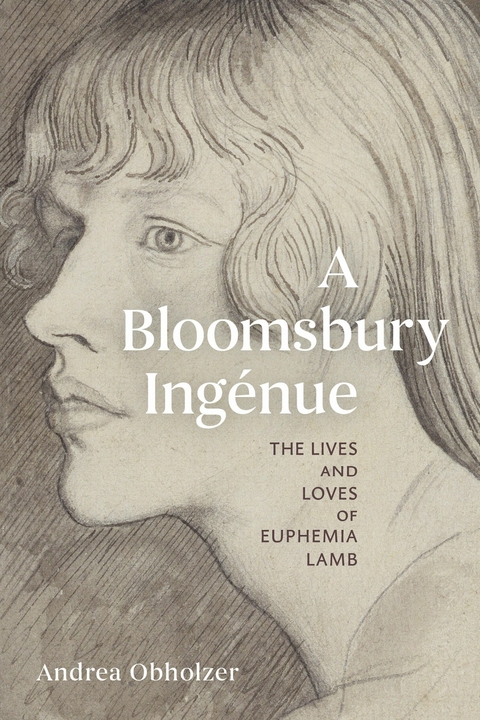
Bloomsbury Ingenue (eBook)
197 Seiten
Unicorn Publishing Group (Verlag)
978-1-917458-33-7 (ISBN)
Andrea Obholzer is currently studying for a MA in History of Art at the Courtauld Institute, having previously studied at the universities of Oxford and Cambridge. She worked for twenty-five years as a child psychotherapist in the NHS. She is married with three adult sons and lives in London.
Euphemia Lamb was painted and sculpted by many renowned artists during the period before the First World War, such as Augustus John, Henry Lamb, Ambrose McEvoy, Jacob Epstein and James Dickson Innes. She was at the vanguard of modern British art. She was also a literary muse for many leading writers of the period, including Virginia Woolf, Henri-Pierre Roche and Aleister Crowley. Euphemia was the embodiment of the modern woman: sexually liberated, hard-working and ambitious. She used her connections in bohemian London and Paris to educate herself and advance the notion of what a woman could be in early twentieth-century British society. Euphemia was a pioneer who broke down barriers and her legacy survives in art and literature.
She is 17 years old, snowy flesh,
periwinkle eyes, long blonde hair,
a rich, fresh pink mouth. – Henri-Pierre Roché
the elopement was scandalous. But Nina and Henry were lovestruck and carefree. Nina’s lowly social origins meant that she had little to lose; she was much less bound to social propriety than a middle-class girl would have been. Nina had no prospects in Manchester apart from menial work and marriage. Henry and the plan to go to London must have seemed like a wonderful opportunity. She was galvanised by his talent and knew that if the worst happened, he would still have his respectable family to fall back on. Henry had a safety net, and she was prepared to take a risk. She had been friendly with the prostitutes in Manchester, so the fall from grace would have been an imaginable and ordinary risk to Nina – she wanted adventure and excitement.
They arrived in London and found separate lodgings. Henry immediately went to visit Francis Dodd who lived in Chiswick. They also visited the artist Muirhead Bone (married to Dodd’s sister) who lived in Chiswick Mall which Nina thought was beautiful, with large Georgian houses and villas nestled on the banks of the river Thames. Like Dickens as a boy seeing the mansion at Gad’s Hill, Nina made a mental note that if ever fortune were to come her way, this was the place she would like to live.
Bernard Leach was working for a London bank and met the young ingénues; he later said that he didn’t know how they existed as they had no money. He helped them find lodgings in Paultons Square in Chelsea. Henry Lamb sat for a portrait for Francis Dodd and as soon as the Chelsea Art School opened, he enrolled. Augustus John, already an artist of some repute, was delighted by his new acolyte, Henry, and equally by his girlfriend and model, Nina. Nina was put to work immediately as an artist’s model at the Chelsea Art School, modelling for Henry and other students, including Edna Clarke Hall and Maresco Pearce.
Augustus John, Portrait of Henry Lamb (1885-1960) c. 1908 pencil on paper, 25.4 x 20.3 cm
Whilst Henry was busy in his studio, there was the problem of what Nina would do if she were not modelling. Walter Lamb introduced the runaways to his Cambridge friend Thoby Stephen, who thought that his sisters might be able to keep Nina entertained. His sisters were Vanessa, later to become Vanessa Bell, the painter, and Virginia Woolf, the novelist and essayist. In 1905 the two girls had recently moved to 46 Gordon Square, Bloomsbury with their brothers Thoby and Adrian Stephen, and were living life in considerably more freedom after the death of their parents. Vanessa wanted to be an artist and was eager to meet Henry Lamb. Virginia was recently recovering from a period of poor mental health. Their correspondence from this period suggests that the whole Stephen family was delighted by the arrival of Henry Lamb and Miss Forrest.
In their new Bloomsbury address, Vanessa and Virginia were keen to throw over the Victorian strictures and censoriousness of their parents and live independently in a modern way. Virginia wrote:
‘In October 1904, 46 Gordon Square was the most beautiful, the most exciting, the most romantic place in the world. To begin with it was astonishing to stand at the drawing room window and look into all those trees. Here Vanessa and I each had a sitting room; there was a large double drawing room; and a study on the ground floor. Instead of Morris wallpapers we decorated our walls with washes of plain distemper. We were full of experiments and reforms. We were going to do without table-napkins, we were going to have large supplies of Bromo1 instead; we were going to paint; to write; to have coffee after dinner instead of tea at 9 o’clock. Everything was going to be new; everything was going to be different, everything was on trial… Bloomsbury is ever so much more interesting than Kensington – visiting a picture gallery and coming home to find the drawing room full of the oddest collections of people.’2
Into this drawing room and social experiment in June 1905 walked Nina Forrest and Henry Lamb. They decided that Nina would have to come up with an explanation for her obscure origins and her elopement with Henry that would satisfy the Stephen family and their albeit modern, Edwardian social mores. Vanessa was clearly delighted with Henry Lamb and accepted his request that she help his friend Miss Forrest. Vanessa and Henry met in a teashop in the King’s Road in December 1905 to discuss the possibility of sharing a studio. Vanessa wrote:
Henry Lamb, Euphemia Lamb, 1906, pencil on paper, 29.8 x 23.5 cm
Photographs of Vanessa Stephens (left) and her sister, Virginia (right), 1902
‘Lamb in his corduroys, smoking a pipe… and I thought with joy how shocked all my friends and relations would be if they could only come in and see us! But our conversation was most innocent and all about Miss Forrest.’3
In a letter to her friend Margery Snowden, Vanessa described the plight of Miss Forrest:
‘Her family wanted her to marry a Russian Count. They forced her to get engaged to him and he wanted to marry her. Whilst engaged to him she met Mr. Lamb in Manchester. He was then a medical student & very clever and she told me, very affected. She didn’t like him at first in consequence but she then made friends with him & I suppose he was about the first intelligent person she had got to know. She told him or he knew about the Russian.
Anyhow she asked him to help her for she had not the courage to escape the man herself. He said it was wrong for her to marry without love & saw the Russian and seems to have talked him into giving her up. Then they both came to London – he to lodgings as an artist & she to other lodgings with no idea at all of what people would think.
I wished very much I could help her for I like her & I think her ignorance makes her position very hard upon her. She is not the least flirtatious, but perfectly simple & open, coming out occasionally with regular terrible infant remarks and not in the least seeing why they should shock.’
A few days later Vanessa updated Margery on the Miss Forrest situation:
‘All our talk was about her unfortunate circumstances. He [Henry Lamb] quite sees how difficult the position is & I think feels responsible for her but you can understand that a boy of 22 or thereabouts knowing hardly anyone in London doesn’t know what to do at all. We settled in the end that I should try & find some place where she could live & some work of a practical kind that she could do. Of course, a place like A.H.4 would be no good for she is not a student. But I think I can probably find some other place of the same kind only not so big. She has plenty of money so there might not be much difficulty – the only thing is that she may be persuaded to go there & stay there and work regularly, but I think she might do and it would be the best thing possible for her whether she married Lamb eventually or not.
I don’t yet call her Nina though she has asked me to, but I soon shall! & do you think there is any harm in it? After all what should we ever do if we stopped to consider the possible harmful results? In this case I really have no fears – for one thing I don’t believe that Lamb and Nina are in love with each other.’5
Vanessa Stephen was keen to further her acquaintance with them and was intrigued by their elopement. One senses some disapproval of Nina’s situation but nevertheless she was taken in and help was offered. There was talk of her and Henry sharing an art studio at one point but this cameto nothing. Nina had told Vanessa a made-up version of her history:
‘She told me a good deal of her history rather incoherently, but I came in the end to a fairly clear idea of her most extraordinary past existence. It’s too full of ins and outs to be repeated at length and it sounds like a medieval romance – but I believe it’s true.
‘She seems to have been deserted by her family and hardly ever to have lived with them. They are quite rich, and they alternately neglect her entirely & have her to live with them for short intervals when they spoil her. She seems to have had no education and to have lived with some very second-rate people going about from one house to another and being adopted by various friends and relations in turn.’6
Nina had embroidered her origin story with great enthusiasm. This was believed by the Stephen family at the time, adding to her mystery and their fascination with her.
Lytton Strachey, the writer and friend...
| Erscheint lt. Verlag | 20.3.2025 |
|---|---|
| Verlagsort | London |
| Sprache | englisch |
| Themenwelt | Literatur ► Biografien / Erfahrungsberichte |
| Literatur ► Essays / Feuilleton | |
| Sachbuch/Ratgeber ► Gesundheit / Leben / Psychologie ► Esoterik / Spiritualität | |
| Schlagworte | Aleister Crowley • Ambrose McEvoy • augustus john • Baron Howard de Walden • Bloomsbury • Bohemia • café culture • Caitlin Macnamara • Dorelia McNeil • Duncan Grant • Dylan Thomas • Edna Waugh • Franz Hessel • Garsington • gumilev • Gwen John • Henry Lamb • Ida Nettleship • Jacob Epstein • Jacob’s Room • James Dickson Innes • Jules et Jim • Knut Hamsun • lady ottoline morrell • Lytton Strachey • modernism • Nicolette Devas • Paris • Slade School • Thoby Stephen • Vanessa Bell • Victor Neuberg • Virginia Woolf |
| ISBN-10 | 1-917458-33-9 / 1917458339 |
| ISBN-13 | 978-1-917458-33-7 / 9781917458337 |
| Informationen gemäß Produktsicherheitsverordnung (GPSR) | |
| Haben Sie eine Frage zum Produkt? |
 EPUB (Adobe DRM)
Kopierschutz: Adobe-DRM
Adobe-DRM ist ein Kopierschutz, der das eBook vor Mißbrauch schützen soll. Dabei wird das eBook bereits beim Download auf Ihre persönliche Adobe-ID autorisiert. Lesen können Sie das eBook dann nur auf den Geräten, welche ebenfalls auf Ihre Adobe-ID registriert sind.
Details zum Adobe-DRM
Dateiformat: EPUB (Electronic Publication)
EPUB ist ein offener Standard für eBooks und eignet sich besonders zur Darstellung von Belletristik und Sachbüchern. Der Fließtext wird dynamisch an die Display- und Schriftgröße angepasst. Auch für mobile Lesegeräte ist EPUB daher gut geeignet.
Systemvoraussetzungen:
PC/Mac: Mit einem PC oder Mac können Sie dieses eBook lesen. Sie benötigen eine
eReader: Dieses eBook kann mit (fast) allen eBook-Readern gelesen werden. Mit dem amazon-Kindle ist es aber nicht kompatibel.
Smartphone/Tablet: Egal ob Apple oder Android, dieses eBook können Sie lesen. Sie benötigen eine
Geräteliste und zusätzliche Hinweise
Buying eBooks from abroad
For tax law reasons we can sell eBooks just within Germany and Switzerland. Regrettably we cannot fulfill eBook-orders from other countries.
aus dem Bereich