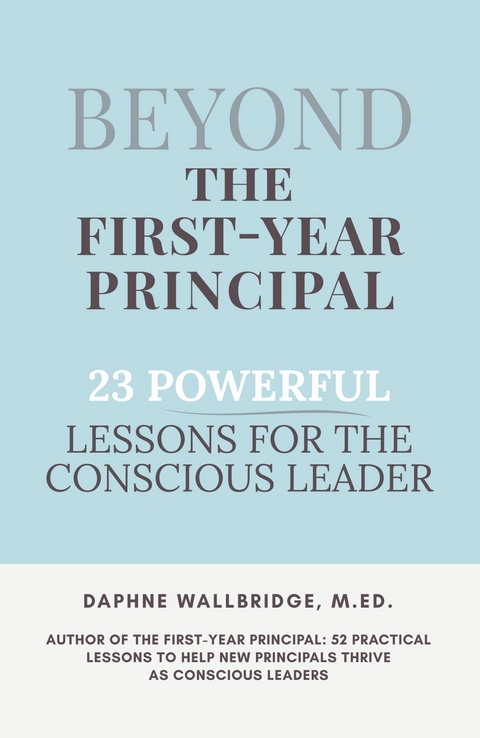
Beyond The First-Year Principal (eBook)
284 Seiten
Bookbaby (Verlag)
979-8-3178-0053-6 (ISBN)
Daphne Wallbridge is a superintendent of education, certified conscious and executive leadership coach, author, and blogger. Passionate about lifelong learning, she creates practical, actionable resources for aspiring and seasoned educational leaders. Daphne specializes in guiding leaders to manage stress, hone their communication skills, and create thriving teams that foster innovation and creative problem-solving. She loves traveling with her family and embracing new adventures that inspire her work and personal growth.
"e;Beyond the First-Year Principal"e; is a transformative guide crafted for school leaders who are ready to elevate their leadership journey to new heights. Steeped in practical strategies, actionable tools, and reflective practices, this book offers a comprehensive exploration of the complexities of conscious leadership. It presents 23 powerful lessons designed to help leaders embrace their roles with greater clarity, authenticity, and purpose. Each chapter addresses critical aspects of leadership, from mastering crucial conversations and fostering innovation to building resilient teams and managing stress effectively. To enhance your experience, this book comes with a free online learning portal where readers can access supplementary resources, tools, and exercises to deepen their understanding and apply the teachings in real-world scenarios. Whether you're a seasoned administrator or an emerging leader, "e;Beyond the First-Year Principal"e; equips you with the insights and resources to create meaningful, lasting impact in your school and beyond. It's more than a book-it's an invitation to lead consciously, with intention and heart.
Lesson 2: Embracing Imposter Syndrome
Success is not final, failure is not fatal: it’s the courage to continue that counts.
—Winston Churchill
When I was initially appointed as the principal, I distinctly recall my mentor’s words echoing in my mind: “Daphne, you’ve got eighteen months to embrace your rookie status, so ensure you learn quickly!” Although he was saying this in jest, I can still remember my initial reaction—somewhere between feeling it was a stern directive and a sigh of relief. You see, there was this dual expectation that hovered over me, a sense that people anticipated me to stumble and make errors, yet also an understanding that these blunders were stepping stones for growth.
This signaled to me that not only were errors permissible, but they were actually anticipated. I was already operating within a system where making mistakes was safe and also encouraged as long as I gleaned wisdom from them. This same dynamic repeated itself when I ascended to the superintendency of my board. Once more, I was granted a fresh “eighteen-month grace period” to acclimate and evolve in my new role.
However, a curious psychological shift occurs when one steps into a new position. The moment we assume a leadership mantle, there’s an automatic presumption that we possess all the answers. It’s as though a mental switch flips in the minds of those around us, and consequently, we find ourselves suddenly expected to possess an encyclopedic knowledge on demand—at least, that’s what we tend to tell ourselves. This is the point when anxiety typically takes hold.
It’s the moment when that relentless inner critic refuses to stay silent, undermining any effort you make to bolster your confidence during the initial weeks in your new leadership role. Regardless of how frequently you recite your affirmations, you still grapple with feelings of inadequacy. You feel like an imposter!
But there is a light at the end of the tunnel. These feelings of early-stage inadequacy are normal and actually healthy. They signal that you know you do not know it all and that you have intentionally put yourself in a position of growth so you can ultimately thrive.
In this chapter, I will deconstruct what I refer to as the Personal Leadership Continuum. Within this continuum, you’ll observe four distinct phases that correspond to an individual’s leadership journey, from inception to completion. Irrespective of your current position, you have likely traversed through one of these four phases at some point, and perhaps even oscillated between them based on the demands of your work environment.
Phase 1: The Swamplands
During this phase, you find yourself in uncharted territory. Everything appears unfamiliar, and your self-assurance and ego are taking a hit. When you’re navigating the swamplands, it’s only natural to grapple with self-doubt and question your sanity for departing the safe harbor of the familiar. After all, you excelled and felt highly competent in your previous role. Now, you’re back to square one, at the mercy of more seasoned leaders and colleagues. It’s as if you’re an imposter. This new chapter seems like an imposing mountain to climb. Just like trudging through a swamp, every task feels arduous and exceptionally challenging.
However, here’s the silver lining: you’re also undergoing significant growth and transformation. Much like when you work out at the gym and your legs shake from lifting weights, in the long run, you’re actually toning and strengthening your muscles. Similarly, when you find yourself in the swamplands, you’re actively reshaping the neural pathways in your brain. You’re dismantling the old connections to construct new, more advanced neural circuits. So, the next time you feel like you’re starting from scratch and experience moments of discouragement, remember that this is, in fact, a positive sign. It signifies that you’re taking bold steps forward. You’ve opted for growth over complacency. You’ve made the decision to step out of your comfort zone, knowing that you’ll have the support and resources you need along the way to guide you through your next challenges.
Phase 2: The Blank Page
After successfully navigating through phase one and coming to terms with the fact that you’re commencing anew from the ground up, a significant shift occurs. You’ve now recognized and embraced that there’s no returning to the way things were in the past. Instead, you view this new journey as a pristine blank page, a fresh, unblemished canvas on which you’ll write the next chapter of your personal and professional journey. You’re adopting what wisdom teachers refer to as a “beginner’s mind,” a truly beautiful state of being where you see every encounter and experience as an opportunity.
Whereas in phase one, your energy levels were sapped by the steep learning curve, in phase two, you’ll notice a surge in your vitality. It’s during this second phase of leadership that you’ll begin to shape your perspective, refine your values, and start to feel a sense of ease, embracing the idea that you are a novice and a perpetual learner. Previously, you might have hesitated to seek assistance, fearing it would cast you in a light of incompetence among your peers. Now, you actively welcome and seek support to bridge the gaps in your knowledge. In the Blank Page phase, everything becomes possible, you begin to rise above the white noise of the inner critic, and your unique personality and individuality begin to radiate brightly.
Phase 3: Grounding
In the grounding phase, leaders experience a heightened sense of stability within their roles. This period marks an increase in their self-assuredness and their ability to make decisions confidently. They become deeply ingrained in their specific domains of responsibility, possessing a thorough understanding of their roles, policies, and procedures. Moreover, during this third phase, leaders expand their professional networks, broadening their access to knowledge resources that aid in making well-informed choices.
A noteworthy shift occurs during the grounding phase. Leaders no longer feel the need to constantly prove themselves to others, having established a track record over time. Consequently, the desire to be universally liked diminishes, and their focus shifts toward developing their unique leadership style. This personalized model serves as a foundation for effective communication, adeptly navigating challenging situations with team members and stakeholders, and making sound decisions for the greater good.
Phase 4: The Summit
In this ultimate phase of leadership, individuals have ascended to the pinnacle of their careers. They now serve as the senior advisors, possessing a treasure trove of experience and knowledge to impart. Having dedicated their ten thousand hours to mastering their leadership craft, they have encountered a multitude of challenges and scenarios. Their leadership toolkit brims with a comprehensive array of strategies and techniques to guide their teams through any obstacles.
Despite their seniority, these leaders continue to seek input and defer to the expertise of others. However, they do so with confidence, as they have mentored these colleagues and hold unwavering faith in their abilities. While these leaders have reached the zenith of their profession, they understand the immense value in sharing the spotlight and allowing the strengths of others to shine. They actively cultivate a diverse and inclusive environment, recognizing that diverse backgrounds and various training approaches enhance productivity and foster innovation.
But what can I do during the early stages when I feel like an imposter?
If we were to consult Webster’s dictionary for a definition of imposter syndrome, we’d come across the following description: “a persistent psychological condition characterized by self-doubt about one’s abilities or accomplishments, accompanied by the fear of being exposed as a fraud, despite ample evidence of ongoing success.” It’s quite harsh, isn’t it? It’s astonishing to think that we inflict this kind of negative self-talk on ourselves, and it’s no wonder our self-confidence suffers as a result. Would we ever speak to our best friend or our child in this manner? Of course not. So why do we subject ourselves to it? My hope is that, from today onward, you’ll begin to break free from this toxic cycle and replace it with more constructive, confidence-boosting strategies.
Now let’s talk about confidence. Let’s redefine it once and for all. From this point forward, our definition of confidence will be simple: “the willingness to take action, to put ourselves out there and give it a try.” Hopefully, this new definition feels like a weight lifted off your shoulders. Two authors who strongly advocate for this new perspective are Katty Kay and Claire Shipman, the authors of The Confidence Code: The Science and Art of Self-Assurance—What Women Should Know. Their entire book is dedicated to the idea that greater self-assurance is built through action and simply trying.
The Competence/Confidence Loop
Now that we’ve redefined confidence as simply the willingness to try, let’s delve into what we refer to as the competence/confidence loop. Essentially, this concept underscores how confidence grows as you take action....
| Erscheint lt. Verlag | 2.4.2025 |
|---|---|
| Sprache | englisch |
| Themenwelt | Sachbuch/Ratgeber ► Beruf / Finanzen / Recht / Wirtschaft |
| ISBN-13 | 979-8-3178-0053-6 / 9798317800536 |
| Informationen gemäß Produktsicherheitsverordnung (GPSR) | |
| Haben Sie eine Frage zum Produkt? |
 EPUB (Ohne DRM)
Größe: 925 KB
Digital Rights Management: ohne DRM
Dieses eBook enthält kein DRM oder Kopierschutz. Eine Weitergabe an Dritte ist jedoch rechtlich nicht zulässig, weil Sie beim Kauf nur die Rechte an der persönlichen Nutzung erwerben.
Dateiformat: EPUB (Electronic Publication)
EPUB ist ein offener Standard für eBooks und eignet sich besonders zur Darstellung von Belletristik und Sachbüchern. Der Fließtext wird dynamisch an die Display- und Schriftgröße angepasst. Auch für mobile Lesegeräte ist EPUB daher gut geeignet.
Systemvoraussetzungen:
PC/Mac: Mit einem PC oder Mac können Sie dieses eBook lesen. Sie benötigen dafür die kostenlose Software Adobe Digital Editions.
eReader: Dieses eBook kann mit (fast) allen eBook-Readern gelesen werden. Mit dem amazon-Kindle ist es aber nicht kompatibel.
Smartphone/Tablet: Egal ob Apple oder Android, dieses eBook können Sie lesen. Sie benötigen dafür eine kostenlose App.
Geräteliste und zusätzliche Hinweise
Buying eBooks from abroad
For tax law reasons we can sell eBooks just within Germany and Switzerland. Regrettably we cannot fulfill eBook-orders from other countries.
aus dem Bereich